Electric trikes are having a moment right now, and I get why. The idea of three wheels instead of two appeals to a lot of people, especially those who worry about balance or who have physical limitations. But an electric trike is not just an electric bike with an extra wheel. The experience is completely different, and whether it’s right for you depends on some specific factors that a lot of people don’t think about until after they’ve bought one.
Let me break down the real differences between electric trikes and electric bikes, talk about who trikes are actually best for, and help you figure out which one makes sense for your situation.
Stability: The Big Selling Point
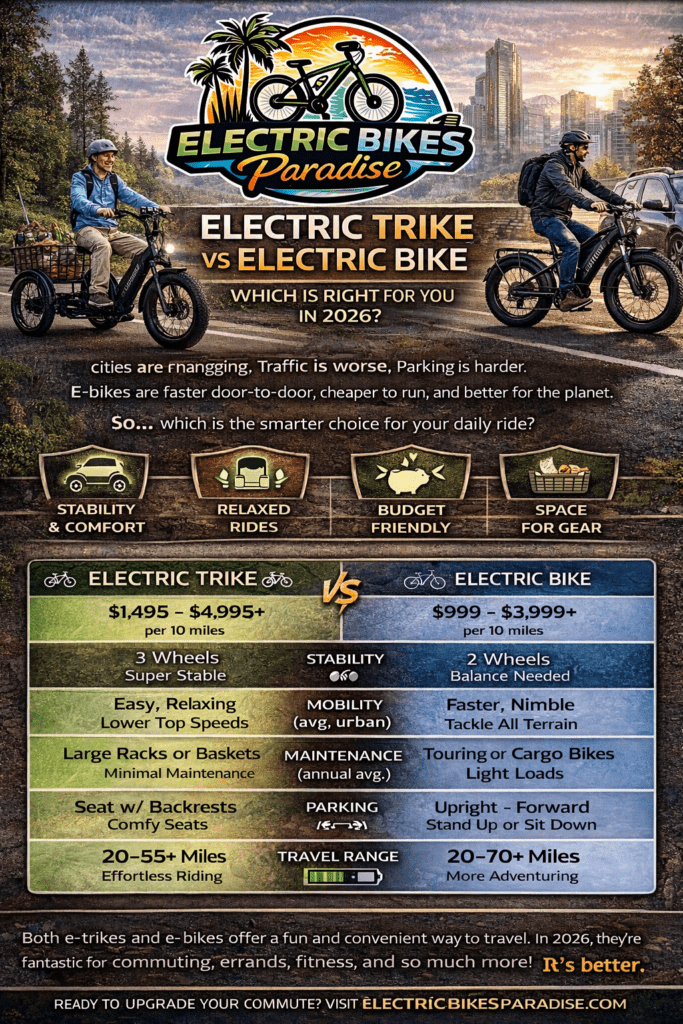
The main advantage of an electric trike is stability. With three wheels instead of two, you don’t need to balance the way you do on a bike. You don’t worry about tipping over at stops. You don’t need to put your foot down on the ground. You can just sit there, completely stable, without any effort.
This is genuinely valuable if you have balance issues. If you’re older, if you have joint problems, if you have a neurological condition that affects balance, a trike can be the difference between being able to ride and not being able to ride at all.
It’s also valuable if you’re carrying cargo. An electric trike with a cargo box is incredibly stable even when heavily loaded. A bike with cargo is stable too, but it requires more skill and attention to balance properly.
For people who’ve been off a bike for years or decades, a trike can feel less intimidating to climb on and less scary to start riding. There’s something really really reassuring about having that third point of contact with the ground.
The Downsides of Trikes
Here’s where trikes get tricky. They’re longer and wider than bikes. That extra length means they don’t turn as quickly or as sharply. They don’t fit through spaces that a bike would fit through. They’re harder to maneuver in tight situations.
The wider profile also means they don’t fit on some bike paths. Some trails explicitly don’t allow trikes because of the width and the traction damage they can do. If you’re planning to use a trike on shared paths, check your local regulations.
Storage is a real pain in the butt with an electric trike. If you don’t have space in a garage, a trike is genuinely hard to store. They take up significantly more space than a bike. If you live in an apartment or don’t have dedicated storage, a trike might not be practical.
Transporting a trike is also challenging. Most people can’t fit a trike in a car without removing it into separate parts or buying a special carrier. A bike can be loaded on a standard bike rack or carrier. A trike usually can’t.
Cost Differences
Electric trikes are more expensive than electric bikes. A decent electric bike costs $1,500 to $2,500. A decent electric trike costs $2,500 to $4,500. Some premium models go higher.
The extra cost reflects the extra materials, the more complex frame design, and the more sophisticated steering mechanism. Trikes need careful engineering to handle properly, and quality trikes cost more because of that.
If cost is a significant factor, an electric bike is the more affordable option. For the same budget, you get a higher-quality bike than you’d get in a trike.
Weight and Momentum
Electric trikes are heavier than bikes. A typical electric trike weighs 70 to 100 pounds. A typical electric bike weighs 45 to 65 pounds. That extra weight comes from the heavier frame and the third wheel.
The heavier weight means more momentum. You build speed faster going downhill and you maintain speed better on flat ground. But you also need more effort to get moving and to stop. Braking distances are longer.
The heavier weight also affects handling. A trike feels more planted and stable at speed, which some riders love. But it also feels less responsive and less agile, which some riders find frustrating.
If you’re older or have limited strength, the extra weight can make it harder to pedal the trike, even with the electric motor assistance. Most trikes have good motors, but the weight matters.
Learning Curve
Electric bikes have a learning curve if you haven’t ridden in years. You need to balance, you need to coordinate steering and pedaling, and you need to learn how the motor assistance feels.
Electric trikes have a different learning curve. You don’t need to balance, which is simpler. But the steering is different. The weight distribution is different. The handling is unique. Most people take a couple of trips to get comfortable with how a trike feels.
For someone who’s never ridden any sort of cycle in decades, a trike can actually be easier to get on and ride immediately. There’s no balance issue to worry about.
Speed and Performance
Electric trikes and bikes have similar motors and similar speed capabilities. Most have motors from 500 to 750 watts and can reach 20 to 28 miles per hour depending on local regulations.
In practice, trikes often feel a little slower because of the extra weight and the slightly less efficient power transmission. But the difference is minimal, and most riders don’t notice it unless they’re actively comparing them side by side.
Uphill performance is similar between bikes and trikes. The motor handles the hill regardless of the platform. Downhill, a trike might feel more stable because of the wider base, which some riders prefer and some find less exciting.
Cargo Capacity
This is where trikes really shine. A cargo trike can carry 50 to 150 pounds depending on the design. They’re purpose-built for cargo. Many cargo trikes have a large box or platform between the front wheels where you load cargo.
A standard electric bike can carry cargo with a rear rack, but the capacity is more limited and the handling is affected more by the weight. An electric trike with cargo handles beautifully because of the three-wheel stability.
If hauling groceries, tools, or other cargo is a primary use case, a cargo electric trike is genuinely purpose-built for that. A bike can do it, but a trike does it better.
For more information about cargo options, check out our collection of cargo electric bikes and trikes.
Who Trikes Are Best For
Electric trikes are ideal for:
People with balance issues or mobility concerns. Older adults who want stability and don’t care about maneuverability. People planning to carry significant cargo regularly. People who want to ride but have physical limitations that make biking impossible. Riders who prioritize stability over agility.
Electric trikes are less ideal for:
People with limited storage space. Riders who value quick maneuverability. Cyclists who use shared bike paths with width restrictions. People who need to transport the vehicle in a car. Riders who care about speed or performance.
Real-World Use Cases
I’ve talked with a lot of people who use electric trikes. Here are the actual use cases where they love them.
Older adults who want to stay active and enjoy being outside. They love the stability and the fact that they don’t need to worry about balance. They’re often riding for 30 minutes to an hour for leisure and exercise, not for transportation.
People with arthritis or joint pain who need low-impact exercise. The stable platform means they can ride comfortably without the stress on balance and coordination that a bike requires. The motor assistance means they can ride further than they could under their own power.
Urban delivery workers and grocery shoppers who need to haul goods regularly. A cargo trike is practical for regular cargo delivery in ways that a bike just isn’t. The stability with a full cargo box is a real advantage.
People with disabilities that affect balance or coordination. A trike can provide access to cycling when biking would be impossible or unsafe.
Rural and small-town riders who have space to store a trike and don’t use shared bike paths. A trike is genuinely functional transportation in these situations.
Comparing Handling and Maneuverability
Bikes turn sharply and respond quickly to steering input. You can navigate crowded areas, avoid obstacles with quick turns, and handle tight spaces. This agility comes from having only two wheels and the inherent responsiveness of the bike geometry.
Trikes turn more gradually. The turn radius is wider. You need to plan your turns and can’t make quick evasive maneuvers like you can on a bike. This is the trade-off for the stability of three wheels.
For commuting on streets and paths, this difference matters. For leisure riding, it often doesn’t matter at all. For getting around an urban environment, the bike is more practical.
Maintenance and Durability
Electric bikes and trikes need similar maintenance: check tire pressure, keep the chain lubricated, inspect brakes regularly. The extra wheel on a trike means one more tire to maintain, but that’s the main difference.
Durability is similar. A quality electric bike lasts 5 to 10 years with proper maintenance. A quality electric trike also lasts 5 to 10 years. The heavier trike frame might actually wear better over time because the materials are more robust, but this is not a major difference.
Where trikes can be more expensive to maintain is if something breaks on the steering or the central hub. Trike-specific repairs are sometimes harder to find and more expensive than standard bike repairs.
Trying Before You Buy
This is my honest recommendation: if you’re torn between a bike and a trike, try to rent or test ride both before buying. The difference in feel is significant enough that you really need to experience it yourself.
Many electric bike shops will let you test ride different models. Some have trikes available for demo. Take advantage of this. Spend 20 to 30 minutes on each one. See how it feels to accelerate, turn, and brake. See which one feels more natural to you.
Your personal preference matters more than any logical analysis. If a bike feels right and a trike feels wrong, buy a bike. If a trike feels stable and comfortable and a bike feels scary, buy a trike. The best vehicle is the one you’ll actually use.
The Practical Hybrid Approach
Here’s something people don’t always consider: what if you owned both? A bike for daily transportation and agility, and a trike for cargo hauling or when you need stability.
This sounds expensive, but if you’re serious about this mode of transportation, both vehicles together cost less than one car. If you use both regularly, the cost per vehicle is actually quite reasonable.
This hybrid approach gives you the agility and practicality of a bike for commuting, plus the stability and cargo capacity of a trike for cargo hauling. It’s a really really flexible solution if you have the storage space.
For More Information
If you’re interested in electric bikes, check out our comprehensive guide on how electric bikes work and our buying guide to help you choose the right one. For cargo transportation, look at our collection of cargo e-bikes and cargo trikes.
For understanding the financial case for electric trikes, check out our analysis of whether electric bikes are worth the cost. The math is even better for trikes if you’re using them for regular cargo hauling instead of personal vehicles.
The Final Comparison
Electric bikes are lighter, more agile, faster, cheaper, and easier to store. They’re better for transportation, commuting, and sport. They’re ideal if you have good balance and want maximum capability.
Electric trikes are more stable, have more cargo capacity, and feel more secure. They’re better for cargo hauling, for people with balance or mobility issues, and for riders who prioritize stability over agility.
The best choice depends on your specific needs, your physical capabilities, your storage space, and what you’re planning to use it for. There’s no universal right answer, but there’s definitely a right answer for you.
If you’re still on the fence, test both before you buy. Talk to people who own each type. Spend time thinking about what you’ll actually use it for. Then make the decision that fits your real life, not the decision that seems like it should be right.
Long-Term Durability and Ownership
Both electric bikes and electric trikes last about 5 to 10 years with proper maintenance. The battery is usually the limiting factor. After 500 to 1,000 charge cycles, the battery starts to lose capacity. For most people, that’s 5 to 7 years of regular use before a battery replacement is needed.
A battery replacement costs $600 to $1,200 depending on the size and brand. This is a real expense, but it’s one-time, and afterwards the trike is good for several more years.
Repair costs for trikes can be higher than for bikes because they’re more specialized. A local bike shop might work on bikes all day but only touch trikes occasionally. Repair labor might be more expensive and harder to find.
Resale Value
If you decide later that a trike isn’t right for you, what’s the resale value? Electric bikes typically resell for 50 to 60 percent of the purchase price if they’re less than 3 years old. A $2,000 bike might sell for $1,000 to $1,200 used.
Electric trikes typically resell for 40 to 50 percent of the purchase price. A $3,000 trike might sell for $1,200 to $1,500 used. The resale value is lower because the market is smaller and trikes are harder to transport.
This is another reason to test before you buy. If you buy a trike on impulse and discover you hate it, you’re losing more money than you would with a bike.
Terrain Handling Comparison
Both bikes and trikes handle different terrain, but differently. A bike is more agile and can navigate tight, technical trails. A trike is more stable but can’t make quick evasive moves.
On smooth pavement, both are excellent. On gravel roads, both work fine. On technical single-track trails with obstacles, a bike is better. On open trails and rough roads, a trike is actually better because of the stability.
For urban riding, a bike is more practical. For rough-terrain touring or cargo hauling off-road, a trike is better. Your specific terrain determines which makes more sense.
Group Riding Dynamics
If you plan to ride with others, this is worth considering. Bikes are standard. Everyone owns one or has ridden one. A trike is unusual. If you’re the only person on a trike in a group of bike riders, you’ll have a different experience.
You can’t keep up on single-track trails. You can’t navigate tight paths. You’re going at your own pace, separate from the group. For some people, this is fine. For others, it defeats the purpose of group riding.
If group riding is important to you, a bike might be the better choice because it’s compatible with how everyone else rides.
The Accessibility Advantage
I want to emphasize something important: electric trikes are genuinely transformative for people with balance or mobility limitations. This isn’t a minor advantage. This is a difference that can mean the difference between being able to ride and not being able to ride at all.
For someone with arthritis, neuropathy, vestibular disorders, or other conditions affecting balance and coordination, an electric trike is life-changing. It gives them independence, exercise, and the ability to get around without physical assistance.
If you fall into this category, the limitations of a trike (storage, maneuverability, price) are worth it for the capability to ride safely and comfortably.
The Future of Your Needs
Think about where you’ll be in 5 or 10 years. If you’re young and fit now, you might want a high-performance bike. If you’re older or have mobility challenges now, a trike might make more sense. But as you age or if your physical situation changes, your needs might change.
A bike that’s perfect for you now might become unsafe or uncomfortable as you age. A trike might become more appealing over time. The best choice is the one that works for you right now, but keep in mind that your needs might shift.
Final Honest Assessment
Here’s my real take after considering all the factors:
Choose an electric bike if: you’re younger or physically fit, you want agility and speed, you have good storage space, you ride with others, you have good balance, you want the most affordable option, you plan to commute on streets and paths.
Choose an electric trike if: you have balance or mobility issues, you plan to carry significant cargo regularly, you want a more relaxed riding experience, you don’t care about maneuverability, you need stability more than speed, you have access to wide paths and trails, you’re not concerned about storage space or cost.
The best choice is honestly the one you’ll use. If a trike feels safe and comfortable, you’ll ride it more. If a bike feels thrilling and fun, you’ll use it more. A vehicle you love using is worth more than a vehicle that’s technically superior but doesn’t appeal to you.
Test ride both. Experience how each feels. Talk to owners. Then make the decision that feels right for your situation and your life. You can’t go wrong with either choice if it’s the right one for you.
For more information, visit https://electricbikesparadise.com/best-electric-bikes/ to see available models. Check https://electricbikesparadise.com/electric-bike-buying-guide/ to understand features that matter for your needs. Read https://electricbikesparadise.com/are-electric-bikes-worth-it-an-honest-look-at-the-costs-benefits-and-trade-offs-in-2026/ for our analysis. Learn the technology at https://electricbikesparadise.com/how-do-electric-bikes-work/.
Explore our collection pages: commuter bikes at https://electricbikesparadise.com/commuter-electric-bikes/, step-through bikes at https://electricbikesparadise.com/step-thru-electric-bikes/, folding bikes at https://electricbikesparadise.com/folding-electric-bikes/, fat tire bikes at https://electricbikesparadise.com/electric-fat-tire-bikes/, and mountain bikes at https://electricbikesparadise.com/electric-mountain-bikes/. Visit https://electricbikesparadise.com/ for comprehensive information about all transportation options.