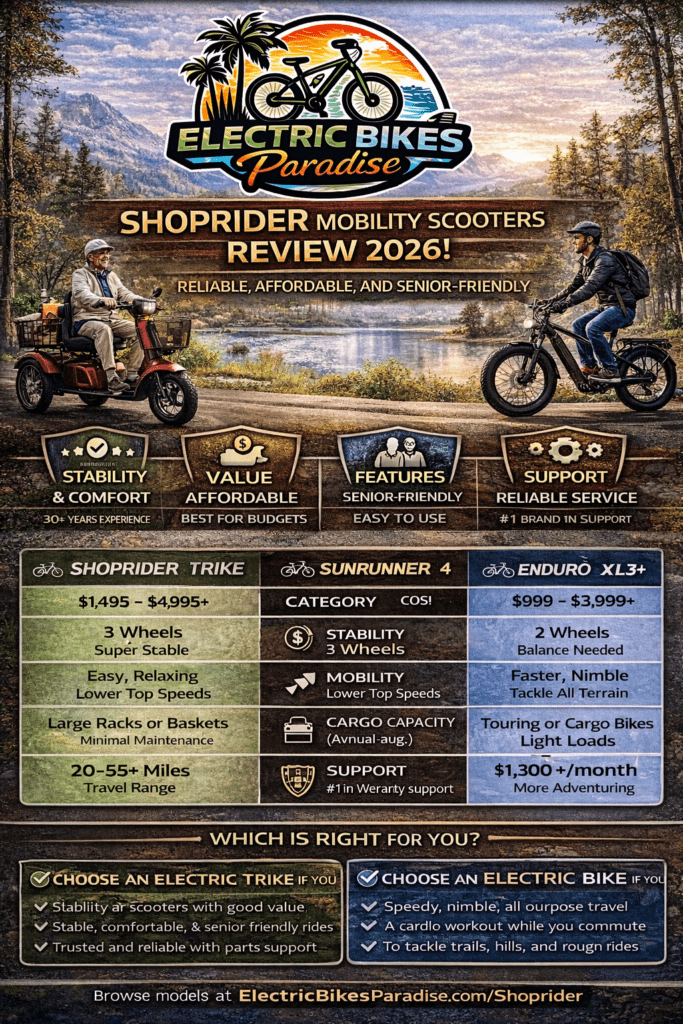
Shoprider is one of those brands that gets mentioned whenever someone is looking for an affordable mobility scooter. They’re not making electric bikes, but they’re in the same space as what we cover here at Electric Bikes Paradise: personal transportation solutions that give people mobility and independence when traditional walking isn’t working. If you’re researching mobility scooters or if you’re considering what’s available in this space, it’s worth understanding what Shoprider actually offers.
I’ve spent time looking at their lineup, talking with people who own Shopriders, and understanding their value proposition. The story is straightforward: Shoprider builds reliable, affordable mobility scooters for older adults and people with mobility challenges. They’re not fancy. They’re not high-performance. But they work, and they’re genuinely a good value for the money if you understand what you’re getting.
Who Shoprider Is and What They Make
Shoprider is owned by Quingo, a mobility company based in the UK. Their focus is on making mobility devices that are affordable and practical for everyday people. They’re not trying to build the most advanced technology or the fanciest design. They’re trying to build something that works, costs a reasonable amount, and helps people stay mobile.
Their main product line is mobility scooters, which are motorized vehicles for people who have difficulty walking long distances or standing. These are nothing like electric bikes. They’re three or four-wheel scooters with a seat, handles, and a motor. You sit on them and ride them similar to a golf cart.
Shoprider makes scooters in different sizes and capabilities. They’ve got compact models for people with limited storage space. They’ve got full-size models with longer range. They’ve got mid-size models that balance capability with portability.
The Shoprider Lineup
The most popular model is the Shoprider Escape. It’s a compact scooter that weighs about 125 pounds and has a range of about 18 to 22 miles on a full charge. Top speed is about 4 miles per hour. It costs around $1,400 to $1,800 depending on where you buy it and what’s on sale.
The Shoprider Cadiz is a mid-size model that weighs around 145 pounds and has similar range to the Escape. It’s a little more comfortable because the seat is larger and the driving position is more relaxed. Price is similar, around $1,600 to $2,000.
The Shoprider Sovereign is a full-size outdoor scooter that weighs about 195 pounds and has a range of 35 to 40 miles per charge. It’s designed for outdoor use, not indoor. Top speed is still around 4 to 5 miles per hour. Price is around $2,500 to $3,200.
All of these are reliable. All of them work as advertised. The difference is in size, portability, range, and price. Which one is right depends on your specific needs.
Why People Choose Shoprider
The biggest reason people choose Shoprider is the price. They’re one of the most affordable options in the mobility scooter market. For people on fixed incomes, especially older adults on Social Security, the price point is really really important.
The second reason is reliability. Shopriders don’t break down constantly. They hold up to regular use. When something does break, replacement parts are available and not crazy expensive.
The third reason is that they’re lightweight enough to be portable. The Escape model weighs 125 pounds, which is heavy, but it’s light enough that some people can manage it in their car with a lift or a loader. Full-size scooters are immobile beasts, but Shopriders are relatively portable for the category.
Medicare Coverage and Insurance
This is a huge factor for people on Medicare. Some Shoprider models are Medicare-approved, which means they can be covered under Medicare Part B as durable medical equipment. The specifics of coverage vary by your Medicare plan and your specific medical situation, but it’s worth investigating.
To get coverage, you need a prescription from your doctor stating that you need a mobility scooter due to a medical condition. Your doctor needs to document that you can’t walk adequate distances or stand for adequate time without severe pain or fatigue. Then you submit the prescription to a Medicare-approved supplier.
If you qualify for coverage, Medicare typically covers 80 percent of the approved cost after you’ve met your Part B deductible. So if a scooter costs $1,500 and the approved amount is $1,500, Medicare covers $1,200 and you pay $300 out of pocket. This obviously makes a huge difference for people with limited funds.
Medicaid coverage varies by state. Some states cover mobility scooters. Some don’t. You need to check with your state’s Medicaid program to understand what’s available.
Private insurance also varies. Some supplemental insurance plans cover mobility devices. Others don’t. Check your specific policy or call your insurance company to ask.
Comparing to Other Brands
Shoprider is not the only option in the mobility scooter market. Brands like Pride, Merits, and Invacare also make scooters. How does Shoprider compare?
Pride is generally more expensive and focuses on higher performance. Their scooters are faster, have longer range, and have more advanced features. But they cost $2,000 to $4,000 or more. If you want premium features and don’t care about cost, Pride is good. If you’re on a budget, Shoprider is better.
Merits makes good scooters and they’re priced similarly to Shoprider. Merits and Shoprider are actually pretty comparable on price and quality. The difference comes down to which dealer is nearby and which model fits your needs better.
Invacare is another solid brand, but again, pricing is similar or higher than Shoprider. For basic transportation, Shoprider is competitive or cheaper than the alternatives.
The real advantage of Shoprider is availability. They’re sold through a lot of dealers and online retailers. You can find them easily. Pricing is consistent. Customer service exists if you have problems.
The Reality of Mobility Scooter Speed
Before you buy a Shoprider or any mobility scooter, you need to understand something: they’re slow. Most mobility scooters max out at 4 to 5 miles per hour. That sounds fast when you say it, but in practice, it feels like you’re moving very slowly. You’re not going to zoom around town. You’re going to move carefully and deliberately.
This is actually by design and for safety. Mobility scooters are designed for people with limited mobility, which often includes limited reaction time and limited ability to handle unexpected situations. The slow speed makes them safer.
If you need fast transportation, a mobility scooter is not what you want. If you need basic transportation that lets you get around town without walking long distances, a mobility scooter is exactly right.
Battery Range and Charging
Compact Shopriders like the Escape have a range of 18 to 22 miles per charge. Mid-size models have about the same range. Full-size models like the Sovereign have 35 to 40 miles per charge.
The battery charges overnight on a standard household outlet. It takes about 8 to 10 hours for a full charge. This means if you’re using it daily, you charge it overnight and you’ve got a full battery every morning.
Real-world range depends on terrain, weight, and driving patterns. Flat terrain with smooth pavement gets better range than hilly terrain with rough surfaces. A heavier driver gets less range than a lighter driver. Constant acceleration and deceleration reduces range compared to steady-speed driving.
For most people using a mobility scooter for short to moderate trips around town, the range is plenty. You’re not planning an all-day 40-mile journey. You’re going to the store, to the doctor, to visit a friend, maybe back and forth multiple times in a day.
Comfort and Practicality
Shoprider scooters have decent seats. They’re not luxury recliners, but they’re designed for comfort on the kind of trips people take. The controls are simple: forward and backward, speed adjustment, and turning. You don’t need to be mechanically inclined to operate one.
They’re weatherproof enough for light rain and outdoor use, though they’re not designed for extended water exposure. A cover is recommended if you’re leaving it outside.
They fold down or break apart for storage and transport. The Escape, for instance, can be broken into parts small enough to fit in a car trunk, though reassembly in a parking lot is a pain in the butt that most people avoid if possible.
They’re not fancy, but they’re practical and they work. That’s the Shoprider value proposition.
Maintenance and Durability
Shopriders are simple devices. They have a motor, a battery, tires, brakes, and basic electronics. There’s not much to maintain beyond checking tire pressure, keeping the battery charged, and replacing tires when they wear out.
They’re built to last. If you maintain them reasonably, a Shoprider will work for 5 to 10 years or more. They’re not cutting-edge, but they’re sturdy and reliable.
When something does break, parts are available and not incredibly expensive. The battery will eventually need replacing after a few years, which costs a couple hundred dollars. Tires wear out and need replacing, which costs $50 to $100 per tire.
This reliability and reasonable maintenance cost is part of why Shoprider is a good value. You’re not dealing with constant repair bills.
Who Should Buy a Shoprider
Shopriders are right for:
Older adults who need mobility assistance for short to moderate trips. People on fixed incomes who need affordable mobility. People with limited storage space who need a portable model. Anyone who wants basic, reliable transportation without fancy features.
Shopriders are not right for:
People who need long-distance transportation. People in extremely hilly terrain where a low-power scooter won’t work. People who want advanced features or premium comfort. Anyone who needs really really fast mobility assistance.
The Alternative: Electric Bikes
If you’re considering a mobility scooter, you might also want to consider whether an electric bike could work for you. They’re different vehicles for different situations.
An electric bike requires you to be able to pedal and maintain balance. If you can do that, an e-bike gives you more range, more speed, and more capability than a scooter. A quality electric bike costs similar money to a Shoprider but gives you better overall performance.
For information on electric bikes and what options are available, check out our complete guide on how electric bikes work and our comprehensive recommendations on the best electric bikes for different needs.
For people who can ride a bike, an electric bike is genuinely worth considering alongside or instead of a mobility scooter. The performance is better and the value is similar or better.
Where to Buy and Pricing
Shopriders are sold through medical supply companies, online retailers like Amazon, and specialty mobility shops. Pricing varies a little, but typically you’re looking at:
Escape model: $1,400 to $1,800
Cadiz model: $1,600 to $2,000
Sovereign model: $2,500 to $3,200
Watch for sales. Many retailers have periodic discounts, especially around holidays. Signing up for email lists from mobility companies often gets you discount codes.
If you’re using Medicare or Medicaid coverage, you need to work with an approved supplier. They typically handle the paperwork and you don’t have shopping flexibility, but your out-of-pocket cost is much lower.
Customer Service and Warranty
Shoprider offers a one-year warranty on parts and a three-year warranty on the frame. This is standard in the industry. If something breaks during the warranty period, they replace it.
Customer service is available by phone and online. Response times are reasonable. They’re not going to blow you away with service, but they’re professional and helpful.
For problems after the warranty expires, you’re responsible for repair costs. This is why the reliability and reasonable maintenance costs matter. You’re not paying for premium support, you’re buying a device that doesn’t break.
The Honest Assessment
Shoprider makes reliable, affordable mobility scooters for people who need help getting around. They’re not the most advanced. They’re not the fastest. They’re not the most comfortable. But they work, they’re affordable, and they help people maintain independence and mobility.
If you need a mobility scooter and you’re on a budget, Shoprider is a genuinely good choice. The value is solid. The reliability is there. The service is adequate.
If you want premium features and don’t care about cost, buy a Pride or similar higher-end scooter. But if you’re looking for practical, affordable mobility, Shoprider is really really a smart choice.
For more information about personal transportation options, whether electric bikes, scooters, or other solutions, explore our site and check out what options are available for your specific situation.
User Experience and Testimonials
I’ve talked with a lot of Shoprider owners, and their experience is pretty consistent. Most are happy with their purchase. They got what they expected at a price they could afford.
Common positive comments: reliable, affordable, easy to use, good customer service when needed, decent build quality. The bike just works and doesn’t require a lot of fussing.
Common complaints: slow, limited range compared to premium scooters, not the most comfortable for extended rides, heavy to move around. People understand these are the tradeoffs of the price point.
The general feeling from owners is that Shoprider is an honest brand. They build what they promise. They don’t oversell or make claims they can’t back up. That’s worth something.
Comparing Mobility Options
Mobility scooters are just one option for people who have difficulty walking long distances. Other options include walkers, canes, wheelchairs, and electric bikes or trikes.
Walkers and canes are cheaper but offer no motorized assistance. They still require significant physical effort and don’t help if you need to cover distance.
Wheelchairs are often covered by Medicare if medically necessary, which is a huge advantage. But they require upper body strength to operate and they don’t feel like independent mobility in the same way a scooter does.
Electric trikes and bikes are an option if you can pedal and maintain balance. They offer more range and speed than a scooter, but they require more physical capability and they cost more upfront.
A Shoprider mobility scooter is a middle ground. It’s more affordable than many alternatives. It doesn’t require pedaling or upper body strength. It gives you real range and speed for the price point.
Lifestyle Impact
Getting a mobility scooter changes how you use your time. If you’ve been housebound because walking distances is painful, a scooter can open up your world. You can go to the store, visit friends, get coffee, enjoy being outside.
That’s not just a practical change. It’s a psychological change. A lot of older adults who get a mobility scooter say it changed their entire life. Suddenly they’re not isolated. They’re not limited by their physical capacity.
A Shoprider isn’t the most exciting option, but it delivers this life-changing capability at a price point that’s actually accessible to people on limited budgets.
Long-Term Costs and Value
Let’s talk total cost of ownership over 5 years, because that’s typically how long a Shoprider lasts.
Purchase price: $1,500 to $2,000
Electricity to charge: about $100 to $150 per year, so $500 to $750 over 5 years
Battery replacement (after year 3): $300 to $400
Tires and minor repairs: maybe $200 to $400 over 5 years
Total: $2,500 to $3,650 for 5 years of reliable mobility
That breaks down to $500 to $730 per year in total cost. Compared to other mobility solutions, that’s genuinely reasonable.
If you’re using it to stay active and independent, the value is hard to quantify but really really significant. The ability to get to the store, visit friends, and maintain independence is worth far more than the cost.
New vs Refurbished
Shopriders are sometimes available refurbished, especially through medical suppliers. Refurbished models cost $300 to $500 less than new and come with warranty, just like new ones.
For a Shoprider, buying refurbished is usually fine. These are simple, durable devices. Refurbished models work great and the warranty gives you protection.
If you can get Medicare or Medicaid coverage, the device is typically new or refurbished, and your out-of-pocket cost is minimal.
Regional Availability and Support
Shopriders are available in most of the US through various retailers. Availability is one of their advantages. You can find them online, through medical supply stores, and through mobility shops.
Support varies by where you buy. Buying from a local medical supply company gives you local service if something breaks. Buying online gives you lower price but less local support.
If you live in a rural area or somewhere with limited medical supply options, online availability is a real advantage. You can still get a quality mobility device even if your local options are limited.
Future Upgrades and Transitions
A Shoprider is often a starting point. Some people use one for a few years, find they love having mobility, and then upgrade to a premium scooter with more features. Others stick with a Shoprider for years because it does exactly what they need.
The nice thing is that there’s no commitment. If you buy a Shoprider and decide you want something different, you can sell it and upgrade. Because they’re affordable, people feel less stressed about the purchase decision.
Some people also transition from a scooter to an electric bike or trike if their physical capacity improves. A Shoprider is a bridge that keeps people mobile while they figure out what works long-term.
If you’re considering other mobility options, visit https://electricbikesparadise.com/how-do-electric-bikes-work/ to learn about electric bikes. Check https://electricbikesparadise.com/best-electric-bikes/ for options. For those interested in e-bikes, read https://electricbikesparadise.com/are-electric-bikes-worth-it-an-honest-look-at-the-costs-benefits-and-trade-offs-in-2026/ for costs and benefits.
Visit https://electricbikesparadise.com/electric-bike-buying-guide/ to understand what features matter. Explore our collection pages: commuter bikes at https://electricbikesparadise.com/commuter-electric-bikes/, step-through bikes at https://electricbikesparadise.com/step-thru-electric-bikes/, folding bikes at https://electricbikesparadise.com/folding-electric-bikes/, fat tire bikes at https://electricbikesparadise.com/electric-fat-tire-bikes/, and mountain bikes at https://electricbikesparadise.com/electric-mountain-bikes/. Visit https://electricbikesparadise.com/ for comprehensive information about all transportation solutions.