This is the question that changes people’s minds about transportation: for your commute, is an electric bike actually better than your car? The answer is more nuanced than you’d think, because it depends on distance, weather, terrain, and what you’re actually using the car for. But let me walk through the numbers, because the financial comparison alone is really really stark.
I’ve worked through the costs for hundreds of people, and the answer almost always surprises them. The car, which feels free once you’ve bought it, is actually costing you a ton of money every single trip. The electric bike, which feels like a big upfront expense, is actually incredibly cheap to operate.
Let me show you the actual numbers, talk about when each option makes sense, and help you figure out which one is right for your specific situation.
The True Cost of Driving
Most people look at a car and think about the car payment or the purchase price. That’s honestly the smallest part of the cost. Here’s what driving really costs you per mile.
Gas: you’re probably paying $3.50 per gallon right now. Most cars get about 25 miles per gallon. That’s $0.14 per mile just for gas. If gas prices spike to $4.50 per gallon and your car gets 25 miles per gallon, that’s $0.18 per mile.
Maintenance and repairs: tires, oil changes, brake pads, fluid top-ups, filters, and the inevitable unexpected repairs. Over the lifetime of a car, maintenance costs about $0.07 to $0.10 per mile.
Depreciation: a car loses value every mile you drive it. The depreciation varies by vehicle, but it averages about $0.15 to $0.20 per mile. This is huge and people almost never include it when they think about driving costs.
Insurance, registration, and taxes: this varies by location and vehicle, but average about $0.05 to $0.10 per mile when you spread the annual cost across your annual mileage.
Parking: if you’re paying for parking at work, that’s additional cost. Many people get free parking and don’t think about this, but if you’re paying, it adds up.
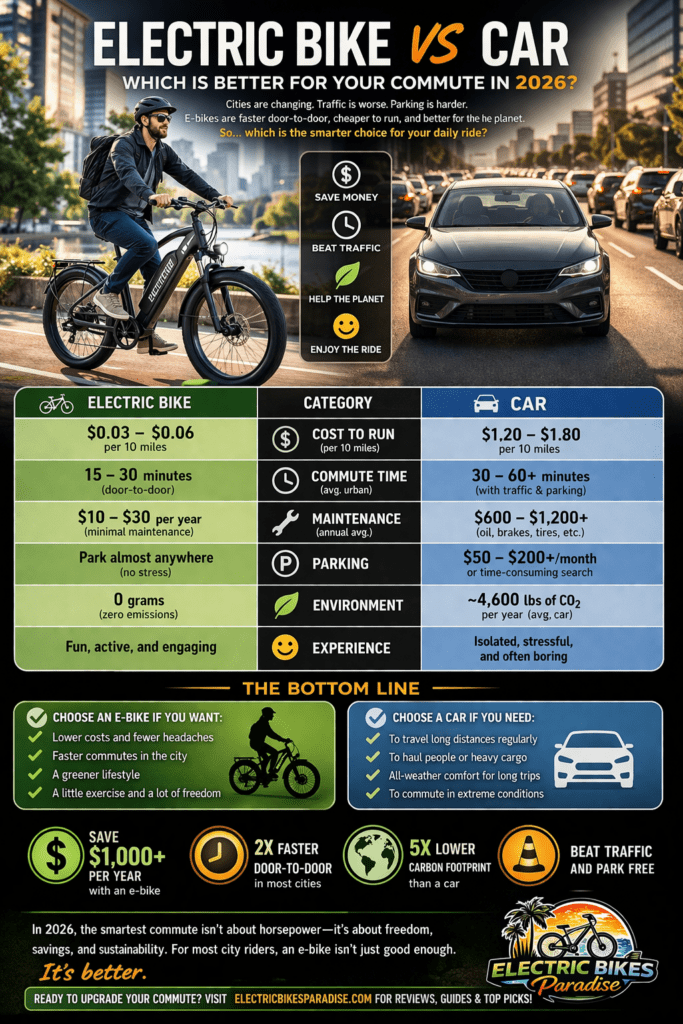
When you add all this together, driving a typical car costs about $0.50 to $0.70 per mile. Some cars cost less. Some cost way more. But $0.50 per mile is a reasonable estimate for a mid-range vehicle.
The Cost of Electric Bikes
An electric bike costs $1,200 to $3,000. Let’s say $2,000 for a decent commuter bike that will last 5 years or more. That’s $400 per year.
Charging costs about $0.05 to $0.08 per charge. A charge gives you about 30 to 50 miles of range. Let’s say 40 miles per charge. That’s $0.001 to $0.002 per mile. Let’s round it to $0.002 per mile.
Maintenance on an electric bike is minimal. You might spend $100 to $200 per year on routine maintenance: new brake pads, chain replacements, tire replacements. That’s about $0.003 to $0.005 per mile if you’re commuting regularly.
Insurance is not required for electric bikes, though some homeowner’s policies cover them. Registration is free. No emissions tests. No inspections.
Total cost per mile: about $0.02 to $0.03 per mile, including depreciation on the initial purchase.
Let me say that again. A car costs $0.50 to $0.70 per mile. An electric bike costs $0.02 to $0.03 per mile. The car is 20 times more expensive per mile.
Real-World Example: 10-Mile Daily Commute
Let’s say you have a 10-mile daily commute and you work 250 days per year. That’s 2,500 miles per year of commuting.
By car: 2,500 miles times $0.55 per mile equals $1,375 per year in direct costs. That’s not including the time spent driving, the stress, or the environmental impact.
By electric bike: you can’t realistically bike 20 miles every day in most climates. But if you bike 3 days per week and drive 2 days per week, you’re cutting your driving mileage by 60 percent. You’re spending about $550 per year on driving costs. Plus your bike depreciation and maintenance, let’s say $400 per year. Total: $950 per year for a combined car and bike commute.
You’ve saved about $425 per year. But here’s the thing: if you bike 3 days per week, you’re getting exercise. You’re getting fresh air. You’re reducing stress. You’re not burning time in traffic. Those benefits don’t show up in the cost calculation, but they’re really really valuable.
If your commute is shorter, say 5 miles, you might bike 4 or 5 days per week. Then you’re saving $600 to $700 per year and getting 4 to 5 hours per week of exercise.
Time Analysis: Bike vs Car
For a lot of commutes, the time difference isn’t as big as you’d think. This varies a ton by location, but let me walk through the comparison.
For a 5-mile commute in good weather: by car, you’re looking at 15 to 20 minutes including traffic, parking, and walking from the parking spot. By electric bike, you’re looking at 15 to 20 minutes depending on hills and fitness. If traffic is heavy, the car might take 25 to 30 minutes. The bike takes the same time either way.
For a 10-mile commute: by car, figure 25 to 35 minutes plus traffic. By electric bike, figure 30 to 40 minutes depending on terrain. Again, if traffic is bad, the car time goes up. The bike time is consistent.
The thing people don’t account for is that biking is exercise. The 30 to 40 minutes on the bike is your exercise for the day. If you drive, you still need to exercise sometime else. So the time difference is smaller than it looks because you’re replacing exercise time, not adding it on top of your commute time.
Plus, when you’re biking, you’re not stuck in traffic. You’re not frustrated. You’re not burning gas while sitting still. Your commute is actually time doing something productive instead of time wasted.
Distance Limitations
Here’s where electric bikes have real limitations: distance. An electric bike realistically handles commutes up to about 15 to 20 miles one way, depending on the battery and motor. Beyond that, you’re pushing the battery limits or you’re spending so much time commuting that it’s not practical.
If your commute is 25 miles or more, a car is probably better. You could do an e-bike one way and drive the other way, or drive some days and bike others. But a pure electric bike commute beyond about 20 miles starts feeling unrealistic.
Also, if you’re commuting in really bad weather regularly, a car is more practical. An e-bike is fine in light rain, but if you’re dealing with snow, ice, or severe storms regularly, you need a vehicle that can handle it.
Weather Considerations
Weather is a real factor, but people usually overestimate how much it matters. Most climates have more good-weather days than bad-weather days. Even in cold, wet climates, you can probably bike 200 to 250 days per year if you’re willing to dress properly.
Light rain? Fine to bike in. Drizzle? No problem. Heavy rain or thunderstorms? Drive that day. Snow that’s light and slushy? Possible if you’ve got good tires, though many people don’t attempt it. Heavy snow? Drive that day.
If you’re averaging biking 3 to 4 days per week, you’re getting massive cost savings even if you’re not biking every single day. The days you do bike, you’re saving money and getting exercise.
Health Benefits of Biking
This isn’t a direct cost savings, but it’s real financial impact. Regular commute cycling reduces cardiovascular disease risk, reduces obesity, reduces depression and anxiety, and increases overall health. These translate to lower healthcare costs and fewer sick days at work.
Studies show that commuters who bike regularly have about 20 percent fewer healthcare costs than those who drive exclusively. Even at a modest level of 2 to 3 bike days per week, you’re talking about meaningful health cost savings.
Plus, regular exercise increases productivity and mental health in ways that are hard to quantify but really really valuable.
The Parking Question
If you’re paying for parking at work, an electric bike is a total game changer. Parking spots at urban workplaces can cost $100 to $400 per month. That’s $1,200 to $4,800 per year. An electric bike eliminates that cost entirely.
Even if you bike 3 days per week, you’re cutting your parking costs by 60 percent. If you bike 5 days per week, you might eliminate the need for a parking spot altogether, which could save you several thousand dollars per year.
In expensive urban markets, this parking savings alone makes the financial case for an electric bike absolutely obvious.
Cargo and Carrying Capacity
Here’s a limitation of electric bikes: cargo capacity. You can carry a laptop bag and some groceries on an electric bike. You can’t carry construction materials, multiple bags of groceries, or anything bulky.
If your commute also involves carrying significant cargo regularly, you need a vehicle. If your commute is just you and your work gear, an electric bike is fine.
For full cargo capacity, look at our collection of cargo electric bikes. These are designed specifically for carrying gear and have impressive capacity compared to standard bikes.
When to Use Each Option
Electric bike is better for:
Commutes under 15 miles one way. Mostly good-weather days. Urban or suburban areas with bike infrastructure. Commutes where parking is expensive. Commuters who want exercise and fresh air. Short trips around town.
Car is better for:
Commutes over 20 miles. Areas with heavy snow or severe weather. Situations where you regularly need to carry cargo. Times when you need to transport passengers. Situations where you need the flexibility of a vehicle for other uses.
The hybrid approach is best for many people:
Bike 3 to 4 days per week when weather is good. Drive on bad-weather days or when you have cargo needs. This gives you most of the cost savings and health benefits without sacrificing practicality.
The Environmental Impact
A car powered by electricity or gasoline has environmental impact. An electric bike has minimal environmental impact. If reducing environmental impact matters to you, an electric bike is significantly better.
Manufacturing the bike has some environmental cost. Charging the battery has minimal environmental impact if you’re using any reasonably clean electrical grid. Compared to manufacturing and running a car, the environmental impact is tiny.
If you bike instead of driving, you’re reducing emissions by about 50 to 60 percent for commuting, even if you drive a couple days per week.
The Real Lifestyle Change
I want to be honest about something: switching from driving to biking is more than a financial decision. It’s a lifestyle change. You need to be someone who doesn’t mind riding a bike. You need to have safe places to bike. You need to be willing to show up to work without being in a car.
For some people, this is incredible. They love the feeling of moving through the world on a bike. They love the exercise. They love not dealing with traffic. For other people, the thought of biking to work is just not appealing, and forcing it will make you miserable.
The best approach is to try it. Get an electric bike, bike to work for a week in good weather, and see how it feels. If you love it, do it 3 to 4 days per week. If you hate it, you’ve lost the bike cost but at least you know.
Most people who try it and stick with it say it’s one of the best decisions they’ve made. The combination of cost savings, health benefits, and the actual experience of biking is genuinely transformative.
Comparing to Our Best Electric Bikes
If you’re seriously considering making the switch, look at our guide to the best electric bikes overall. For commuting specifically, check our collection of commuter electric bikes, which are designed for regular use on streets and light trails.
The cost of a good commuter electric bike is high upfront, but the math works out really really clearly over the lifetime of the bike. A $2,000 bike that lasts 5 years saves you about $2,000 to $3,000 per year compared to driving a car, which adds up to $10,000 to $15,000 in cost savings over those 5 years.
The Bottom Line
For most commutes under 15 miles in areas with reasonable weather, an electric bike saves you money and improves your health compared to driving. Even if you bike 3 days per week, you’re saving hundreds or thousands of dollars per year.
A car is still necessary for some purposes, bad weather, and longer distances. But for regular commuting, an electric bike is the better choice financially, environmentally, and for your health.
The real question isn’t whether an electric bike is better than a car. It’s whether you’re willing to make the lifestyle change to use one. Once you try it, most people are. And then they wonder how they ever lived any other way.
The Flexibility Factor
There’s something about having a car that feels flexible. You can go anywhere, anytime, regardless of weather or distance. An electric bike doesn’t give you that same flexibility. You’re limited by weather, distance, and physical capacity.
But here’s the reality: most of your car trips are short. Studies show that the average car trip is under 5 miles. A bike trip covers that distance in 15 to 20 minutes. For 80 percent of your trips, a bike is genuinely more flexible than a car because you’re not dealing with traffic, parking, or startup time.
It’s the occasional longer trip or the bad weather day where the car is better. Most people can live with that limitation in exchange for the money and time savings on regular trips.
Hybrid Transportation Model
The smart approach for most people is a hybrid model. You have an electric bike for regular commuting and short trips. You have a car for longer trips, bad weather, and cargo situations.
This gives you the cost savings on 80 percent of your trips and the convenience of a car for the 20 percent that really need it. You’re not putting 100 miles per week on the car like you would if you were driving every day. You’re using it strategically.
A hybrid approach costs you $1,500 to $2,000 for the bike, your existing car expense, but you’ve cut your car usage by 60 to 70 percent. Your total transportation cost is dramatically lower than driving a car for everything.
The Social and Psychological Shift
Switching from a car to a bike for commuting is more than a financial decision. It’s a psychological shift. You’re moving from a bubble of isolation and convenience to being part of the world around you.
Some people love this. They feel more connected, more present, and more alive. They like seeing the same people on their commute route. They like noticing the changing seasons as they ride. They feel more engaged with their community.
Some people hate it. They like the isolation, the climate control, and the convenience of a car. They don’t want to be sweaty, they don’t want to deal with weather, and they don’t want to be vulnerable to traffic.
There’s no right answer here. It’s about what actually works for your personality and your life. But if you try it and love it, the financial benefits are amazing. And if you try it and hate it, you’ve lost the cost of a bike and you’ve learned about yourself.
The Environmental Case
I’ve mentioned this briefly, but it deserves more attention. Switching from a car to an electric bike for regular commuting cuts your transportation carbon emissions by 50 to 60 percent. If you have an electric vehicle and you bike instead, you’re still reducing emissions, though not as dramatically.
If environmental impact matters to you, biking is one of the single highest-impact changes you can make for personal transportation. The only thing better would be not traveling at all or moving closer to work.
A lot of people who switch to biking are motivated by environmental concerns. The financial savings are a bonus, but the ability to significantly reduce their carbon footprint is the real motivator.
The Challenges You Need to Honestly Consider
I’ve painted a pretty rosy picture, but let me be honest about the challenges because they’re real.
Physical fitness: if you’re out of shape, commuting by bike is going to be difficult at first. Electric motors help, but you still need to do some pedaling. You need to be reasonably healthy to do this regularly.
Weather tolerance: you need to be willing to ride in light rain, cold, and wind. Electric bikes work in these conditions, but it’s not comfortable. If you hate being uncomfortable in weather, biking might not be for you.
Time commitment: biking takes longer than driving for most trips. If you’re always rushing and time is critical, biking might add stress instead of reducing it.
Infrastructure: you need safe places to ride. If your area doesn’t have bike lanes, trails, or safe routes, biking is stressful and potentially dangerous.
Social acceptance: some people feel self-conscious about biking to work. They worry about being sweaty, about looking weird, about what coworkers will think. If this is you, biking might not work regardless of the financial benefits.
These are real limitations. They don’t apply to everyone, but they apply to some people. If any of these are deal-breakers for you, biking isn’t right for your situation.
Making the Decision
So should you switch from driving to biking for your commute? Here’s how to actually make that decision.
First, look at your current commute. How far is it? How is the weather where you live? Are there safe places to bike? If you’ve got a 3-mile commute, good weather 200 days per year, and bike lanes on your route, biking is worth serious consideration.
If you’ve got a 25-mile commute, live in the snow belt, or have no bike infrastructure, biking probably isn’t realistic.
Second, try it. Rent a bike, borrow a friend’s bike, or buy one with a good return policy. Ride for a week during good weather and see how it feels. Does it feel amazing or is it terrible?
Third, talk to people who bike in your area. Ask them about the experience, the challenges, and the reality. They’ll give you honest feedback that’s better than anything I can tell you.
Fourth, run the numbers for your specific situation. Calculate your actual commuting costs and understand what you’d save. The generic numbers show huge savings, but your specific situation might be different.
Fifth, make a trial period commitment. Buy the bike, commit to biking 3 days per week for 3 months, then reassess. You need enough experience to actually know if you like it or not.
By the end of three months, you’ll know if biking is right for you. If you love it, increase to 4 or 5 days per week. If you hate it, you’ve lost the cost of the bike and you’ve learned something valuable about yourself.
To learn more, visit https://electricbikesparadise.com/how-do-electric-bikes-work/ to understand the technology. Check https://electricbikesparadise.com/best-electric-bikes/ for available models. Visit https://electricbikesparadise.com/electric-bike-buying-guide/ for features that matter for your commute. And read https://electricbikesparadise.com/are-electric-bikes-worth-it-an-honest-look-at-the-costs-benefits-and-trade-offs-in-2026/ for the true costs and benefits.
Explore our collection pages: commuter electric bikes at https://electricbikesparadise.com/commuter-electric-bikes/, folding bikes at https://electricbikesparadise.com/folding-electric-bikes/, step-through bikes at https://electricbikesparadise.com/step-thru-electric-bikes/, fat tire bikes at https://electricbikesparadise.com/electric-fat-tire-bikes/, and mountain bikes at https://electricbikesparadise.com/electric-mountain-bikes/. Visit https://electricbikesparadise.com/ to start your commuting transformation.