
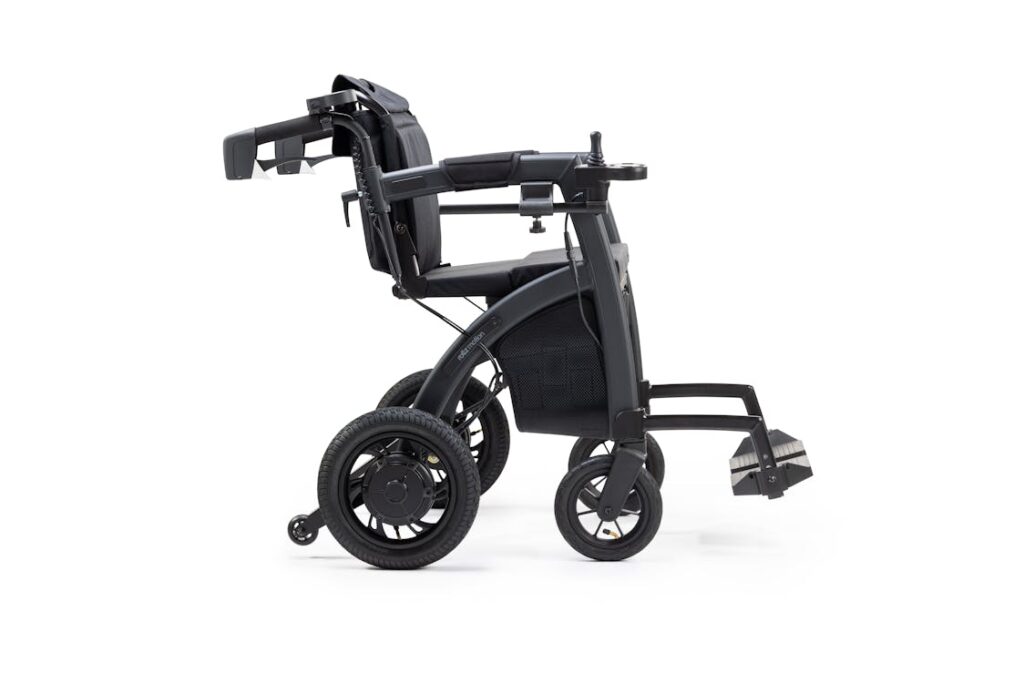
Electric wheelchairs are fundamentally different from manual wheelchairs. With a manual wheelchair, you’re using your own arm and core strength to move around. With an electric wheelchair, you’re using a motorized system that lets you travel farther, faster, and with less physical exertion. For people who have limited upper body strength, dexterity issues, or who simply want to be able to travel longer distances without exhaustion, an electric wheelchair can be genuinely life-changing.
The challenge is that electric wheelchairs are expensive, there are a lot of options to choose from, and the technology can be confusing. You’ve also got Medicare coverage, insurance questions, and medical necessity requirements to navigate. I’m going to walk you through all of this so you can make an informed decision about whether an electric wheelchair is right for your situation, and if it is, what to look for.
Electric Wheelchairs Versus Manual Wheelchairs
Let’s start with the basic difference. A manual wheelchair is moved by the user pushing on the wheels. It’s lightweight, portable, and simple, but it requires significant upper body strength. A long day in a manual wheelchair can leave you exhausted and in pain.
An electric wheelchair, sometimes called a power wheelchair, has a motor and battery system that propels the wheelchair. The user controls speed and direction with a joystick, pushbutton, or other controller, but the wheelchair is doing the work. That means you can travel much farther with much less physical effort.
The trade-off is weight, size, cost, and complexity. An electric wheelchair weighs 200 to 300 pounds. A manual wheelchair weighs 20 to 50 pounds. An electric wheelchair requires batteries and motors that need maintenance. An electric wheelchair is also way more expensive, typically $1,500 to $10,000 or more depending on the model.
So the question isn’t which is objectively better. The question is which one actually serves your needs given your specific situation.
Understanding Medicare Coverage for Electric Wheelchairs
This is really really important, so let me explain it clearly. Medicare Part B covers electric wheelchairs if they’re deemed medically necessary. The coverage is typically 80 percent after you’ve met your Part B deductible. But there are specific requirements, and the process is bureaucratic.
To qualify for Medicare coverage, you need several things. First, you need a doctor who will prescribe an electric wheelchair as medically necessary. Not just helpful or convenient, but medically necessary. The doctor needs to document why you can’t operate a manual wheelchair safely and effectively.
Second, you need a face-to-face evaluation by the doctor that documents your medical condition and justifies the need for a power wheelchair. This evaluation needs to happen within a specific timeframe before the wheelchair is prescribed.
Third, you need to use a Medicare-approved supplier to purchase and deliver the wheelchair. Not all wheelchair suppliers are Medicare-approved, so you can’t just buy whatever you want and submit it for reimbursement. You have to work with an approved supplier.
Fourth, the wheelchair itself needs to meet Medicare’s specifications. This is where things get really restrictive. Medicare covers what they consider “basic” features but not upgrades or premium options. If you want a nicer wheelchair with better comfort or additional features, you’re paying out of pocket for the upgrades.
The whole process typically takes weeks or months. You get a prescription, you work with an approved supplier, Medicare reviews the claim, they approve or deny it, and then the wheelchair gets ordered and delivered. It’s slow, but if it works out, it can save you thousands of dollars.
Other Insurance Coverage Options
Medicaid coverage varies dramatically by state. Some states have robust durable medical equipment programs that cover power wheelchairs. Others barely cover anything. You’d need to check with your specific state’s Medicaid program to see what’s covered in your state.
Private insurance policies also vary. Some group insurance plans cover durable medical equipment like wheelchairs. Others don’t. Check your specific policy to see what’s covered. You might need to get a prescription and go through an approval process similar to Medicare.
Veterans Administration covers wheelchairs for eligible veterans. If you’re a veteran, the VA typically covers both the wheelchair and customizations necessary for your specific condition. The VA process is different from Medicare and can actually be faster and more comprehensive.
If you have coverage questions, your best resource is to call your insurance directly and ask about durable medical equipment coverage. Ask specifically about power wheelchairs, what prescription requirements there are, and what the approval process looks like. Get the answers in writing if possible.
Types of Electric Wheelchairs
Electric wheelchairs come in different types, and the type you need depends on your specific situation.
Portable electric wheelchairs are lightweight, usually 35 to 60 pounds, and fold or disassemble for transport. They’re designed for people who need power assistance but also want portability. Range is typically 10 to 15 miles. These are good for people who travel or need to be able to transport the wheelchair themselves.
Standard electric wheelchairs are larger and heavier, usually 100 to 150 pounds, and don’t fold. They’re designed for everyday use and durability. Range is typically 15 to 25 miles. These are good for people who have indoor and outdoor access, who have caregivers who can help transport it, or who have a vehicle with a lift.
Heavy-duty electric wheelchairs are for people with higher weight capacity needs or who need significant customization. These are 150 to 250 pounds and have more powerful motors and larger batteries. Range can be 20 to 30 miles or more. Cost is also significantly higher, often $5,000 to $15,000.
Powered recline and tilt wheelchairs are electric wheelchairs where the seat itself can recline backward or tilt to help with positioning, circulation, and pressure relief. These are particularly important for people who spend most of their day in the wheelchair or who have pressure sore concerns.
Key Features and Specifications
Weight capacity is the first critical specification. Most standard electric wheelchairs have a capacity of 250 to 300 pounds. Heavy-duty models go up to 400 pounds or more. You want to choose a wheelchair rated for more than your current weight because exceeding the capacity affects performance and durability. Pick one with at least 50 to 100 pounds of additional capacity as a buffer.
Range determines how far you can travel on a single charge. A 20-mile range sounds good on paper, but real-world use typically gets you 15 to 18 miles depending on your weight, terrain, and driving style. If you need to travel 30 miles daily, a 20-mile range wheelchair won’t work. You need closer to 40-mile range to have a safety buffer.
Motor power is measured in watts. More watts mean faster acceleration and better hill-climbing ability. Most standard electric wheelchairs have motors in the 500 to 1000 watt range. More powerful motors are helpful if you live in a hilly area or need faster movement, but they also drain the battery faster.
Seat width, seat height, and seat depth need to fit your body properly. A seat that’s too wide or too narrow will be uncomfortable and can create pressure points. A seat that’s too high or too low will make getting in and out difficult. Many wheelchairs have adjustable dimensions or custom seat options to accommodate different body types.
Turning radius determines how tight of a turn the wheelchair can make. A tighter turning radius (smaller number) means you can navigate in smaller spaces. Some wheelchairs have a 20-inch radius; others are 30 inches or more. If you’re maneuvering in tight home or office spaces, a smaller radius is really really helpful.
Footrest options include fixed, swing-away, or elevating footrests. Elevating footrests are helpful if you have lower leg swelling or circulation issues. Swing-away footrests let you get closer to tables or desks for work. The right option depends on your specific needs and lifestyle.
Control Mechanisms
The most common control system for electric wheelchairs is a joystick that you can manipulate with one hand or fingers. The joystick controls both speed and direction. You push forward to go forward, pull back to go backward, and move side to side to turn.
For people with limited fine motor control, touchpad or button controls might be better. These use arrays of buttons that you press to control the wheelchair. They’re less intuitive than a joystick, but they can be easier for people with certain disabilities.
Head controls, eye-tracking controls, and other advanced options exist for people with very limited mobility. These let you control the wheelchair without using your hands or arms. They’re expensive and require calibration, but they give people with severe limitations genuine independence. Costs for these systems can be $5,000 to $20,000 just for the control system.
The quality and responsiveness of your control system directly affects your driving experience. A responsive joystick that needs minimal force makes driving easier. A joystick that requires a lot of pressure or has a delay between input and response is fatiguing to use.
Suspension and Ride Comfort
How does the wheelchair handle bumps, uneven terrain, and rough pavement? That’s determined by the suspension system. Some wheelchairs have no suspension; others have front, rear, or full suspension.
Wheelchairs with suspension absorb shocks and vibrations, making the ride more comfortable and smoother. They’re particularly important if you’re spending hours in the wheelchair daily or if you need to navigate rough terrain. The trade-off is that suspension adds weight and complexity.
Tires also affect ride quality. Solid tires never go flat, which is convenient, but they transmit vibrations directly to the wheelchair and your body. Pneumatic (air-filled) tires are more comfortable but require maintenance and can go flat. Most people find pneumatic tires worth the maintenance for the comfort difference.
Seat cushion quality is another factor. A basic wheelchair comes with a thin foam cushion. If you’re spending most of your day in the wheelchair, upgrading to a gel or memory foam cushion is really really worthwhile for comfort. These can cost $300 to $1,000, but the comfort improvement is significant.
Battery Technology and Charging
Modern electric wheelchairs use lithium-ion batteries, which are lighter and longer-lasting than older lead-acid batteries. Lithium batteries degrade slowly over time, losing about 1 to 2 percent of capacity per year. After five years, you might have lost 5 to 10 percent of your original range.
Battery life under normal use is typically 500 to 1,000 charge cycles, which translates to 3 to 5 years for most users. When the battery starts losing significant capacity, you can replace it, usually for $800 to $2,000 depending on the wheelchair model.
Charging time varies but is typically 6 to 12 hours for a full charge from empty. You can charge overnight, or if you need faster charging, some models have fast chargers that charge in 2 to 4 hours. These are convenient but add cost and heat generation to the battery.
Charger portability matters if you travel. Some wheelchairs have chargers that are lightweight and portable. Others have heavy stationary chargers that you can’t easily take with you. If you travel frequently, a portable charger is a real advantage.
Durability and Maintenance
A quality electric wheelchair should last 5 to 10 years with normal use. The motor and drive system are sealed and require minimal maintenance. The batteries will eventually need replacement. Tires may need occasional replacement. Cushions may wear out and need replacement.
Routine maintenance is minimal. Keep the wheelchair clean, check for loose bolts or connections occasionally, and keep the batteries charged. That’s about it for regular users.
When things do break, repair costs can be significant. A motor replacement might cost $1,000 to $2,000. A controller replacement might be $500 to $1,000. So choosing a wheelchair from a reputable manufacturer with good warranty coverage is important.
Price Ranges and Budget Considerations
Portable electric wheelchairs run from $1,500 to $3,500. Standard electric wheelchairs run $2,500 to $8,000. Heavy-duty wheelchairs run $5,000 to $15,000 or more. These prices are before Medicare coverage or insurance.
If Medicare covers 80 percent of an approved wheelchair costing $4,000, you’d pay 20 percent, which is $800. If you’ve already met your deductible, that becomes your out-of-pocket cost. If you haven’t met your deductible, add that to the $800.
If insurance doesn’t cover it and you’re paying out of pocket, you need to make a budget decision. A basic functional electric wheelchair can be had for $1,500 to $2,500. A more comfortable, feature-rich wheelchair with better comfort and capabilities might be $4,000 to $6,000.
Financing options are sometimes available directly from manufacturers or through medical equipment financing companies. You can also explore whether you qualify for any grants or assistance programs. Some disability organizations and foundations offer financial assistance for mobility equipment.
Customization and Modifications
Once you have an electric wheelchair, there are a lot of customization options available. You can add cup holders, phone holders, and storage baskets. You can upgrade the seat cushion or add back support. You can add lights for visibility or a bell for signaling. You can customize the color or add custom paint.
Most of these upgrades are $50 to $500 each. You don’t need to buy everything upfront. Get a basic wheelchair and add customizations as you figure out what you actually need.
If you need specialized accommodations, like a wheelchair ramp, vehicle lifts, or accessible vehicle modifications, those are significant expenses beyond the wheelchair itself. You might be looking at $5,000 to $10,000 for vehicle modifications to accommodate an electric wheelchair. Those modifications might be covered by insurance or grants, so investigate before assuming you’re paying out of pocket.
Common Electric Wheelchair Models
The Pride Mobility Jazzy is one of the most popular electric wheelchairs. It’s reliable, customizable, and has good dealer support. Models range from portable to heavy-duty, with prices from $2,000 to $8,000. Parts and repairs are readily available.
The Quantum Q6 is another popular choice, particularly for heavier users or those needing heavy-duty capabilities. It’s built for durability and has excellent customization options. Prices typically run $4,000 to $10,000.
The Drive Medical Cirrus Plus is a solid mid-range option at $2,500 to $4,000. It offers good reliability, decent range, and a reasonable price point. It’s a good choice for someone just starting to use an electric wheelchair.
For portable options, the Lively Mobility Aries is lightweight (about 50 pounds) and foldable, with about 13 miles of range. Price is typically $1,500 to $2,500. It’s good for travel and storage in small spaces.
Accessibility and Getting Around
An electric wheelchair opens up possibilities for accessibility, but accessibility is also something you need to actively consider. Your home might need modifications: ramps instead of steps, wider doorways, accessible bathrooms. Your workplace or school might need to make accommodations.
The Americans with Disabilities Act (ADA) requires businesses to make reasonable accommodations for people with disabilities, including wheelchair accessibility. But “reasonable” can be interpreted different ways, and enforcing your rights sometimes requires legal action.
Before committing to an electric wheelchair, honestly assess the places you spend time. Are they accessible? Will you need to advocate for accessibility improvements? Are you willing to do that? For some people, the answer is yes and they’re willing to push for change. For others, it’s a barrier.
Comparing Electric Wheelchairs to Other Mobility Options
If you’re interested in mobility solutions more broadly, check out our guide to electric bikes and mobility solutions. While electric bikes and wheelchairs serve different needs, they’re both part of the broader landscape of motorized mobility.
We also have information about how electric vehicles work, including information about battery technology and motor systems that applies to wheelchairs as well. For a framework on evaluating mobility devices, review our detailed buying guide.
For cost-benefit analysis of whether motorized mobility devices are worth the investment, read our honest look at whether electric vehicles are worth it.
Trial and Testing Before Buying
Before committing to buying an electric wheelchair, try one. Rent one if possible. Borrow one from someone who has one. Spend a day or a week using an electric wheelchair to see how it feels, what challenges you encounter, and whether it actually improves your quality of life.
Visit wheelchair showrooms where you can sit on different models, test the controls, and get a feel for how it handles. Don’t just order online. The wheelchair needs to feel right for your body and your specific situation.
Talk to other wheelchair users. Find out what they like and what they wish they’d done differently. Online communities and local support groups are great resources. Real people using the same wheelchairs can give you honest feedback that marketing materials never will.
The Independence Factor
Here’s what I really want you to understand about electric wheelchairs. They represent independence. They represent the ability to get around without depending on someone else to push you. They represent the ability to travel far, to explore, to live your life on your terms.
For some people, that independence comes with an emotional journey. You might feel like using a wheelchair is “giving up” on regaining the ability to walk. You might feel self-conscious or worried about judgment. Those feelings are real, and they’re worth acknowledging.
But here’s the truth: an electric wheelchair isn’t giving up. It’s giving yourself tools to live more fully. It’s choosing to do more things, go more places, and maintain more independence than you could without it. That’s not surrender. That’s adaptation and resilience.
Medical Justification and Working With Your Doctor
To get insurance coverage or to pursue any medical assistance programs, you’ll need your doctor to document medical necessity. Don’t just accept your doctor’s initial response. If they’re not familiar with your situation, push them to really understand why you need a power wheelchair.
Bring documentation about your condition. Show them your fatigue levels, your pain levels, your functional limitations. Be specific about what you can’t do that a power wheelchair would let you do. Talk about the difference between being able to go to the store and not being able to go to the store.
Some doctors are very familiar with these processes; others aren’t. If your doctor isn’t being responsive, consider getting a second opinion from a physiatrist or another specialist who regularly works with mobility issues.
Trial Periods and Return Policies
Some wheelchair suppliers offer trial periods or return policies where you can try a wheelchair for 30 days and return it if it doesn’t work for you. This is really really valuable because it lets you make sure the wheelchair actually meets your needs before fully committing.
Ask about trial periods when you’re shopping. If one supplier offers it and another doesn’t, that’s a good reason to work with the one that does.
Scooters Versus Wheelchairs
Sometimes people wonder whether they should get a mobility scooter instead of a wheelchair. They’re different tools for different situations. A scooter is good if you can walk but need rest periodically. You drive the scooter sometimes and walk other times. A wheelchair is for people who can’t walk, or who can walk but it causes pain or exhaustion.
If you can walk at all, even with significant difficulty, a scooter might be a good option before committing to a wheelchair. But if walking isn’t possible or causes severe pain or exhaustion, a wheelchair is the better choice.
Future Technology and Advancements
Electric wheelchair technology is constantly improving. Batteries are getting lighter and longer-lasting. Motors are getting more efficient. Controllers are getting smarter with better responsiveness. Wheelchairs are getting lighter and more maneuverable.
That said, don’t wait for the next generation. Technology is always improving, and if you need a wheelchair now, waiting for future improvements means missing out on years of independence and capability. Get the wheelchair that works for your situation today.
Life With an Electric Wheelchair
Using an electric wheelchair changes your life, usually for the better. You can do more things. You can go more places. You can be more independent. You can participate more fully in your community and your life.
There are challenges. Accessibility issues still exist. Social stigma is still real for some people. The device itself requires maintenance and eventually replacement. But the benefits, in terms of independence and capability, typically far outweigh the challenges.
Most people who use electric wheelchairs talk about how much better their lives are compared to before. They travel more. They work more. They socialize more. They’re happier because they’re not exhausted and in pain from trying to push a manual wheelchair.
Final Thoughts
An electric wheelchair is a significant investment in your independence and quality of life. The cost is real, the process of getting one can be bureaucratic and frustrating, and there are legitimate accessibility challenges to navigate.
But if you need one, it’s worth it. Do the work to understand your options. Work with your insurance. Talk to other users. Take your time making the decision. And once you have a wheelchair that works for you, don’t apologize for using it. You’ve made a smart choice about your independence and your future.
Check out our detailed buying guide for electric mobility solutions. Browse our electric wheelchairs collection to compare specific models. Visit our homepage to explore all the electric mobility options we cover. Check our accessibility features guide, medical mobility devices, and mobility scooters for specialized solutions. For Medicare coverage information and medical necessity guidelines, visit CMS.gov, the VA.gov for veteran benefits, and NCOA for senior resources. If you have specific questions or want recommendations, reach out. We’re here to help.