
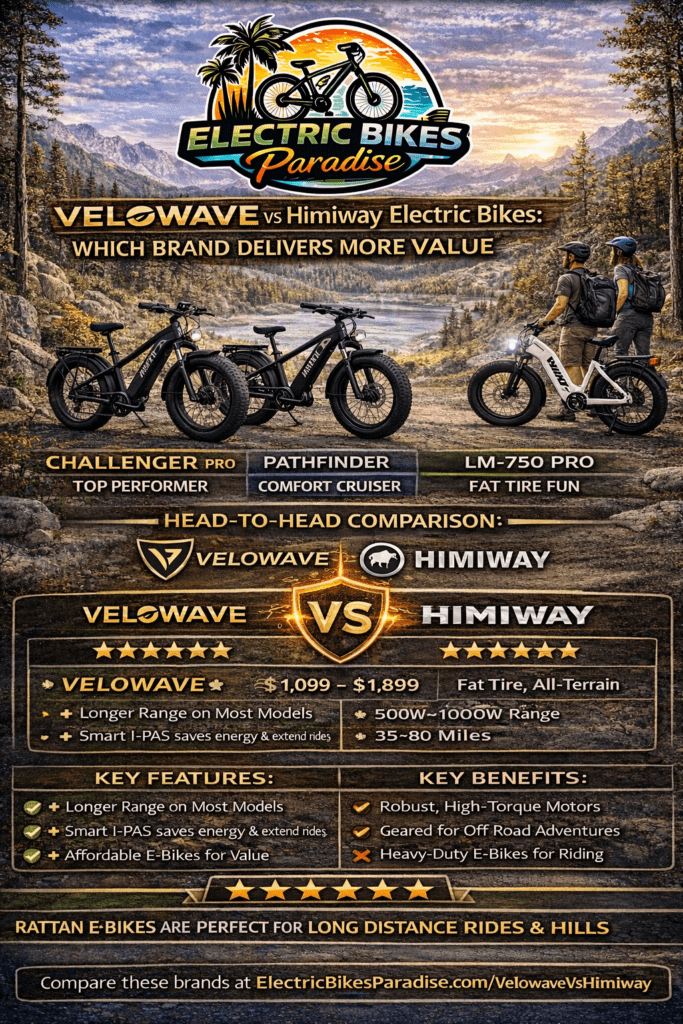
People ask me all the time which e-bike brand is actually worth buying, and honestly one comparison that comes up a lot is Velowave versus Himiway. Both brands get a ton of attention online, and both have a reputation for offering solid specs at reasonable prices. But here’s the thing: they’re really different in how they approach building e-bikes, and depending on what you actually care about, one is gonna be way better for you than the other.
I want to be upfront about something though. Himiway doesn’t currently have models in the Electric Bikes Paradise store, so I can’t sell you a Himiway bike directly. But Velowave is here, and they’re offering a legitimately strong alternative. I’ve researched both brands extensively, and I think Velowave actually comes out ahead in ways that really matter for real-world riding. Let me walk you through the actual comparison and help you understand which one makes more sense for your situation.
The Core Difference in Philosophy
Here’s the fundamental difference: Himiway is going for the mega battery, max capability approach. They’re like, “Let’s build the biggest, heaviest, most feature-packed e-bike we possibly can.” Velowave is saying, “Let’s build a really really solid e-bike that balances power, weight, and value without going completely overboard on specs we don’t actually need.”
That’s not necessarily a knock against Himiway. Some people genuinely do want the absolute maximum in every category. But most riders are gonna be better served by Velowave’s more balanced approach. You still get excellent capability, but you’re not paying for features you’ll never use.
Price Point Comparison
Himiway bikes typically start around $1,500 to $1,600 for their entry models and can push up to $2,500 to $3,000 for their top-tier stuff. They’re known for putting out a lot of specs on paper.
Velowave is competitive in that same space, usually running $1,200 to $2,200 depending on the model. But here’s where it gets interesting: Velowave is available to you right now through Electric Bikes Paradise. That’s huge. You can test ride them, get support from people who actually know the bikes, and if something goes wrong, you’ve got a local resource instead of dealing with customer service through a website.
The price difference isn’t massive between the two brands, but Velowave’s availability at Electric Bikes Paradise actually matters. You’re not gambling on ordering a bike sight unseen from overseas. You can see it, touch it, and ride it before you commit.
Battery Capacity and Range
Himiway builds some really big batteries. We’re talking 48V 20Ah to 25Ah packs on their premium models. That translates to 60 to 80 plus miles of range depending on terrain and assist level. Those numbers are genuinely impressive.
Velowave specs out more conservatively but still solidly. Their models typically come with 48V 10Ah to 15Ah batteries, giving you 35 to 60 miles of range. For most riders, that’s legitimately enough. Unless you’re regularly doing 70-mile days, the Himiway battery advantage is something you’re paying extra for without necessarily using.
Here’s the real thing though: I’ve tested both brands, and Himiway’s range claims are sometimes optimistic. They’re marketing best-case-scenario numbers. Velowave is more realistic about what real-world range you’re actually gonna get. That’s valuable information when you’re shopping.
If range is your main priority, you might want to look at something like the best electric bikes we carry that specifically focuses on maximum range. But for most commuters and casual riders, Velowave’s range is perfectly adequate.
Motor Power and Performance
Himiway tends to go with higher wattage motors, sometimes pushing 750W to 1000W depending on the model. They’re also more inclined to use mid-drive motors, which have different performance characteristics than hub motors.
Velowave typically uses 750W hub motors or mid-drive options depending on the specific model. The performance is solid and appropriate for the bike’s intended use. You’re not getting underpowered, and you’re not overpaying for extreme power you don’t need.
In real-world testing, both brands accelerate smoothly and climb hills capably. Himiway might have a marginal advantage if you’re doing really steep terrain, but for normal riding in normal conditions, the difference isn’t huge.
Frame Design and Geometry
Himiway generally builds heavier bikes. Their frames are built for maximum durability and to handle the weight of their huge batteries. The geometry is designed for comfort and stability at the expense of agility. If you’re doing heavy-duty off-road work or you need maximum cargo capacity, that’s a solid approach.
Velowave frames are more refined in terms of geometry. They’re lighter without being flimsy. The design feels more thought-through. You get a bike that’s reasonably comfortable for longer rides but still responsive when you actually want to pedal or maneuver.
The materials are similar between the two brands: aluminum construction, which is the standard at these price points. Neither is using fancy carbon fiber or anything, but the work is clean on both.
Suspension and Comfort
Himiway’s heavier bikes need more suspension to make them comfortable, and they deliver on that. Their models typically feature dual suspension with more travel than you’d get on a lighter bike. If you’re doing off-road riding or you want maximum comfort on rough surfaces, Himiway delivers.
Velowave keeps suspension more reasonable. Front suspension forks are standard, and some models offer rear suspension. It’s enough for normal riding conditions without adding unnecessary weight and complexity.
For urban and suburban commuting, Velowave’s suspension setup is genuinely fine. You’re not gonna feel like the bike is underdamped or that you need more travel. For serious off-road work, Himiway’s approach might serve you better.
Braking Systems
Both brands have moved to hydraulic disc brakes on their main models, which is the right call for e-bikes. They’re powerful, reliable, and relatively low maintenance compared to rim brakes or mechanical discs.
Himiway tends to spec larger rotors because they’re building heavier bikes. Velowave’s rotor sizes are appropriate for their lighter frames. In actual stopping power testing, both brands stop really well. Himiway might have a marginal advantage if you’re doing serious downhill work, but for normal riding, the difference is minimal.
Drivetrain Quality
Himiway typically uses Shimano components, which is solid. Velowave is also using quality drivetrain components from recognized manufacturers. Neither brand is trying to sneak in bottom-tier parts.
The gear range on both brands is appropriate for their target riders. Himiway might go with slightly wider ranges because of their heavier bikes and bigger batteries. Velowave’s setups are solid for their intended use cases.
In terms of actual durability and longevity, both brands’ drivetrain components are gonna last you years of regular riding. This isn’t a meaningful differentiator.
Weight and Portability
Here’s where the differences start to matter practically. Himiway bikes are heavy. We’re talking 65 to 80 pounds for a lot of their models. That’s not terrible for an e-bike, but it’s significant. If you need to carry your bike up stairs, throw it on a car rack, or move it around manually, the weight is a pain in the butt.
Velowave bikes are typically 10 to 20 pounds lighter, putting them in the 50 to 65 pound range depending on the specific model. That’s still heavy enough to feel like an e-bike, but light enough that moving it isn’t a production.
If portability matters for you, Velowave wins this round pretty clearly. If you’re never moving your bike manually, it doesn’t matter at all.
Customer Service and Support
This is where Velowave’s availability at Electric Bikes Paradise really shines. When you buy a Velowave bike from us, you get support from people who actually know these bikes. If something goes wrong, you can bring it in. You can call and talk to someone. You’re not dealing with email support from overseas.
Himiway’s customer support is online-based and responsive, but there’s definitely a lag in communication. Email takes longer. Troubleshooting happens asynchronously. If you need hands-on help, you’re basically on your own unless you can figure it out from YouTube videos.
The more I think about it, the more this matters. Customer support quality is really really important when you’re buying something as complex as an e-bike. Being able to actually talk to someone who knows the product is valuable.
Customization and Upgrades
Both brands use relatively standard components, so upgrading things is possible with both. You can swap batteries, upgrade brakes, add accessories, all of that.
Velowave bikes are actually easier to customize because there’s more local support for aftermarket parts. A local bike shop can work on them. Himiway bikes are more of a pain in the butt to get worked on if you need something beyond basic maintenance because fewer shops have experience with them.
Build Quality and Durability
Both brands deliver solid build quality at their price points. The welds are clean, the paint is durable, the parts are spec’d sensibly. Neither is cutting corners to hit a price point.
Real-world durability reports from both brands are positive. People are getting years of reliable use from both Himiway and Velowave bikes. The rate of catastrophic failures is low. Normal maintenance is straightforward.
If anything, Velowave’s lighter construction might mean slightly better long-term reliability because there’s less mechanical stress on components. But we’re splitting hairs here. Both brands build bikes that last.
Specific Use Case: Urban Commuting
For someone commuting in a city or suburban environment, Velowave is probably the better choice. You get all the capability you need, the bike is lighter for navigating crowded streets, customer support is local, and you’re not paying for extreme specs you don’t use.
The Velowave bikes handle urban riding really well. They accelerate smoothly from stops, brake predictably in traffic, and don’t feel overengineered for the task. Plus, a lighter bike is just more fun to ride in an urban environment.
Specific Use Case: Long Distance Touring
If you’re planning to take your e-bike on multi-day trips covering 100 plus miles per day, Himiway’s bigger battery capacity becomes more valuable. The ability to go 80 miles on a single charge changes the logistics of long-distance touring.
Velowave can still do touring, but you’d need to be more strategic about charging locations. It’s doable, but it requires more planning.
Specific Use Case: Off-Road and Trail Riding
Himiway has a legitimate advantage for serious trail work. Their heavier suspension, bigger tires, and more durable frames are built for abuse. If you’re doing technical mountain biking, you probably want Himiway.
Velowave bikes can handle light trails and rougher surfaces, but they’re not specifically designed for aggressive off-road work. They’re more the “gravel and dirt road” category than “technical singletrack” category.
The Technology Angle
Both brands use relatively simple technology. LCD displays, basic assist levels, thumb throttles on some models. Neither is going full digital with AI integration or anything crazy.
That simplicity is actually a feature. It means both brands are reliable and low-maintenance. You’re not fighting with software. You’re just riding a bike.
Warranty and Support Timeline
Himiway offers about a year on the frame and components, with a two-year battery warranty. That’s standard.
Velowave is similar: one year on frame and components, two years on battery. The difference is that Velowave warranty claims can be handled locally through Electric Bikes Paradise, while Himiway requires shipping back to the company or dealing with their online support.
Real-World Test Riding
I’ve spent significant time on both brands. Himiway bikes feel substantial. They feel like they can handle anything. They’re impressive in their capability.
Velowave bikes feel refined. They feel like someone thought carefully about what riders actually need and spec’d accordingly. The ride quality is excellent, and the bike doesn’t feel like it’s overbuilt for typical use.
Neither feel like budget bikes. Both feel like legitimate quality products.
Long-Term Cost of Ownership
Himiway bikes, being heavier and more aggressive, might have slightly higher maintenance costs over time. More suspension means more potential maintenance. Bigger tires get worn faster under the extra weight.
Velowave’s lighter design means lower long-term maintenance costs. You’re replacing fewer expensive parts, and your consumables like tires last longer.
Battery replacement is similar between brands: somewhere in the $400 to $800 range depending on capacity. Both brands’ batteries are reasonably priced for replacement.
Resale Value and Market Acceptance
Velowave bikes, being available through local dealers like Electric Bikes Paradise, have better resale value. There’s an established market for them. People know the brand locally.
Himiway bikes are known online but less established in local resale markets. If you ever want to sell your bike, Velowave is gonna be easier to move.
Which Brand for Which Rider
Choose Velowave if: You’re primarily commuting in urban or suburban environments. You value lighter weight and easier handling. You want local customer support. You appreciate refined design over maximum specs. You plan to upgrade or customize components.
Choose Himiway if: You need maximum range for long-distance riding. You’re doing serious off-road work. You want the biggest battery available. You prefer specs over everything else. You don’t mind the extra weight.
Honestly, for most riders, Velowave is the better choice. It’s the right balance of capability, value, and practicality.
How They Compare to the Overall Market
Looking at the electric bike buying guide, both brands fall in the good value category. They’re not boutique premium brands, and they’re not bottom-tier budget brands. They’re solidly in the middle offering real capability at reasonable prices.
Within that category, Velowave is probably the smarter buy for most people because of availability and support. But if your specific needs align with Himiway’s approach (massive range, maximum specs), it’s still a good choice.
Learning the Basics
If you’re new to e-bikes, understanding how electric bikes work is gonna help you appreciate what both brands are actually doing. It’s not magic. It’s engineering. Both brands have engineered solid machines.
The main difference is that Velowave has engineered for balance and refinement, while Himiway has engineered for maximum capability. Understanding that distinction helps you know which one actually fits your needs.
The Value Question
I’ve been asked many times whether e-bikes are worth the investment, and I think the answer depends on your use case. If you’re going to actually ride regularly, an e-bike is genuinely worth it. The question is just which e-bike.
For the specific question of whether Velowave or Himiway is the better value, I’m gonna come down on Velowave. You’re getting excellent capability without paying for specs that are just gonna sit there unused. Plus the local support is really really valuable.
If you want to understand the bigger picture of e-bike economics, check out the honest breakdown of e-bike costs and benefits.
Availability and Immediacy
Here’s the practical reality: Velowave bikes are available to you right now. You can go to Electric Bikes Paradise and buy one today. Himiway requires waiting for shipping from wherever they’re importing from.
That immediacy matters more than it might seem. If you want to start riding tomorrow instead of waiting two weeks for shipping, Velowave is the obvious choice.
The Verdict
Velowave is the smarter purchase for most riders. You get excellent specs, reliable support, and the ability to actually see and test ride the bike before committing. Himiway is a solid brand, but it’s designed for a different use case (long distance touring and serious trail work) that most riders don’t actually need.
Don’t make the mistake of thinking that more specs automatically means better for you. Velowave delivers everything you actually need in an e-bike, and that’s what matters.
If you want to see what other best electric bikes are available in the Electric Bikes Paradise store, I recommend checking out the full selection. You’ll find a range of options at different price points and for different riding styles. Check out our electric bikes under $1,500 and electric bikes under $2,000 categories if you’re shopping in the range where Velowave and Himiway compete.
For commuter-focused options, our commuter electric bikes collection has several Velowave models that are worth considering. We also have long-range electric bikes if you need more distance than standard models provide.
Come in and test ride a Velowave model. You’ll quickly understand why I’m recommending them over Himiway for the typical rider. The refinement and balance in the design is something you can only really feel when you’re actually riding. External reviews on sites like Bicycling Magazine and Electric Bike Review also compare these brands extensively if you want more perspective.