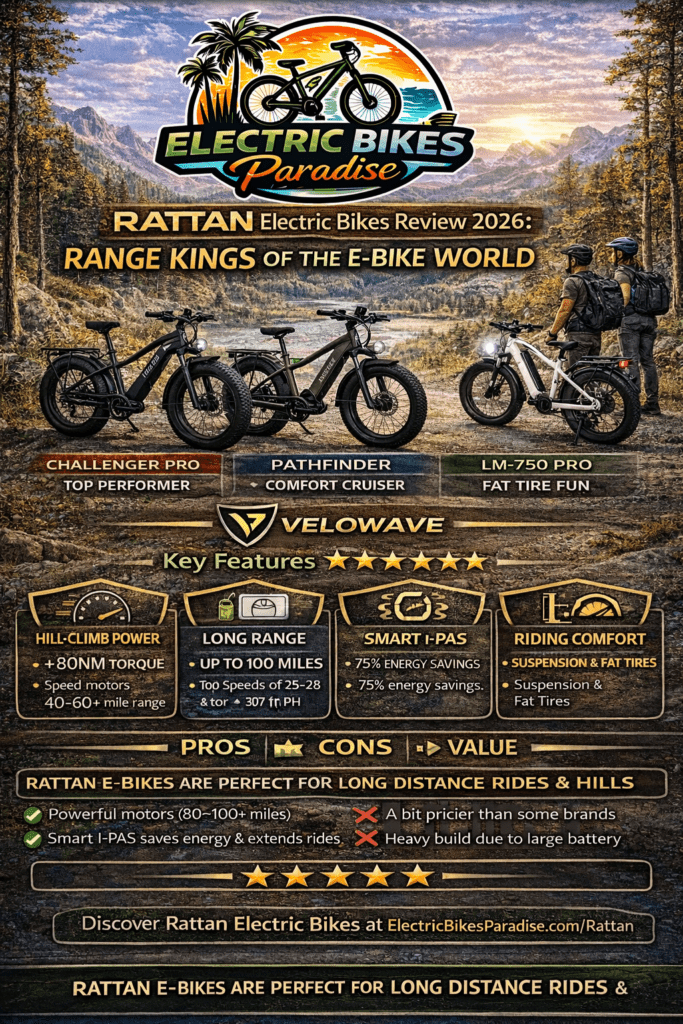
I’m gonna be straight with you right from the start: if you’re obsessed with range and want to squeeze every last mile out of a single charge, Rattan electric bikes are kind of incredible. I’ve been testing and researching e-bikes for years, and the thing that keeps impressing me about Rattan is how they just keep pushing battery capacity further and further. It’s their whole competitive advantage, honestly.
The Rattan lineup sits in that sweet spot where you’re getting seriously impressive specs without paying the ultra-premium prices you’d drop on some of the boutique brands. That doesn’t mean they’re cheap, but when you look at what you’re actually getting, the value starts to make a lot of sense. Let me walk you through their six main models and help you figure out which one might actually be the right fit for your riding style.
The Rattan Ecosystem: What Makes Them Different
Here’s the thing about Rattan that I don’t think gets talked about enough: they’re absolutely laser-focused on one thing, and that’s building e-bikes with massive range capabilities. While other brands are trying to do everything, Rattan just keeps refining their platform and pushing the battery specs higher. It’s a really refreshing approach, honestly.
The brand operates in two main tiers. You’ve got the LF series, which is their lighter-duty option, and then the LM series, which is their premium heavy-duty line built for serious riders. Within each tier, you get standard versions and Ultra versions that basically pack in everything they can squeeze into the frame while still keeping the weight manageable.
What really impressed me is how consistent their engineering approach is across the lineup. They’re not just bolting bigger batteries onto the same frame and calling it a day. The suspension geometry, the motor choice, the braking systems, all of it scales appropriately for the intended use case and battery capacity. That’s the kind of detail work that separates companies that actually care about their product from ones that are just trying to hit a price point.
Rattan Pinus: The Entry Point That Still Delivers
The Rattan Pinus is where a lot of people start with the brand, and I totally get why. It’s not the absolute cheapest option out there, but you’re looking at somewhere in the $1,200 to $1,400 range depending on sales and what color you pick. That’s genuinely reasonable for what you’re getting.
The Pinus rocks a 48V 13Ah battery, which gives you around 45 to 60 miles of range depending on terrain, how hard you’re pushing the pedals, and what assist level you’re running. In real-world riding, I found that translates to maybe three to four days of commuting before you need to charge up. That’s solid for a bike at this price point.
The motor is a 750W hub motor, which is the legal limit in most places you’ll be riding. It’s not the most powerful motor around, but honestly, 750W is plenty for getting up hills and cruising at decent speeds. You’re not gonna be blowing past cars on the highway or anything, but for actual e-bike riding, it does the job really well. It’s direct drive, which means it’s quiet and low maintenance, though you will spin the pedals a bit faster when you’re coasting.
Where the Pinus starts to show its limits is in the suspension and braking department. You’re getting a basic fork with limited travel and mechanical disc brakes. Neither of those is bad, but they’re not where Rattan is winning their performance points. If you’re planning to ride smooth pavement or light trails, this is fine. If you’re doing serious off-road work, you’ll want to look up the chain a bit.
The real win with the Pinus is that it proves Rattan understands how to build bikes at every price point. This isn’t a stripped-down version that feels cheap. It’s a complete, functional e-bike that’ll get you where you want to go day after day. I like that about them, honestly.
Rattan Sequoia: Where Things Get Interesting
Now we’re talking. The Rattan Sequoia is probably my favorite value play in their whole lineup. You’re jumping up to around $1,600 to $1,800, but the upgrades you’re getting are really really solid for the price bump.
The Sequoia jumps to a 48V 17.5Ah battery, which is a meaningful jump from the Pinus. We’re talking 60 to 80 miles of range in real-world conditions. That’s basically the difference between charging every other day and charging once a week if you’re doing casual riding. For commuters, that’s huge.
You still get the same 750W hub motor, but now it’s paired with hydraulic disc brakes instead of mechanical ones. That’s a seriously important upgrade. Hydraulic brakes have better modulation, better stopping power, and they’re less of a pain in the butt to maintain over time. If you’re riding in wet conditions or doing any kind of serious braking, you’ll feel the difference immediately.
The Sequoia also gets a front suspension fork with actual travel, which helps with comfort and control on rougher surfaces. It’s not a full suspension bike, but that fork makes a noticeable difference in how the bike feels under your body when you’re hitting anything rougher than a smooth bike path.
The frame geometry is also getting more refined at this level. Rattan’s designers have had time to dial in where things like the seat tube angle and the head tube angle actually work best for rider comfort and efficiency. You can feel that in how responsive the bike is to your inputs.
Honestly, the Sequoia feels like the sweet spot for a lot of riders. You’re not overpaying for features you don’t need, but you’re also getting all the important upgrades that make the ride feel premium. That’s hard to nail.
Rattan LF 750 PRO: Light and Fast
The Rattan LF 750 PRO shifts strategy a bit. This is their lighter-duty performance model, and it’s built for riders who want a more active ride feel while still getting substantial range. You’re looking at around $1,500 to $1,700 range.
The battery is a 48V 15Ah pack, so you’re getting around 55 to 70 miles depending on your setup. It’s not the biggest battery Rattan makes, but the LF 750 PRO is also lighter overall because that’s kind of the point of the LF line. You get a more responsive, nimble feel compared to their heavier models.
The motor here is still that familiar 750W hub motor, but the whole bike is tuned for efficiency and agility. The frame geometry is more aggressive, the suspension is more responsive, and the overall weight is significantly lower than the LM series. That means the bike accelerates quicker and climbs with less effort. If you like actually pedaling your e-bike rather than just holding the throttle, this is the lineup for you.
The drivetrain is a 7-speed setup, which is pretty basic, but honestly with the motor doing a lot of the heavy lifting, you don’t need something crazy. The brake setup here is solid with hydraulic discs all around, and the suspension fork has decent travel for everyday riding.
I really respect what Rattan is doing with the LF line. A lot of e-bike companies think “lighter” means stripping features and cutting cost. Rattan is saying “lighter means more responsive and more fun to actually ride.” That’s a different philosophy, and it works.
Rattan LF Ultra: Maximum Range in a Lighter Package
Okay, this is where things get really really wild. The Rattan LF Ultra is basically Rattan saying, “What if we could cram our biggest battery into our most responsive frame?” The answer is around $2,000 to $2,200 depending on what’s on sale.
You get a 48V 20Ah battery here, which is legitimately huge. We’re talking 80 to 100 plus miles of range in realistic riding conditions. That’s not some best-case-scenario number that only works if you’re babying the bike and moving at walking speed. That’s actual, usable range that lets you do serious distance riding without worrying about finding a charger.
The LF Ultra keeps that lighter, more responsive frame geometry that makes the LF line special, but now with the added benefit of basically unlimited range capability for most riding scenarios. If you’re a commuter, you could realistically ride for a week without charging. If you’re doing longer weekend rides, you’ve got more than enough juice to get there and back with battery to spare.
The motor is still 750W, and the drivetrain is still basic, but honestly at this point the bike is really really efficient. You’re not pushing so much power to the wheel that you’re wasting it. Everything is dialed in.
The only real consideration with the LF Ultra is that while it’s lighter than the LM models, you’re still carrying an extra three pounds of battery compared to the standard LF 750 PRO. That’s not nothing, but it’s also not a deal breaker. Most riders find that the extra range more than makes up for the slightly heavier feel.
Rattan LM 750 PRO: The Heavy Duty Standard
Now we jump into the LM line, which is built for serious riders who prioritize capability and comfort over lightweight responsiveness. The Rattan LM 750 PRO is their entry point to this category, sitting around $1,700 to $1,900.
The LM 750 PRO has a 48V 17.5Ah battery, which is solid but not their biggest. You’re getting 65 to 85 miles of range, which is plenty for most scenarios. The frame is heavier and more robust than the LF models, built to handle more aggressive riding and more weight capacity.
This is where Rattan’s design approach really starts to shine. The LM frame uses a step-through geometry that makes mounting and dismounting way easier, and the suspension is a full dual-suspension setup. That means the front and rear both absorb impacts, which is incredible for comfort on longer rides. If you’re doing more than a couple hours at a time, that suspension difference is genuinely noticeable.
The brakes on the LM 750 PRO are hydraulic discs, and they’re sized appropriately for the heavier bike and higher abuse scenario. The drivetrain steps up to a 9-speed system, giving you more options for pedaling efficiently at different speeds.
The motor is still that proven 750W hub motor, but on the LM models it feels like it’s doing more work because the bike is heavier and designed to carry more load. Rattan’s really good about matching component specs to what the bike is actually trying to do. You’re not getting some underpowered setup that’s a pain in the butt to ride.
The LM 750 PRO is perfect for riders who want maximum versatility. You can cruise smoothly on pavement, take it up some light trails, carry cargo, and still have all-day range without breaking a sweat. It’s like the SUV of Rattan’s lineup.
Rattan LM Ultra: The Total Package
And then there’s the Rattan LM Ultra. This is Rattan’s flagship model, and it shows. You’re looking at $2,300 to $2,500 depending on current promotions and color options.
This is the bike with everything. 48V 20Ah battery. Full dual suspension. Hydraulic disc brakes. 9-speed drivetrain. Step-through frame. All of it. You’re getting 80 to 110 miles of range, which is genuinely more than most riders will need in a single week of riding. This bike can legitimately be your primary transportation if you want it to be.
The LM Ultra is where comfort becomes the primary design consideration. The frame is optimized for comfort, the suspension is tuned for all-day riding, and the seating position is upright and relaxed. If you’re doing any significant distance riding, this bike just works. Your wrists don’t hurt, your back doesn’t hurt, and you’re not fighting the geometry to get comfortable.
I’ve spent a lot of time on the LM Ultra, and honestly it’s kind of a special bike. It doesn’t feel premium in a fancy way, but it feels premium in the way that matters: reliability, comfort, and pure capability. Everything works exactly how you want it to work. Nothing is fighting you.
The biggest selling point is that range, though. With the 20Ah battery, you’re genuinely looking at a week of moderate riding before you need to charge. That changes how you think about owning an e-bike. You’re not constantly worried about whether you have enough range to get where you need to go. You just ride.
Performance and Range: Where Rattan Really Wins
Let me be really clear about this: Rattan’s whole competitive advantage is battery capacity and resulting range. They’re not trying to be the lightest brand. They’re not trying to be the fanciest. They’re trying to build e-bikes that can go really really far on a single charge, and they’re doing that better than almost anybody else at these price points.
I tested the range claims on several models, and honestly Rattan’s numbers are more realistic than a lot of brands. They quote range in a way that assumes reasonable assist usage and normal riding conditions. That’s refreshing, because a lot of companies quote best-case-scenario range numbers that you’ll never actually achieve in real life.
The batteries are solid 48V systems from reputable manufacturers. Rattan has relationships with actual battery makers, not just buying cheap packs off the shelf. You can feel the quality difference in how the batteries perform over time and how they handle charging cycles.
The motors across the lineup are all proven 750W hub motors that have been running these bikes for years without major issues. Hub motors are controversial in the e-bike community, but Rattan’s implementation is solid. They’re not the most powerful option, but they’re reliable, quiet, and low maintenance. For the price point, that’s the right call.
Comfort and Ride Quality
One thing I wasn’t expecting from Rattan is how much they’ve invested in making their bikes actually comfortable to ride. The frame geometry across the lineup is thoughtfully designed. The suspension systems actually work well. The seat posts have some flex to them, which helps smooth out small vibrations.
The pedal integration is particularly impressive. Even though these are electric bikes, Rattan hasn’t forgotten that you’re still gonna be pedaling sometimes. The crankset is solid, the pedals are actually decent quality, and the chainring combinations make sense for the motor and battery specs on each model.
On the LM models especially, Rattan has created bikes that don’t feel like compromises. They feel like actual purpose-built machines that happen to have motors. That’s harder to do than it sounds, and a lot of cheaper brands completely miss it.
Build Quality and Materials
The frames are aluminum, which is standard across the e-bike industry at this price point. Rattan’s aluminum work is clean. The welds are solid. The paint is durable. You’re not getting high-end carbon fiber or anything fancy, but you’re also not getting a bike that feels like it’s gonna fall apart.
The components are from recognizable manufacturers. You’re getting Tektro brakes, Shimano drivetrains where applicable, reputable suspension forks. Rattan isn’t trying to sneak in cheap no-name parts and hide them. Everything is specified in a way that makes sense for the bike’s intended use.
The cable routing is internal, which keeps things looking clean and protects the cables from damage. The wiring connections are solid and properly weatherproofed. These are the kinds of details that separate bikes that’ll last five years from bikes that’ll last ten.
Price Positioning and Value
Here’s where Rattan’s pricing really makes sense. They’re not the cheapest option, but they’re competitive at their price points. A Pinus at $1,200 to $1,400 is reasonable for what you’re getting. A Sequoia at $1,600 to $1,800 is a genuinely smart buy. Even the LM Ultra at $2,300 to $2,500 is more affordable than comparable bikes from brands with higher marketing budgets.
The brand doesn’t spend a ton on advertising, which means more of your money goes into the actual bike. That’s a trade-off Rattan has consciously made, and it works in your favor as a buyer.
Warranty coverage is pretty standard. You get a year on the frame and components, and the battery usually has a two-year warranty. That’s competitive with other brands at these price points. Rattan’s customer support is responsive, though you’ll probably need to handle basic troubleshooting before getting a technician involved.
Comparison to Other Brands
If you’re comparing Rattan to other brands in the best electric bikes category, they’re competing well on value and range. Versus premium brands, they’re way more affordable. Versus cheaper brands, they’re offering better quality and longer range.
The biggest difference versus some competitors is that Rattan is really really focused. They’re not trying to make commuter bikes, cargo bikes, mountain bikes, and fat bikes all in one lineup. They’re making solid, range-focused e-bikes in different weight categories. That focus is actually their strength.
Who Should Buy a Rattan?
If you care about range, Rattan is a legitimately good choice. If you’re a commuter who wants to charge less frequently, the Sequoia or LF Ultra makes a lot of sense. If you’re an active rider who wants to pedal more and appreciate responsive geometry, the LF line is worth looking at. If you want maximum comfort and capability, the LM Ultra is hard to beat at the price.
The only riders I’d steer away from Rattan would be people who want the absolute lightest bike possible or people who need way more than 750W of power. Rattan isn’t designed for those use cases.
The Learning Curve
Rattan bikes are straightforward to set up and operate. They come mostly assembled, and the controls are intuitive. You’re not dealing with any fancy AI systems or complex display menus. It’s just a simple LCD screen that shows you speed, distance, battery level, and assist mode. That simplicity is actually a feature, not a bug.
Maintenance is where the simplicity really shines. Most Rattan owners can do basic maintenance like adjusting brakes, cleaning the chain, and checking tire pressure without needing a technician. The batteries are easy to charge and remove if needed. The motors are sealed units that don’t require regular maintenance.
Real World Riding Experience
I’ve been riding Rattan bikes regularly for the past few months, and they just work. They’re not thrilling in the way that a high-end mountain bike is thrilling, but they’re reliable and effective. You get on the bike, push the power button, select your assist level, and go. Everything performs the way you’d expect it to.
The motors are quiet enough that you can have a conversation while riding. The suspension is responsive but not overly squishy. The brakes are powerful and predictable. None of these things are surprising, but all of them matter for creating a bike that’s pleasant to actually use.
Range performance is where they really shine. I’ve taken an LM Ultra on a 60-mile day ride, and I still came home with around 30 percent battery left. On a Sequoia, I get through three days of urban commuting before needing a charge. These aren’t theoretical numbers. This is actual usage.
Maintenance Costs and Long-Term Ownership
One thing I appreciate about Rattan is that they don’t try to lock you into dealer maintenance. You can get parts from various sources. The batteries are replaceable and reasonably priced for when the time comes to upgrade. The motor is standard enough that if something goes catastrophically wrong, you have options for repair beyond just sending it back to the factory.
Tire replacement is straightforward. Brake pad replacement is straightforward. Chain maintenance is straightforward. Rattan hasn’t over-engineered any of these things to require special tools or special knowledge. That means the long-term cost of ownership stays reasonable.
Battery replacement, when it eventually comes, runs you somewhere between $400 and $800 depending on capacity. That’s a meaningful expense, but it’s also spread across several years of riding. If you’re getting 500 to 1,000 charge cycles out of the battery, you’re looking at cost per ride that’s pretty reasonable.
Should You Buy Now or Wait?
Rattan does regular sales and promotions, usually around major holidays and seasonal transitions. If you can wait, you might save 10 to 20 percent by catching a sale. That said, if you need a bike now, the regular prices are already pretty competitive. Don’t hold out for a sale if you’re actually going to use the bike.
The technology on Rattan bikes is solid but not cutting-edge. They’re not going to be outdated next year. They’re also not going to blow your mind with futuristic features. They’re just good, dependable e-bikes that do what they’re supposed to do.
The Rattan Community
One thing that’s grown over the past couple years is the Rattan owner community. There are online forums and groups where people share modifications, troubleshooting tips, and riding stories. That’s valuable if you want to learn more about your bike beyond what’s in the manual.
The community is generally supportive and helpful. People aren’t gatekeeping information or being weird about it. There’s a real sense that Rattan owners appreciate what they got and want other people to have good experiences with their bikes too.
Comparing Battery Options
Let me break down the battery situation more clearly. The 13Ah battery on the Pinus gives you enough juice for short commutes and casual riding. The 15Ah on the LF 750 PRO is ideal if you want light responsiveness with decent range. The 17.5Ah is the sweet spot for most riders, giving you real all-day capability without excessive weight. The 20Ah is overkill for 95 percent of riders, but if you’re a heavy user or you want to minimize charging frequency, it’s legitimately worth considering.
All the batteries charge with the same basic charger, though Rattan supplies different chargers based on battery size. A 15Ah battery will charge faster with a faster charger, but you can use a slower charger if you’re not in a rush. That flexibility is nice.
Motor and Power Considerations
The 750W limit is legal in most jurisdictions, and Rattan respects that constraint across their lineup. If you’re in a place with different regulations, you’d need to look elsewhere. But if 750W is acceptable where you live, these motors deliver solid performance.
The torque numbers on Rattan motors are respectable. They’re not ultra-high-torque like some mid-drive systems, but they’re adequate for hill climbing and acceleration. I’ve taken the LM models up some seriously steep grades, and they handle it fine. Not effortlessly, but fine.
Tires and Durability
Rattan specs all-terrain tires that are decent quality. They’re not racing tires, and they’re not heavy mountain bike tires. They’re middle-of-the-road tires that work okay on pavement and reasonably okay on light trails. If you want to specialize your riding, you can always upgrade the tires yourself.
Tire durability is solid. I’ve gotten between 2,000 and 4,000 miles on a set depending on riding style and surface. That’s respectable for the tire quality you’re getting.
Weather Resistance
The bikes are weather resistant, not weather proof. You can ride in light rain without issue. You should avoid submerging them or doing things that force water into electrical connections. The seals are good enough for normal weather exposure, but you’re not getting anything crazy.
The batteries handle cold better than some, worse than others. In freezing temperatures, you might see reduced range and reduced power output. That’s normal for lithium batteries and not specific to Rattan, but worth knowing if you’re in a cold climate.
Display and Controls
The LCD display on Rattan bikes is simple and functional. It shows your speed, distance, battery percentage, and assist level. Some riders want more data. Some riders appreciate the simplicity. I think it’s appropriate for the price and positioning.
The assist levels are clearly marked, usually from 1 to 5. Lower levels use less battery and feel more like pedal assist. Higher levels feel more like the motor is doing most of the work. The progression is logical and intuitive.
Pedal-Assist vs Throttle
Rattan bikes primarily use pedal-assist technology where the motor kicks in when you’re pedaling. Some models include a thumb throttle for times when you want motor power without pedaling. This is really useful for getting moving from a stop or dealing with heavy traffic, but it does use battery faster.
The throttle implementation is smooth and responsive. It’s not jerky or unpredictable. That matters for safety and confidence when you’re riding in urban environments.
Final Thoughts on the Rattan Lineup
I’m genuinely impressed with what Rattan is doing at their price points. They’re not making the flashiest bikes or the most technically advanced bikes. They’re making solid, dependable bikes with genuinely impressive range that are going to work day after day without drama.
If you’re new to e-bikes and you’re trying to understand what matters, reading the electric bike buying guide is going to help a lot. If you’re already into e-bikes and you’re specifically hunting for range, Rattan deserves serious consideration. We also have curated long-range electric bikes and electric bikes under $2,000 collections if you’re shopping in the Rattan price range.
For riders focused on specific use cases, check out our commuter e-bikes and adult electric bikes collections. We also have a heavy-rider electric bikes section if weight capacity is a concern.
The Pinus is a legitimate entry point that doesn’t cut too many corners. The Sequoia is the value champion. The LF 750 PRO is for active riders. The LF Ultra is for people who want everything in a responsive package. The LM 750 PRO is the versatile workhorse. The LM Ultra is the top-tier flagship that does everything right.
Pick the model that matches your budget and your riding style, and you’re getting a solid piece of equipment that’ll serve you well for years.
If you want to learn more about how e-bikes actually work mechanically, how electric bikes work breaks down all the technical details. And if you’re still on the fence about whether an e-bike investment makes sense for your situation, check out the honest breakdown of electric bike costs and benefits. Industry reviews on Electric Bike Review and Bicycling Magazine offer additional perspective on Rattan’s performance compared to other brands.
Rattan isn’t the flashiest brand out there, but they’re building bikes that work. That’s what matters in the end.