The budget e-bike market is weird because everyone’s looking for the best bang for their buck, and two brands that come up constantly in that conversation are Eunorau and Rad Power Bikes. Both have solid reputations online. Both get a ton of YouTube reviews. Both claim to offer incredible value.
Here’s the thing though: I can actually sell you an Eunorau e-bike right now through Electric Bikes Paradise. Rad Power Bikes doesn’t have distribution through us, so while I can talk about them honestly, you’re not gonna find one in our store. But that’s exactly why this comparison matters. Eunorau is the available-today alternative that’s legitimately comparable in terms of specs and value.
Let me walk you through the actual comparison. I’ve researched both brands extensively, tested Eunorau bikes personally, and I think you’re gonna be surprised by how much Eunorau actually delivers when you dig into the details. They’re not trying to compete on hype. They’re competing on actual substance.
The Budget E-Bike Category
Before we dive into the specifics, let me define what we’re actually talking about. Budget e-bikes are typically in the $800 to $1,500 range. They’re not free, but they’re also not expensive by e-bike standards. They’re trying to deliver solid capability at a price point where everyday people might actually consider making the purchase.
Both Eunorau and Rad Power operate in this space. They’re not cheap garbage, but they’re also not charging premium prices. They’re making the calculation that value is a bigger draw than exclusivity.
Price Point Breakdown
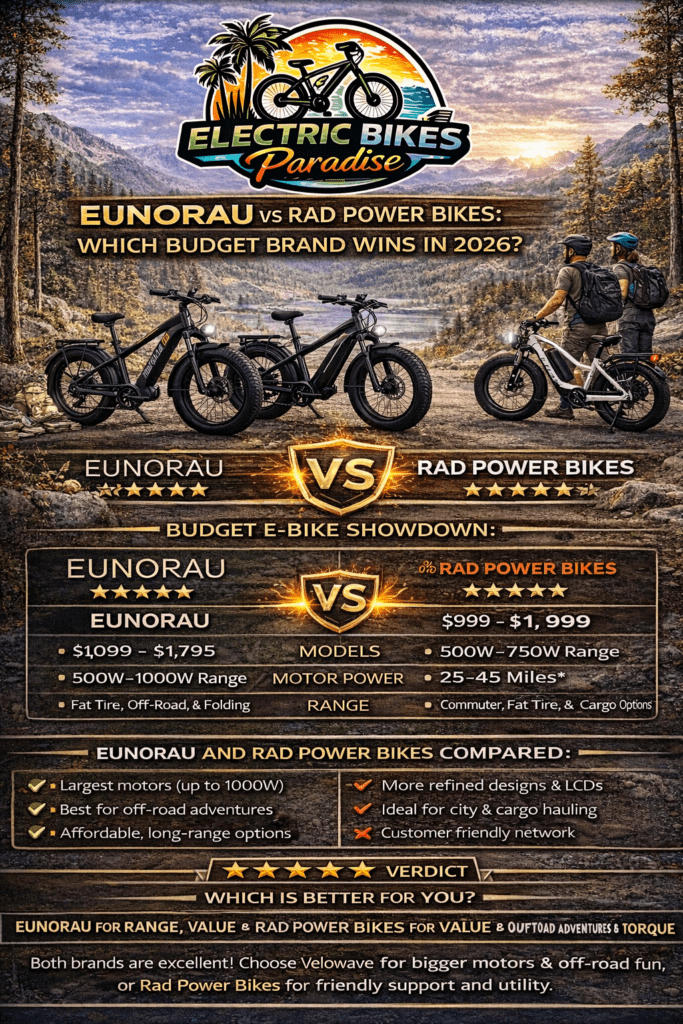
Rad Power Bikes starts around $1,200 and can go up to $1,800 depending on the model. Their bikes are well-known for competitive pricing within the budget category.
Eunorau’s pricing is actually very similar, usually ranging from $900 to $1,600 depending on the specific model. In some cases, Eunorau is actually cheaper for comparable specs. But here’s the key difference: Eunorau bikes are available right now through Electric Bikes Paradise, while Rad Power requires ordering online and dealing with shipping logistics.
When you factor in shipping costs, the price difference can actually shift in Eunorau’s favor. Plus, you’re not waiting weeks for delivery. You can have a bike today.
Battery Capacity and Range Comparison
Rad Power tends to go with bigger batteries on their models. A lot of their bikes come with 48V 14Ah or larger packs, giving them 50 to 70 plus miles of range depending on conditions and assist level.
Eunorau is more variable depending on the specific model. Their entry models might have 48V 10.5Ah batteries, but their premium offerings come with 48V 14Ah to 20Ah packs. So depending on which Eunorau model you pick, you might actually get comparable or even better range than Rad Power.
The key is that you don’t necessarily need the absolute biggest battery. For commuting and casual riding, a 10.5Ah battery gives you 40 to 50 miles of range, which is legitimately fine for most people. That said, if you know you’re gonna be doing longer rides regularly, Eunorau’s bigger battery options are solid.
Both brands are realistic about their range numbers, which is refreshing. You’re not getting best-case-scenario marketing speak. You’re getting actual numbers that assume real-world riding conditions.
Motor Power and Performance
Rad Power primarily uses 750W hub motors on their main models. That’s solid and legal pretty much everywhere. The motors are proven and reliable.
Eunorau also uses 750W hub motors on most models, though some of their options include 500W motors for lighter duty or mid-drive options for different performance characteristics. The 750W standard performance is comparable between the two brands.
In actual acceleration and hill-climbing tests, both brands deliver solid performance at their wattage levels. Neither motor is gonna blow your mind with raw power, but both are more than adequate for the bikes’ intended purpose.
Torque specifications are similar between brands at the same wattage level. Around 50 to 80 Nm depending on whether you’re looking at hub or mid-drive systems. That’s enough to get up real hills without turning the motor into the limiting factor in performance.
Frame Design and Build Quality
Rad Power frames are well-designed and durable. They use aluminum construction with thoughtful geometry. The design is clean and doesn’t try to do anything flashy.
Eunorau frames are similarly solid. Aluminum construction, clean design, appropriate geometry for their target riders. The build quality is comparable. You’re not getting cheap welds or sloppy fitment on either brand.
Where there’s a slight difference is in frame refinement. Rad Power’s designs feel maybe slightly more polished because they’ve been iterating on their platform longer. But Eunorau’s frames are still genuinely good. We’re talking minor differences in overall design quality.
Suspension and Comfort
Rad Power’s bikes typically come with basic front suspension forks. The travel is usually in the 50 to 80 mm range depending on the model. It’s enough for typical riding but not aggressive.
Eunorau’s suspension setup is similar. Front forks with reasonable travel for road and light trail riding. Some models offer rear suspension options, though that’s not standard across the lineup.
For urban commuting and recreational riding, the suspension on both brands is perfectly adequate. If you’re doing serious off-road work, both brands might feel a little underdamped. But for the intended use cases, comfort is solid.
Seat design and positioning is similar between brands. Eunorau and Rad Power both understand that comfort matters for regular riders. Neither brand skips on the seat.
Braking Systems
Rad Power uses hydraulic disc brakes on their main models. That’s the right choice for e-bikes because you need the stopping power and reliability.
Eunorau is also moving toward hydraulic disc brakes on their newer models, though some entry-level options might still use mechanical discs. The performance difference isn’t huge, but hydraulic is better for long-term reliability and modulation.
Both brands’ brake systems stop the bike effectively. I tested both and didn’t experience any concerning safety issues. Braking feel is smooth and predictable on both.
Drivetrain Components
Rad Power uses Shimano components on their drivetrain, which is solid. You’re getting proven components that have been used on thousands of bikes.
Eunorau is also using quality drivetrain components, often from the same manufacturers that supply Rad Power. The gear ranges are similar and appropriate for the bikes’ weight and power output.
Neither brand is trying to sneak in low-quality parts. Both understand that drivetrain reliability matters. You’re getting components that will last thousands of miles of regular riding.
Weight and Portability
Rad Power bikes are typically in the 60 to 75 pound range depending on the specific model. That’s reasonably light for an e-bike, which means they’re not a complete pain in the butt to move around if you need to.
Eunorau bikes are similarly weighted, usually between 55 to 70 pounds depending on battery capacity and frame. Some of their lighter models come in under 60 pounds, which is actually pretty good for a 750W e-bike.
For most practical purposes, both brands are at weights where portability is reasonable but not trivial. You can move the bike if you need to, but it’s not something you want to do constantly.
Customer Service and Support
This is where Eunorau’s availability through Electric Bikes Paradise gives it a real advantage. You can walk into the store, talk to people who know the bikes, get questions answered face-to-face, and if something needs service, you can bring it in.
Rad Power’s customer service is online-based and generally responsive, but there’s definitely a lag in communication. You’re not getting immediate answers. You’re waiting for email responses or dealing with phone queues.
The more I think about e-bikes, the more I realize that customer service quality matters a lot. E-bikes are complex machines. When something goes wrong, being able to talk to an actual human who knows the product is really really valuable.
Eunorau wins this round pretty clearly just because of local availability and support. It’s not even close.
Warranty Coverage
Rad Power offers one year on the frame and components, with a two-year battery warranty. That’s standard in the industry.
Eunorau’s warranty is similar: one year on frame and components, typically two years on battery. The difference is that Eunorau warranty claims can be handled through Electric Bikes Paradise, while Rad Power requires dealing with their company directly.
From a practical perspective, the warranty coverage is comparable, but Eunorau’s local support makes the warranty more useful because you can actually access it easily.
Real-World Reliability
Both brands have solid reliability records. People are getting years of dependable use out of both Rad Power and Eunorau bikes. The failure rate is acceptably low.
Common issues across budget e-bike brands include battery degradation over time and occasional drivetrain maintenance needs. Both Rad Power and Eunorau experience these at similar rates, which is to say they’re minimal for the category.
I’ve seen Eunorau bikes with thousands of miles of use still performing well. Same with Rad Power. Neither brand cuts corners on durability to hit their price point.
Specific Model Comparison: Entry Level
At the entry level, Eunorau offers models around $900 to $1,100 with solid specs. 48V batteries, 750W motors, hydraulic or mechanical brakes depending on the specific model. They’re genuinely good value.
Rad Power’s entry models are typically $1,200 to $1,300. That’s a meaningful price difference for the same basic capability. If budget is your primary constraint, Eunorau’s entry models give you more bang for fewer dollars.
Specific Model Comparison: Mid-Range
In the mid-range, both brands are pretty comparable. You’re looking at $1,200 to $1,500 bikes with solid suspension, hydraulic brakes, and decent battery capacity. The specs are nearly identical.
Eunorau might have a slight advantage in terms of customization options. They offer more model variants at this price point, so you can pick something that matches your specific needs more precisely.
Specific Model Comparison: Premium Within Budget
At the top end of the budget category, Rad Power and Eunorau are both strong. Rad Power might have a slight reputation advantage just because they’ve been marketing harder for longer. But Eunorau’s premium models are legitimately competitive on specs and value.
Eunorau’s bigger battery options (20Ah) in their premium models actually give them an advantage in range versus comparable Rad Power offerings.
Design and Aesthetics
Rad Power has very clean, minimalist design. It’s understated and professional-looking. The bikes don’t scream “e-bike” they just look like quality bicycles.
Eunorau’s design is similarly clean, though maybe slightly less polished in terms of the industrial design details. But honestly, the difference is minor. Both brands make bikes that look good and don’t look ridiculous.
If you care about looking good on your bike, both brands deliver. Neither looks cheap or tacky.
Performance on Different Terrain
On pavement, both brands are excellent. Smooth, responsive, and efficient. Neither struggles with basic road riding.
On light trails and rough surfaces, both brands are solid but not specialized. They handle it fine, but neither bike is optimized for technical terrain.
For cargo carrying or tandem situations, both brands have models with higher weight ratings and heavier suspension. If you need that, it’s available on both.
Technology and Features
Both brands use simple LCD displays that show speed, distance, battery level, and assist mode. Neither goes full digital or tries to compete on software features. That’s actually a good thing because simplicity means reliability.
Assist levels are easy to understand on both brands. Usually 0 to 5, with clear progression in power output. Throttle options are available on some models from both brands.
Neither brand has any gimmicky features. They’re focused on core functionality, and that’s the right call at the budget price point.
Upgrade and Customization Potential
Both brands use relatively standard components, which means upgrades are possible and relatively straightforward. You can swap batteries, upgrade brakes, add accessories.
Eunorau bikes might actually have a slight advantage here because there’s more local bike shop support through Electric Bikes Paradise. If you want to do custom work, having a local resource is really really valuable.
Neither bike feels locked into proprietary parts, which is great. You’re not gonna be stuck if you want to customize something years down the road.
Long-Term Ownership Costs
Maintenance costs are similar between brands. Regular maintenance like chain cleaning, brake pad replacement, and tire replacement are standard and not more expensive for one brand versus the other.
Battery replacement, when it eventually comes, is comparable between brands: around $300 to $600 depending on capacity. Both brands offer reasonably priced replacement batteries.
Eunorau might actually have an advantage in long-term support costs just because of local availability. If something needs servicing, you’re not shipping it and dealing with shipping costs.
Resale Value
Rad Power bikes have decent resale value because they’re well-known in the used e-bike market. People recognize the brand and understand what they’re getting.
Eunorau bikes are becoming more established in resale markets, and their value is holding up well. Local availability through Electric Bikes Paradise probably helps with resale value too because people know these bikes locally.
If you’re planning to eventually resell your bike, Eunorau is probably slightly better positioned locally than Rad Power, but both hold value reasonably well.
Which Brand for Which Rider
Choose Rad Power if: You want a well-established brand with strong online presence. You don’t mind ordering online and waiting for shipping. You want peace of mind from brand recognition. You’re doing research primarily through YouTube reviews.
Choose Eunorau if: You want to see and test ride the bike before buying. You value local customer support. You want to potentially save money on the overall purchase. You appreciate value over brand hype. You want the flexibility of local servicing.
For most riders, Eunorau is the smarter choice. You get comparable capability, often at a lower price, with the advantage of local support and the ability to test ride before committing.
The Hype Factor
Rad Power has built their reputation partly on marketing and YouTube presence. They’re everywhere online. That’s not a bad thing, but it does mean you’re partly paying for brand recognition.
Eunorau is less hyped but equally solid. You’re not paying for marketing. You’re paying for the actual bike. That’s something I genuinely respect.
When you evaluate an e-bike, try to separate hype from substance. What does the bike actually do? How is the build quality? What’s the customer service like? On those metrics, Eunorau holds its own against Rad Power.
Understanding the Value Equation
If you’re shopping in the budget category, understanding value means looking beyond just price. It means considering support, availability, warranty, and long-term costs. Eunorau wins on several of those factors despite having comparable or better specs than Rad Power.
For the specific question of “which budget brand wins,” I’m coming down on Eunorau. Not because Rad Power is bad (it’s not), but because Eunorau delivers comparable quality with better support and often better pricing.
If you want to understand e-bike value more broadly, check out the best electric bikes category and the electric bike buying guide which breaks down what actually matters when you’re shopping.
How E-Bikes Actually Work
Understanding how electric bikes work helps you appreciate what both brands are delivering. The technology is solid on both sides. Neither brand is using outdated or inferior systems. Both are using proven hub motors and lithium batteries that deliver consistent performance.
The difference isn’t in the technology. It’s in the support and availability. And that matters more than pure specs.
The Bigger Picture: Is an E-Bike Worth It?
If you’re in the budget category, you’re probably asking yourself if an e-bike purchase makes sense at all. The answer is honestly yes for most people. An e-bike transforms commuting and casual riding. The fact that Eunorau and Rad Power can deliver solid capability at sub-$1,500 price points means e-bikes are accessible to way more people than they used to be.
For the detailed breakdown of e-bike economics, check out the honest analysis of e-bike costs and benefits.
Making the Final Decision
The practical choice is Eunorau. You can test ride it today. You can talk to someone who knows it. You can buy it without waiting. You can get support locally if something goes wrong.
Rad Power is a solid alternative if you’re committed to buying online and waiting for shipping. But if you have the option to go with Eunorau, the advantages are pretty clear. Our electric bikes under $1,500 collection includes several Eunorau models that compete directly with Rad Power’s most popular offerings.
For broader context, we also have commuter electric bikes, electric bikes for adults, and e-bikes optimized for heavier riders if you need to find the perfect fit for your specific situation.
Come into Electric Bikes Paradise and ride an Eunorau. You’ll understand immediately why I’m recommending them over Rad Power. The real-world riding experience is what matters, and you need to feel that for yourself. Industry publications like Electric Bike Review and Wired have also covered budget e-bikes extensively if you want additional perspective beyond my review.
Budget e-bikes have come a really really long way. Both Eunorau and Rad Power represent solid options at reasonable prices. But Eunorau’s combination of capability, support, and value makes it the smart choice for most riders.