Buying an electric bike is a big investment. You drop anywhere from $1,200 to $5,000 or more on a quality e-bike, and then you’ve gotta figure out where to actually keep the thing. If you’re like most people, you don’t have a dedicated bike room with climate control and a security system. You’ve got an apartment, a garage that’s half full of junk, or a basement that gets damp in the spring. So how do you store your e-bike without watching the battery die or the frame rust?
I’ve been riding and testing electric bikes for years now, and storage is honestly one of the things people ask me about most. It’s not glamorous, but it matters. Where you store your e-bike affects how long it lasts, how safe it stays, and whether you’ll actually want to ride it next season. Let me walk you through everything you need to know.
Why E-Bike Storage Actually Matters
Here’s the thing: an electric bike is more sensitive than a regular bike. You’ve got a battery that can lose capacity if it gets too hot or too cold. You’ve got electrical connections that can corrode if they get wet. You’ve got a motor that’s worth $300 to $800 on its own. Store your e-bike wrong, and you’re not just being careless. You’re literally throwing money away.
The average e-bike battery costs between $400 and $800 to replace. The motor? Another $400 to $1,200. If water gets into the electrical system, you’re looking at damage that’s really really hard to fix. And that’s before we even talk about theft, which is a legitimate concern with expensive bikes.
When you store your e-bike properly, you’re protecting your investment. You’re making sure the battery holds its charge. You’re preventing rust and corrosion. You’re giving yourself the best chance that your e-bike will be ready to ride whenever you want it to be. That’s why I’m going to take the time to explain all your options.
Indoor Storage: The Gold Standard
If you can store your e-bike indoors, do it. Full stop. This is the best option for your bike’s longevity and your peace of mind. Indoor storage protects your e-bike from rain, snow, temperature swings, and potential theft. It also means your bike is right there when you want to ride it.
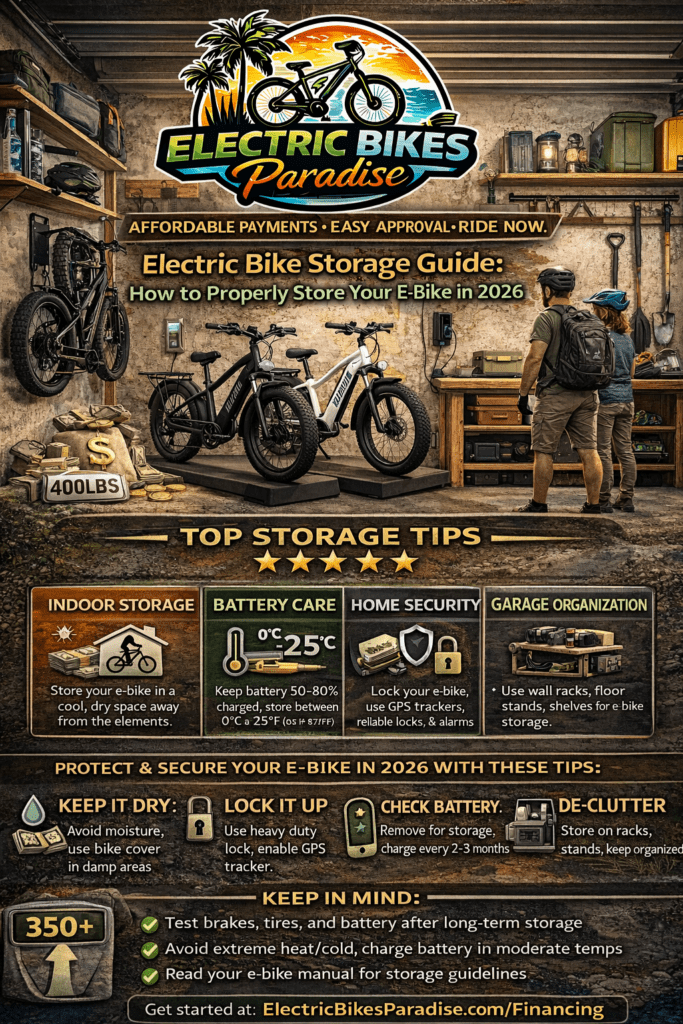
The ideal indoor spot is a basement, garage, or spare closet that stays between 50 and 80 degrees Fahrenheit. You want somewhere dry, away from direct sunlight, and preferably with minimal temperature fluctuations. That’s your sweet spot. Most homes can provide this, and if you can dedicate even a small corner to your e-bike, you’re doing great.
Your garage is probably your best option. Even if it’s attached to your house and gets a little cold in winter, it’s still way better than leaving your bike outside. The key is to keep your e-bike off the ground, away from standing water, and covered if you can manage it. A bike stand or wall mount works perfectly. I recommend a quality bike stand designed for heavier e-bikes, not some flimsy thing meant for a 30-pound road bike.
In an apartment, things get trickier. Space is tight. But here’s what I’d suggest: use a wall mount, a vertical bike rack, or a folding stand in your bedroom, living room, or entryway. Yeah, your e-bike might be visible. That’s actually fine. It looks cool, and you’ll be more likely to ride it if it’s right there in your space instead of locked up in some storage unit somewhere. Cover it with a light cloth if dust bothers you, and you’re good to go.
Battery Storage: The Critical Part
This deserves its own section because it’s really really important. Your e-bike battery is the most sensitive component, and if you don’t take care of it, you’re going to have problems. Lithium batteries, which is what most modern e-bikes use, don’t like extreme temperatures. They don’t like being overcharged. They don’t like being fully drained either.
Here’s the best practice: store your battery indoors at room temperature, somewhere between 50 and 77 degrees Fahrenheit. Before you store your bike for an extended period, charge the battery to about 50 to 60 percent capacity. Not full. Not empty. Right in the middle. This is the sweet spot for long-term storage because it reduces stress on the cells.
If you’re storing your e-bike for more than a month, take the battery off and keep it in a cool, dry place inside your home. Check it every month or so and top it up to that 50 to 60 percent range if it’s dropped below it. You can actually remove most modern e-bike batteries. They’re designed to be swappable. Taking five minutes to unplug it and bring it inside is a pain in the butt, but it’s worth it for battery longevity.
Never store your battery in extreme heat or cold. Don’t leave it in your car in summer, your shed in winter, or your garage if you don’t keep that space climate controlled. Temperatures above 95 degrees or below 32 degrees will degrade your battery faster than normal use will. Heat is especially brutal. A battery that gets too hot can lose 10 to 15 percent of its capacity permanently.
Outdoor Storage: It’s Not Ideal, But Here’s How to Do It Right
I get it. Not everyone has indoor space for an e-bike. Some apartments don’t allow bikes in the unit. Some houses don’t have garages. If you absolutely have to store your e-bike outside, you need a really really solid strategy to protect it from the elements and from theft.
First, the theft part. You need a heavy-duty lock, and you need to use it right. Spend at least $100 to $150 on a quality U-lock. Use it to attach your frame and at least one wheel to something immovable. A bike rack bolted to concrete is ideal. A pole or fence post works. Never leave your bike locked to something that can be cut through in five minutes.
Second, you need a bike cover. A good outdoor bike cover costs between $30 and $80, and it protects your e-bike from rain, snow, and UV damage. It won’t completely prevent water from getting in, but it’ll keep most of the moisture away from your motor and battery connectors. Get one that’s specifically designed for e-bikes or at least for larger bikes. Those flimsy covers meant for regular road bikes aren’t going to cut it.
Keep the battery inside whenever possible. If your e-bike has a removable battery, bring it into your apartment or house. This is the single most important thing you can do for outdoor storage. The battery is what’s really expensive and really sensitive. Protecting it should be your top priority. Even if the rest of the bike gets a little weathered, a protected battery can last years longer than one that sits outside in the cold and wet.
Position your bike in a location that gets some air flow but isn’t constantly beaten by wind and rain. An overhang, a covered porch, or the side of a building that’s somewhat protected is way better than leaving your bike in the middle of an exposed parking lot. If you can orient it so the motor and battery connections face away from the direction of prevailing rain, even better.
Winter Storage: Special Considerations
Winter is a challenge for e-bike storage. Cold weather slows down battery chemistry, ice and salt corrode components, and snow can hide your bike from view. If you’re in a cold climate, winter storage needs to be handled differently than summer storage.
If you plan to ride in winter, great. Just make sure you’re checking your battery’s range more frequently, because cold weather cuts range by 20 to 30 percent or even more in really harsh conditions. Store your battery somewhere warm when you’re not riding, and bring it back out when you’re ready to go. This is a pain in the butt, but it keeps your battery healthy.
If you’re not going to ride during winter, the best option is to store your entire e-bike indoors in an unheated space like a garage or shed. Charge the battery to 50 to 60 percent, remove it and bring it inside to your home where it’s climate controlled, and then check on it every month or two. Store the bike with a light coat of lubricant on the chain and drivetrain to protect against rust and corrosion during those cold, damp months.
Never store your e-bike where salt is present. Salt corrodes everything: the frame, the motor, the battery connectors, the cable housing. If you live somewhere that uses road salt in winter and your bike has to be outside, rinse it down regularly with fresh water to remove salt buildup. Better yet, keep it indoors.
Check out the comprehensive buying guide if you’re thinking about winter riding, because certain e-bike designs handle cold weather better than others.
Apartment Storage Solutions
Apartment living is really really common, and apartment storage is one of the biggest barriers people face when considering an e-bike. Here’s what actually works for most people without getting you evicted or taking over your living space completely.
Wall mounts are your friend. A good wall mount designed for heavy bikes costs between $50 and $150, and it takes up almost no floor space. You drill two holes into your wall, hang the mount, and your e-bike stays vertical against the wall. It looks clean, it’s accessible, and it keeps your bike safe. Make sure whatever wall you’re mounting it to is sturdy. You need something that can handle 50 to 80 pounds of bike, which usually means hitting studs in the wall or using some really solid anchors.
Vertical bike racks are another option. These are freestanding or leaning racks that let your bike sit nearly upright against them. They take a little more floor space than a wall mount, but they don’t require any drilling. Prices range from $80 to $200, and they’re simple to set up. They work great in a corner of your bedroom or even in a living room if you don’t mind your e-bike being visible.
Some people use folding e-bikes in apartments. Models like the Velowave Pony fold up take up almost no space. When you fold them up, they’re roughly the size of a large suitcase. You can lean them in a closet or corner. This is a game-changer if you have seriously limited space. The downside is that folding bikes are usually smaller and less comfortable for taller riders, but for short trips around the city, they’re really really practical.
Another option that works is storing your e-bike in a storage unit. If you’re willing to spend $40 to $80 a month for climate-controlled storage, your bike will be protected and out of your living space. Obviously this adds up to $500 to $1,000 a year, which isn’t cheap. But if it means you’ll actually buy and ride an e-bike instead of letting the idea sit in your head forever, it’s worth it.
Security and Theft Prevention
An e-bike is a theft target. They’re expensive. They’re increasingly common, which means more people know what they’re worth. And a good e-bike is mobile, which means a thief can throw it in a truck and be gone in minutes. You need to take security seriously.
If your e-bike is indoors, that’s your main protection right there. A locked door is worth more than any lock on your bike. But if your bike is visible from outside, or if you’re storing it anywhere semi-public, you need something stronger than a cable lock.
Buy a U-lock. Spend the money. A solid U-lock costs between $80 and $150, and it’s way harder to cut through than anything else. Use it to lock your frame to something immovable. If your e-bike has quick-release wheels, either lock both wheels or get wheels with axle skewers so they can’t be removed easily. Some e-bikes have integrated lights, computers, or battery connectors that are also theft targets. Lock those down or remove them when your bike is unattended.
Take a photo of your serial number and store it somewhere safe. Register your bike with your local police department’s bike registry if you have one. If your bike gets stolen, having documentation of ownership makes recovery much more likely. It’s a pain in the butt to do, but it takes ten minutes.
Some people install GPS trackers on their e-bikes. This costs between $30 and $200 depending on the device, and if your bike gets stolen, you can potentially track it down and give the coordinates to police. This is worth considering if you live in an area with high bike theft or if your e-bike cost more than $3,000.
Climate Control and Temperature
Temperature matters more than people think. Your e-bike’s battery and motor don’t like extreme heat or cold. If your storage space temperature swings between 10 degrees in winter and 95 degrees in summer, you’re stressing your components every single day.
Ideally, keep your e-bike somewhere that stays between 50 and 80 degrees Fahrenheit year-round. If your garage gets too cold in winter, insulate it a little better or move your bike to a different space during those months. If your shed gets too hot in summer, maybe you park your car in there instead and keep your e-bike in the garage or a climate-controlled area of your basement.
Humidity is also a factor. Don’t store your e-bike anywhere that’s consistently damp. A basement with standing water after heavy rain is not a good storage location. A dry garage is great. A climate-controlled apartment is ideal. If you have to store your bike somewhere damp, bring the battery inside and consider using a dehumidifier or at least opening windows regularly to improve air circulation.
Maintenance While Stored
Storing your e-bike doesn’t mean you get to completely ignore it for six months. You need to do some basic maintenance to keep it ready to ride when you want it.
Once a month, check the battery charge if it’s stored separately. Top it up to 50 to 60 percent if it’s dropped below that. Once every couple of months, take your e-bike out of storage and spin the wheels to make sure everything still moves smoothly. Charge the battery fully and take a short ride to make sure the motor and brakes are working right.
Before you store your e-bike for winter, give it a good cleaning. Remove dirt and debris from the chain and drivetrain. Apply a light coat of chain lubricant. If you’ve ridden in wet conditions, dry the bike completely. This prevents rust and corrosion while your bike sits idle.
Check the tire pressure occasionally. Tires lose air over time, and if your tires are completely flat when you want to ride again, that’s a pain in the butt. Keep the tires at their recommended pressure, which you’ll find on the sidewall of the tire.
Moving Your E-Bike Between Storage Locations
Sometimes you need to move your e-bike from one storage location to another. Maybe you’re moving to a new apartment. Maybe you’re transitioning from summer storage to winter storage in a different location. Here’s how to do it safely.
If you’re moving your bike in a car, lay it on its side in a cargo area if you can. Secure it so it doesn’t roll or slide. Use padding or blankets to protect the frame and components from scratches. If you’re taking it on a plane or in long-distance shipping, remove the battery and pack it separately. Federal regulations require batteries to be removed and shipped separately because they’re considered hazardous materials.
If you’re moving your e-bike more than a few hundred miles, seriously consider having a professional shipping company handle it. Yes, you’ll pay $100 to $300 for shipping, but you won’t risk damage to your battery or motor during transit. For a bike that cost $2,000 or more, that’s good insurance.
Seasonal Storage Checklist
Before you put your e-bike away for a season, run through this list to make sure you’re doing it right.
First, clean your entire bike. Get the dirt off. Second, check your tire pressure and inflate to recommended levels. Third, apply lubricant to the chain and any moving parts. Fourth, charge your battery to 50 to 60 percent capacity. Fifth, if your battery is removable, take it out and store it separately in your home. Sixth, inspect your bike for any damage and make a note of anything that needs repair before you ride again. Seventh, cover your bike if it’s stored in a dusty location.
That’s it. You’re done. Your e-bike is ready to sit for months without degrading.
The Bottom Line on E-Bike Storage
Proper storage is not complicated, but it matters. Keep your e-bike indoors if you possibly can. If you can’t, use a cover and lock it up really really well. Take your battery inside and keep it at 50 to 60 percent charge. Check on your bike occasionally. Do these things, and your e-bike will last for years and be ready to ride whenever you are.
Storage becomes even more important when you understand the full value of an e-bike. Take a look at the honest breakdown of e-bike costs and benefits to see what kind of investment you’re protecting when you store your bike right. And if you’re thinking about buying your first e-bike, check out how electric bike systems actually work so you understand what you’re storing in the first place.
The Electric Bikes Paradise homepage has tons of resources on e-bikes, and our best electric bikes guide can help you pick the right model for your needs. Once you have your bike, storage is just about protecting your investment and keeping it in shape. Do that right, and you’ll be riding for years.