Electric bikes are fast. They’re really fast. I’ve been riding e-bikes since the early days when everyone thought they were just mobility scooters for older people, and I can tell you that modern e-bikes will absolutely catch regular cyclists off guard. A pedal-assist Class 1 e-bike with a 500-watt motor can take you from 0 to 20 miles per hour in just a few seconds. Some Class 3 bikes will hit 28 miles per hour almost immediately. Add to that the fact that these bikes are heavier than regular bikes, require different braking techniques, and handle differently in emergency situations, and you’ve got a recipe for accidents if you’re not paying attention to safety.
I’m not trying to scare you. E-bikes are genuinely fun and genuinely practical. But they require respect and proper technique. Over the last five years, I’ve tested dozens of e-bikes, ridden thousands of miles, and learned what actually keeps riders safe. Let me walk you through everything you need to know to ride confidently without getting hurt.
The Helmet Decision Is Really About Your Brain
Let’s start with the most obvious one: wear a helmet. I know, I know. You’ve heard it a million times. But here’s why it matters specifically for e-bikes. Most people who ride regular bikes at casual speeds survive crashes without serious head injuries. The speed is just not that high. But an e-bike moving at 20 to 28 miles per hour is hitting you with significantly more kinetic energy. When you crash, that extra speed means the difference between a scraped knee and a serious head injury.
A helmet costs between $50 and $200. Your brain is worth infinitely more than that. It’s not complicated. Get a good helmet, wear it every single time you ride, and adjust the straps so it doesn’t shift around on your head. Your future self will thank you.
Make sure the helmet you buy actually fits your head. Some people have wider heads, some narrower. Some helmets have better ventilation, some are sleeker. Try on several options. A helmet that doesn’t fit right is uncomfortable enough that you’ll skip wearing it sometimes. A helmet that fits is one you’ll actually use every ride. I prefer helmets with good ventilation because I live somewhere warm, but if you’re in a cold climate, that matters less. Whatever you choose, make sure it fits snug without being painful.
Look for a helmet certified by DOT, SNELL, or CPSC. These standards mean the helmet has actually been tested to protect your brain. Don’t buy the cheapest helmet you can find. Spend at least $80 to $120 on something with decent reviews. Your head is not the place to save money.
Class 1, Class 2, Class 3: Understanding the Rules
E-bikes are classified into three categories, and these classifications determine where you can legally ride and what safety considerations apply. Understanding your bike’s class is really important because breaking these laws can get you fined, and also because each class has different performance characteristics that affect how you need to ride.
Class 1 e-bikes are pedal-assist only. The motor turns off at 20 miles per hour. These are the most regulated-friendly bikes. They’re legal on bike paths, trails, and most places where regular bikes are allowed. They’re the safest because the limited top speed means you’re not going way too fast for most infrastructure. Most people who are new to e-bikes should start with a Class 1 bike. They’re easier to control, require less emergency braking power, and feel more manageable in crowded areas.
Class 2 e-bikes have a throttle and motor assistance that cuts off at 20 miles per hour. The throttle is a game-changer because you can go full speed without pedaling at all. This is great for getting out of the saddle quickly or dealing with a steep hill, but it also means you have to be extra careful about speed management. Class 2 bikes are legal in most places where Class 1 bikes are legal, but some regions have restrictions. Check your local laws before buying a Class 2 e-bike.
Class 3 e-bikes are pedal-assist only, but they go up to 28 miles per hour instead of 20. At 28 miles per hour, you’re moving seriously fast. These bikes require more skill to handle safely, especially in urban areas with car traffic and pedestrians. Class 3 e-bikes are often not legal on bike paths, only on roads. If you’re considering a Class 3 bike, you should already be a confident cyclist with good bike handling skills. If you’re new to cycling or new to e-bikes, start with something slower.
There are also Class 3 e-bikes with throttles in some places, though regulations vary wildly. Some states have a fourth category for throttle-assist bikes that go up to 28 miles per hour. Before you buy any e-bike, check your local regulations. Breaking the law isn’t worth it, and also, you might not have insurance coverage if you get in an accident on an illegal bike.
Visibility: Making Absolutely Sure People See You
Here’s the truth: a lot of bicycle accidents happen because the car driver simply didn’t see the bike. You can do everything right, but if someone in a car doesn’t notice you, you’re in trouble. E-bikes make this worse because you move faster and more silently than a car driver expects a bicycle to move. They’re looking for bikes moving at 12 to 15 miles per hour. You’re going 20 or 25. They don’t see you coming.
Get lights. Front and rear lights, preferably with multiple brightness modes. A good bike light costs between $30 and $100, and it absolutely makes a difference. I prefer lights that are bright enough to see by in dark conditions, not just to be seen. A 500-lumen front light is better than a 200-lumen light. A rear light that flashes is better than one that’s just steady. Check out the best electric bikes guide to see which models come with quality lights already installed.
Ride with your lights on even during the day. Studies show that daytime running lights reduce crashes. It takes almost no battery power on an e-bike because the bike’s battery is huge compared to a regular bike light. If you’re riding at dawn, dusk, or night, definitely use your lights. Use them whenever you’re in traffic.
Wear bright colors. That neon yellow or orange jacket is not fashionable, but it’s really really visible. Drivers see you better when you’re wearing contrast colors. A bright shirt or jacket costs $30 to $50 and might literally save your life. Reflective gear helps too, especially reflective strips on your legs. When drivers see a flash of light on your leg moving, they recognize it as a bike immediately. Reflective pedals and wheel spoke reflectors add visibility with almost no cost.
Make yourself bigger and louder. Use hand signals well before you change direction. If you have a bell on your bike, use it. Some e-bikes have horns, which are actually really useful in heavy traffic. Make eye contact with drivers when you can. Let them know you’re there and that you see them. This mutual awareness is what keeps everyone safe.
Riding in Traffic: Techniques That Actually Work
Traffic is dangerous for bikes. Full stop. More cyclists get hit by cars in traffic than anywhere else. If you’re going to ride an e-bike in urban areas with car traffic, you need to understand how to behave in that environment.
First, ride predictably. Don’t weave between cars. Don’t suddenly change lanes. Don’t run red lights just because you’re on a bike. That stuff might feel clever, but it’s how people get killed. Ride in a straight line, follow traffic signals, and give drivers the benefit of the doubt. Assume they don’t see you and ride accordingly.
Stay out of car blind spots. A driver in a car can’t see a cyclist who’s directly beside them at the rear quarter of the car. Don’t ride there. Either stay well behind the car or move ahead to where the driver can clearly see you.
Don’t ride on the sidewalk unless it’s absolutely necessary. A car driver pulling into a driveway is not looking for a fast-moving bike on the sidewalk. They’re looking down the street. You’re in their blind spot. The road is actually safer than the sidewalk in most situations.
Ride as far right as practical, but not so far right that you’re in the gutter. You need enough space to avoid potholes and debris. If you move left a little bit to avoid an obstacle, that’s fine. Drivers understand that bikes need to move around stuff.
At intersections, position yourself where drivers can see you. Be visible. Use signals. Look the driver in the eye if you can. Make it clear that you see them and they see you. The worst accidents happen when both parties think they have right of way. Clear communication prevents that.
Braking Power and Stopping Distance
E-bikes are heavier than regular bikes. A regular bike weighs 25 to 30 pounds. An e-bike weighs 50 to 80 pounds or more depending on the motor and battery. That extra weight means you need more braking power to stop in the same distance. Most modern e-bikes come with hydraulic disc brakes, which is good. But you still need to understand your bike’s stopping characteristics.
When you buy an e-bike, test the brakes thoroughly. Ride at moderate speed and test how hard you need to squeeze the levers to stop quickly. Do this in a safe area with nothing around you. Get a feel for how much pressure stops the bike gradually versus how much pressure creates emergency braking. There’s a sweet spot where you can brake hard without sliding or flipping over the handlebars. Find that spot before you ride in traffic.
E-bikes with torque sensing motors have different braking characteristics than cadence-sensing e-bikes. Torque sensors cut the motor immediately when you brake, which can feel abrupt if you’re not used to it. Test this before you ride at high speed.
Practice emergency braking. Go to an empty parking lot, accelerate to 20 miles per hour, and then brake as hard as you can while maintaining control. Do this a few times so your muscles understand what hard braking feels like. If you ever need to do emergency braking in traffic, your body will already know how to do it.
Remember that wet conditions require longer stopping distances. Your brakes might still work fine, but the tires lose traction on wet pavement. Riding in the rain means leaving extra space between you and the car in front of you. Ride slower. Give yourself more time to stop.
Speed Awareness and Control
The biggest change when moving from a regular bike to an e-bike is speed. You go from cruising at 12 to 15 miles per hour to easily cruising at 20 to 25 miles per hour. That might not sound like a huge jump, but it affects everything. Your stopping distance increases. Your reaction time becomes more critical. Your ability to handle unexpected obstacles decreases.
This is especially true at the beginning. The first week or two riding an e-bike, your brain is still operating on regular bike speed expectations. You misjudge gaps between cars. You underestimate how long it takes to stop. You ride faster than you’re actually comfortable with because the motor makes speed feel easy.
Slow down intentionally for the first few rides. Keep your speed to 15 miles per hour in urban areas even though your bike could go 20 or 25. Use the throttle or pedal assist to accelerate slowly instead of hammering the pedals and launching forward. Get used to how the bike handles at different speeds before you ride at the bike’s maximum speed.
In residential areas, keep your speed to 15 miles per hour or less. Most residential areas have 25 mile per hour speed limits for cars, and bikes should go slower than that. In urban areas with traffic, 15 to 18 miles per hour is a good speed. On empty bike paths or roads, 20 to 25 miles per hour is fine. Know where you are and choose an appropriate speed.
Weather affects safe speed. Wind, rain, and reduced visibility all require slower riding. If it’s windy, your bike might feel less stable at high speed. If it’s raining, your brakes are less effective and your tires have less traction. If it’s getting dark, ride slower. You’re not a race car. Arriving safely five minutes later is better than arriving quickly in an ambulance.
Battery Management and Range Anxiety
This sounds like it’s not about safety, but it is. If you run out of battery in the middle of a busy street or on a long downhill where you need motor assistance, you’re in trouble. E-bikes without power have to be pedaled like regular bikes, which is significantly harder with the extra weight. You need to manage your battery carefully.
Know your bike’s range. Most modern e-bikes go 30 to 60 miles on a full charge depending on the motor power, battery size, terrain, and how hard you’re pedaling. Test your bike on different routes and different terrains to understand how far you can actually go in different conditions. Don’t trust the manufacturer’s range estimates too much. Those are optimistic.
Plan your routes so you never end up more than 10 or 15 miles from home without a charge. If you’re taking a longer ride, know where you can charge your battery. Some cafes, libraries, and shopping centers have charging stations. Many do not.
If you’re riding in cold weather, your range drops significantly. Cold reduces battery chemistry efficiency by 20 to 30 percent. In winter, go 10 to 15 miles with caution if you’re in a cold climate. Don’t assume you can go 40 miles just because your bike goes 40 miles in warm weather.
Charge your battery regularly. Don’t let it completely drain. This is both a safety issue and a battery longevity issue. A fully depleted battery might not have enough juice to get you home. Keep your battery charged to at least 30 to 40 percent at all times if you’re going to ride.
Handling Different Road Conditions
E-bikes handle differently than regular bikes on various surfaces. Understanding how your bike behaves on different terrain is really important for safety.
On gravel or loose surfaces, slow down. The heavier weight of an e-bike gives you more momentum, which means you slide further before stopping if you brake hard. Gravel surface traction is already reduced. Add heavier bike weight to that and you’re looking at a potential crash if you’re going too fast.
On hills, use the motor to maintain a steady speed rather than relying on gravity. If you’re going downhill with no power, the extra weight of the e-bike means you accelerate faster. You pick up speed quicker than on a regular bike. This is genuinely dangerous. Use the motor to control your speed on downhills.
On wet pavement, ride slowly and brake gently. Disc brakes work better than rim brakes in wet conditions, and most modern e-bikes have disc brakes, which is good. But wet pavement is still slippery. Reduce your speed by 20 to 30 percent when riding in rain.
Watch for potholes and debris. Hit a pothole at 25 miles per hour on an e-bike and you could lose control. Regular cyclists deal with this too, but the heavier weight of an e-bike means potholes hit harder. Scan ahead and dodge obstacles when you can.
Tire Maintenance: More Important Than You Think
Tire maintenance is a safety issue. A flat tire or a tire running at low pressure will cause you to lose traction and potentially crash, especially on an e-bike where you’re moving faster than on a regular bike.
Check your tire pressure once a week if you ride daily. E-bike tires lose air gradually, and running at low pressure reduces traction and increases rolling resistance. Your bike will feel sluggish and slow. Proper tire pressure is listed on the sidewall of the tire, usually between 40 and 65 pounds per square inch depending on the tire. Use a bike pump with a gauge so you know what pressure you’re at.
Inspect your tires for damage. Look for cuts, embedded objects, or areas where the tread is wearing thin. A tire that’s worn thin has less traction. A tire with a cut might blow out at speed. Replace tires that look damaged.
Use tires appropriate for your riding conditions. If you’re riding on roads, use a road or commuter tire. If you’re riding on trails, use a trail or off-road tire. Fat tires are great for beach and sand riding, but they increase rolling resistance on roads. Use the right tire for what you’re doing.
The Mental Game: Confidence and Caution
Here’s something people don’t talk about enough: the mental part of riding safely. If you feel panicked or out of control, you’re more likely to crash. If you feel overconfident, you’re more likely to take unnecessary risks.
When you’re new to e-bikes, you should feel a little bit uncomfortable. That discomfort is your brain telling you that you’re in an unfamiliar situation. That’s good. It keeps you alert. But you shouldn’t feel terrified. If you feel terrified, you’re going too fast or riding in conditions you’re not ready for. Slow down. Ride slower. Move to a safer area. Confidence comes with practice.
After a few weeks of riding, you’ll start to feel really confident. That’s good. But don’t let confidence turn into overconfidence. Just because you can go 28 miles per hour doesn’t mean you should in heavy traffic. Just because you’ve ridden the same route a hundred times doesn’t mean you can stop paying attention. Accidents happen when confidence turns into carelessness.
Think of your e-bike like driving a car. You wouldn’t drive a car at night without lights. You wouldn’t drive in heavy rain at highway speed. You wouldn’t text while driving. Those same safety principles apply to riding an e-bike.
Maintenance That Affects Safety
Beyond tires, there are other maintenance tasks that directly affect your safety. Brake pads wear down over time. Cables can fray. Bolts can loosen. Ignoring these issues is how accidents happen.
Check your brakes every month. Squeeze the brake levers and make sure you get firm resistance. If the levers feel soft or if you have to squeeze them more than halfway to the handlebars to stop, your brake pads might be worn. Replace them. Brake pads cost $20 to $50 and take 15 minutes to replace or take your bike to a shop for $50 to $75.
Check all bolts and connection points. Make sure your handlebars are tight and don’t move. Make sure your seat doesn’t shift around. Make sure your wheel quick releases or axle bolts are secure. Loose components cause crashes and injuries.
Keep your chain clean and lubricated. A dry or rusty chain can skip or break. A dirty chain wears faster. Clean your chain every two weeks if you ride regularly, and apply chain lubricant after cleaning. This takes ten minutes and costs almost nothing.
Get a professional tune-up at least once a year. A bike shop can check everything: brakes, drivetrain, wheel alignment, bearings, and electrical systems on the e-bike. This costs $75 to $150 and catches problems before they become safety issues.
Group Riding and Other Cyclists
If you ride with other cyclists, there are some specific safety considerations. You’re a different weight and speed than regular bikes, and other riders might not be used to riding around e-bikes.
Be predictable. Don’t suddenly accelerate and drop other riders. Don’t draft too closely. Keep a steady speed. Signal your intentions clearly. Let people know what you’re doing before you do it.
If you’re riding with slower cyclists, hold back your speed. It’s really really tempting to drop the pedal and leave everyone in the dust, but that’s not group riding. It’s being rude. Enjoy the company and the slower pace. You can crank it later on a solo ride.
Be aware that other riders might not understand how fast your e-bike is. They might not expect you to be able to climb hills at speed. They might not understand that you’re going 25 miles per hour when they think they’re going 15. Clear communication prevents accidents. Tell people you’re riding an e-bike so they know what to expect.
Electric Bike Buying Guide for Safety
When you’re buying an e-bike, safety should be a factor in your decision. Some bikes are safer than others. Better brakes, better lights, better tires, and better geometry all contribute to safer riding.
Look for a bike with hydraulic disc brakes. Cable-operated brakes are cheaper but less effective, especially in wet weather. Look for lights that come stock on the bike. Look for tires appropriate for your riding conditions. Look at the geometry of the bike and make sure it fits you properly. A properly fitted bike is safer than an oversized or undersized bike.
Check out the comprehensive buying guide for detailed information on choosing a bike that matches your needs and skills. The Electric Bikes Paradise homepage has all kinds of resources about safe e-bike selection and riding.
Weather Riding and Special Conditions
Riding in different weather conditions requires different safety approaches. Winter brings cold, ice, and snow. Summer brings heat and glare. Rain is slippery. Wind throws you around.
In snow or ice, ride slowly and be prepared for your tires to slide. Fat-tire e-bikes handle snow better than regular tires, but even fat tires slide on ice. Use studded tires if you live somewhere with regular ice. Don’t ride in conditions where even car drivers are sliding around.
In rain, brake gently and ride slowly. Wet pavement has less traction. Your lights are more important because visibility is reduced. Wear bright colors or reflective gear so drivers can see you. Avoid puddles because you might not know how deep they are.
In heat, take breaks and drink water. Dehydration affects your ability to think and react. If you’re getting tired or dizzy, stop and rest. Don’t push yourself to the point where you’re too fatigued to ride safely.
In wind, your bike might feel less stable. Crosswinds especially can throw you around. Ride slower and expect to work harder to maintain your line. Avoid riding on really windy days until you’re very comfortable with your bike.
Learning to Ride: Be Patient With Yourself
If you’re new to cycling entirely, there’s a learning curve with e-bikes. You need to learn how to balance, pedal, brake, and handle a bike in traffic. Adding 50 pounds of weight and a motor that actually works makes that harder.
Take a bike safety course if one is available in your area. Many cities offer adult cycling courses that teach urban riding skills. These courses are really really worth it if you’re new to cycling or new to e-bikes. You’ll learn skills that you’ll use for years.
Practice in safe areas before you ride in traffic. Empty parking lots, quiet residential streets, and empty bike paths are good places to get used to how your e-bike handles. Spend a few hours in these safe areas before you venture into heavy traffic.
Don’t be embarrassed to ride slowly or to walk your bike in situations where you don’t feel confident. A 20-year-old who learned to ride bikes as a kid still might need time to adjust to an e-bike’s speed and weight. Take the time to adjust. There’s no prize for jumping into traffic before you’re ready.
The Bottom Line on E-Bike Safety
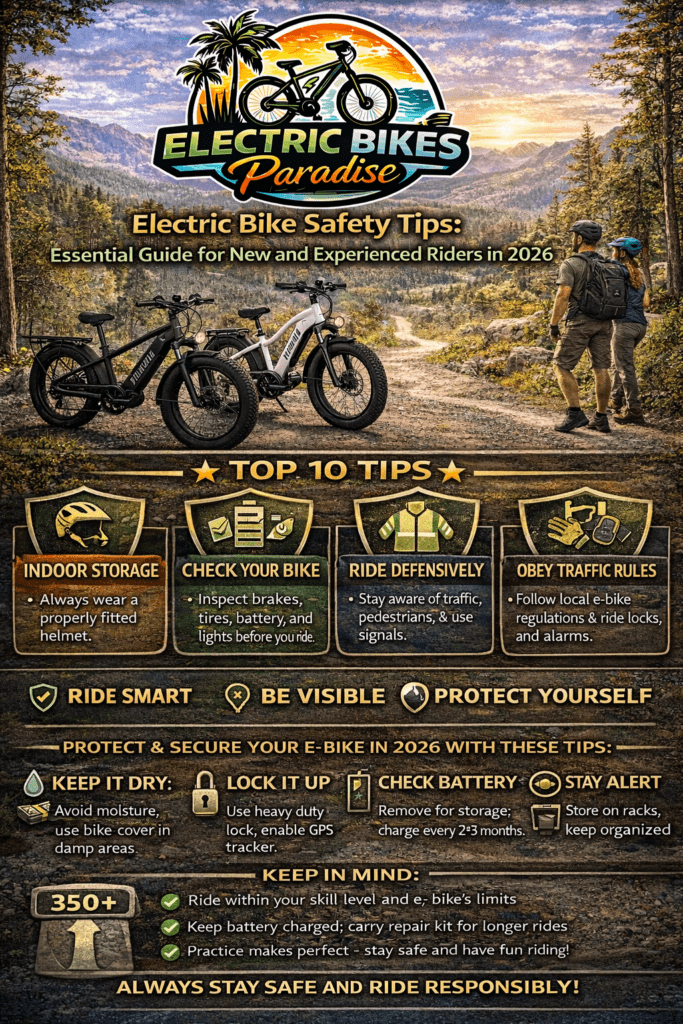
E-bikes are safe if you ride them responsibly. Wear a helmet, use lights, ride at an appropriate speed, maintain your bike, and treat traffic with respect. These simple practices will keep you safe for years of riding.
The key thing is understanding that your e-bike is not a toy or a status symbol. It’s a vehicle that can move at 20 to 28 miles per hour. It requires skill and attention. If you approach e-bike riding with that mindset, you’ll have a fantastic experience and stay safe doing it.
Want to understand more about how e-bikes work so you can ride them more effectively? Check out the detailed guide on electric bike systems. And if you’re still deciding whether an e-bike is right for you, read about the costs and benefits of owning an e-bike. The best electric bikes guide has detailed reviews of models known for safety and reliability.