Published by Electric Bikes Paradise | Updated 2026
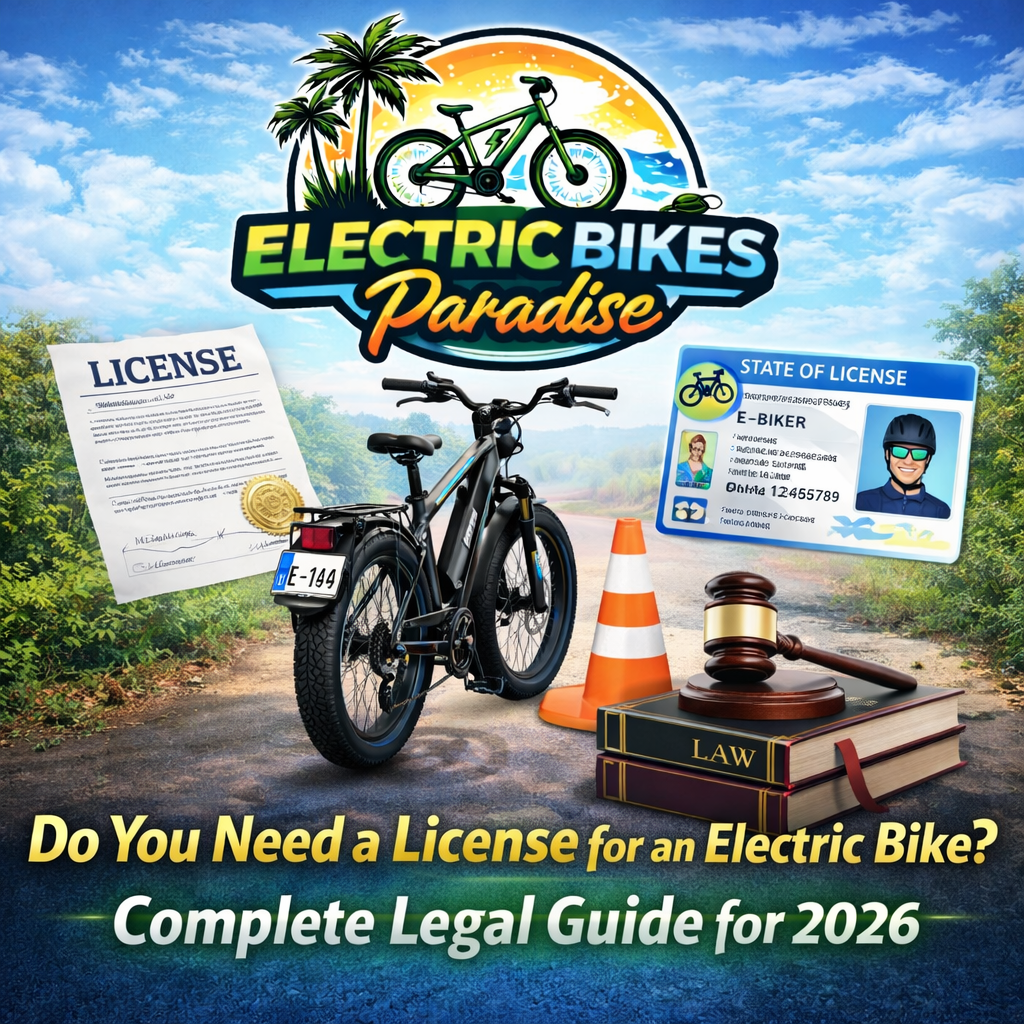
One of the first questions people ask when considering an electric bike is whether they need a driver’s license, registration, or insurance to ride one legally. It’s a completely understandable concern — e-bikes look more powerful than regular bicycles and can reach speeds that feel closer to a moped or motorcycle than a traditional pedal bike.
The short answer for most riders in most U.S. states is: no, you do not need a license, registration, or insurance to ride a standard electric bike. But as with most legal questions, the details matter — and the rules vary depending on which state you’re in, what class of e-bike you’re riding, and how the bike is configured.
In this comprehensive guide we’ll cover everything you need to know about e-bike licensing requirements in the United States in 2026 — including state-by-state trends, how e-bike class affects the rules, age requirements, helmet laws, and what happens when an e-bike crosses the line into moped or motor vehicle territory.
How the U.S. Classifies Electric Bikes
Before diving into licensing requirements, it’s essential to understand how electric bikes are legally defined under federal and state law. As we cover in detail in our Class 1 vs Class 2 vs Class 3 Electric Bike guide, the United States uses a three-class system to categorize e-bikes:
- Class 1: Pedal assist only, no throttle, maximum assisted speed of 20 mph
- Class 2: Throttle and pedal assist, maximum assisted speed of 20 mph
- Class 3: Pedal assist only, maximum assisted speed of 28 mph
Under federal law — specifically the Consumer Product Safety Act — an electric bicycle is defined as a two- or three-wheeled vehicle with fully operable pedals, an electric motor of less than 750W, and a maximum speed of 20 mph on a paved level surface when powered solely by the motor. Bicycles meeting this definition are regulated as consumer products by the Consumer Product Safety Commission, not as motor vehicles by the Department of Transportation.
This federal definition is the foundation for how most states treat e-bikes — as bicycles rather than motor vehicles — which is the primary reason no license is required in most cases.
Do You Need a Driver’s License to Ride an Electric Bike?
In the vast majority of U.S. states, no driver’s license is required to ride a Class 1, Class 2, or Class 3 electric bike. Because these bikes are legally classified as bicycles rather than motor vehicles, the same rules that apply to regular bicycle riding apply to e-bike riding — and you don’t need a license to ride a regular bicycle.
This is true regardless of whether you have a driver’s license or not. A 14-year-old, someone whose license has been suspended, and someone who has never held a driver’s license can all legally ride a standard e-bike in most states without any special permit or license.
However, there are exceptions and nuances worth knowing:
Age restrictions: Some states impose minimum age requirements for certain e-bike classes. Class 3 e-bikes — with their higher 28 mph top speed — have age restrictions in several states, typically requiring riders to be at least 16 years old. Always check your specific state’s rules if younger riders will be using a Class 3 bike.
Local ordinances: While state law may not require a license, some municipalities have their own e-bike rules that may impose additional requirements. This is uncommon but worth checking for your specific city or county.
High-power or high-speed bikes: If an e-bike has a motor exceeding 750W or a top speed above 28 mph, it may be classified as a moped or motor vehicle under state law — which does require registration and a license. See the section below on when an e-bike becomes a moped.
Do You Need to Register an Electric Bike?
In the overwhelming majority of U.S. states, standard Class 1, 2, and 3 electric bikes do not require registration, license plates, or title certificates. They are treated the same as regular bicycles for registration purposes — which is to say, no registration is required at all.
This is one of the most appealing practical aspects of e-bike ownership compared to mopeds, scooters, and motorcycles, all of which require registration and title in every state.
A small number of states have historically required registration for some e-bikes, but most have moved away from this requirement as the three-class framework has been adopted. Always verify current requirements in your specific state.
Do You Need Insurance for an Electric Bike?
No state currently requires liability insurance to ride a standard Class 1, 2, or 3 electric bike on public roads — the same as regular bicycles. E-bike riders are not required to carry proof of insurance when riding.
That said, voluntary insurance coverage for your e-bike is well worth considering for several reasons:
Theft protection: E-bikes are valuable — often $1,500–$5,000 or more — and are attractive targets for thieves. A dedicated e-bike insurance policy or a rider on your homeowner’s or renter’s insurance policy can provide financial protection if your bike is stolen.
Damage coverage: Accidents happen. If your e-bike is damaged in a crash — whether your fault or someone else’s — insurance can cover repair or replacement costs.
Liability coverage: While not legally required, liability coverage protects you financially if you injure someone or damage property while riding. A collision between a 60-lb e-bike traveling at 25 mph and a pedestrian can cause serious injury, and the financial consequences without insurance can be significant.
Several insurance companies now offer dedicated e-bike insurance policies at reasonable annual premiums. It’s a worthwhile investment for anyone riding a higher-value e-bike regularly.
Helmet Laws for Electric Bike Riders
Helmet requirements for e-bike riders vary significantly by state and age. Here’s the general picture:
Class 3 e-bikes: Many states that have adopted the three-class system require riders to wear helmets on Class 3 e-bikes, often regardless of age. This reflects the higher speeds Class 3 bikes can achieve.
Class 1 and Class 2 e-bikes: Helmet laws for Class 1 and 2 riders vary widely. Some states require helmets for all e-bike riders under 18. Some require helmets for all riders regardless of age. Others have no specific e-bike helmet law at all, leaving it to the same rules that apply to traditional cyclists.
Regardless of the legal requirement in your state, we strongly recommend wearing a properly fitted helmet every time you ride an e-bike. E-bikes are heavier and faster than regular bicycles, which means the consequences of a crash are more serious. A helmet is your single most important piece of safety equipment.
For more safety guidance, see our How to Ride an Electric Bike guide.
Age Requirements for Electric Bike Riders
Most states have no minimum age requirement for riding Class 1 and Class 2 e-bikes, treating them the same as regular bicycles. However, several states have imposed age restrictions specifically for Class 3 e-bikes:
16 years minimum: California, Colorado, and several other states require Class 3 riders to be at least 16 years old.
No specific minimum age: Most states have no e-bike-specific age requirement for any class, though general bicycle rules and parental supervision expectations apply for young children.
For families with younger children interested in electric riding, Class 1 and Class 2 e-bikes are available in youth-appropriate sizes, and kids electric dirt bikes are designed specifically for young riders in supervised, off-road settings.
When Does an Electric Bike Become a Moped or Motor Vehicle?
This is a critical point that every e-bike buyer should understand. Standard e-bikes — Class 1, 2, and 3 — are legally distinct from mopeds, scooters, and motorcycles in most states. But there’s a line, and crossing it changes the legal requirements dramatically.
An electric bike may be reclassified as a moped or motor vehicle under state law if it:
Exceeds 750W motor power — Some states have lower thresholds. In New York, for example, the limit for electric bicycle classification has historically been lower than the federal standard.
Exceeds 20 mph on motor power alone — Some states use this as the threshold, meaning a Class 3 bike that reaches 28 mph on pedal assist alone may still qualify as a bicycle, but a bike that reaches 28 mph on throttle alone may not.
Has no functional pedals — A motorized two-wheeled vehicle with no pedals — or with vestigial pedals that aren’t functionally used for propulsion — is almost certainly a moped or motor vehicle, not a bicycle, regardless of motor power.
Is designed to look like a motorcycle — Electric mopeds and e-motorcycles that happen to have pedals attached are often classified as mopeds or motor vehicles based on their overall design and intended use, not just their specs.
If a vehicle crosses into moped or motor vehicle territory under state law, it typically requires registration, a title, a valid driver’s license (often with a specific endorsement), and liability insurance. Riding an unregistered or unlicensed moped on public roads can result in fines, vehicle impoundment, and legal liability.
When purchasing an e-bike, always verify that the model you’re buying meets the legal definition of a bicycle — not a moped — in your state. Reputable dealers like Electric Bikes Paradise sell bikes that comply with U.S. e-bike regulations, but it’s always wise to verify.
State-by-State Overview: Key States to Know
While a full 50-state breakdown is beyond the scope of this guide, here are highlights for some of the most populous states:
California
California was one of the first states to adopt the three-class e-bike system and has clear, well-established rules. Class 1 and 2 e-bikes require no license, registration, or insurance. Class 3 e-bikes require the rider to be at least 16 years old and wear a helmet. No license or registration is required for any class.
Texas
Texas treats Class 1, 2, and 3 e-bikes as bicycles. No license, registration, or insurance is required. Helmet laws vary by municipality — no statewide helmet requirement for adults.
Florida
Florida has adopted the three-class system and requires no license or registration for standard e-bikes. E-bike riders under 16 must wear a helmet. Florida has been particularly progressive in opening state park trails to e-bikes.
New York
New York has had a more complicated e-bike history but has moved toward broader acceptance of e-bikes under the three-class framework. Class 1, 2, and 3 e-bikes are permitted without a license or registration. New York City has its own specific rules for delivery e-bikes and throttle-equipped bikes — check local rules if riding in NYC.
Colorado
Colorado has fully adopted the three-class framework. No license or registration is required for any class. Class 3 riders must be at least 16 years old and wear a helmet.
Washington
Washington state treats Class 1, 2, and 3 e-bikes as bicycles with no license or registration requirement. Helmet laws apply the same as for traditional cyclists.
Arizona
Arizona has adopted the three-class system with no license or registration required for standard e-bikes. No statewide helmet requirement for adult riders.
What About Electric Trikes and Mobility Scooters?
Three-wheeled electric vehicles occupy a slightly different legal space in some states. Most electric trikes that meet the same power and speed specifications as e-bikes are treated as bicycles under state law — no license or registration required.
Mobility scooters — designed for individuals with limited mobility — are generally classified differently from e-bikes and mopeds. They’re typically regulated as mobility devices rather than motor vehicles or bicycles, and are generally permitted on sidewalks and in pedestrian areas where other e-bikes may not be. No license or registration is typically required for mobility scooters.
What About Electric Scooters?
Electric scooters — stand-up or sit-down scooters without pedals — occupy a more complex legal space than pedal-equipped e-bikes. Because they lack pedals, they cannot qualify as bicycles under the federal definition, and state classification varies widely.
In many states, electric scooters are classified as motorized scooters or mopeds if they exceed certain speed or power thresholds, which can trigger registration and licensing requirements. In other states, low-powered electric scooters are treated similarly to e-bikes with minimal requirements.
Always check your specific state’s rules for electric scooters before purchasing, particularly if you’re concerned about licensing and registration requirements.
Practical Checklist: What You Need to Ride an E-Bike Legally
For a standard Class 1, 2, or 3 electric bike in most U.S. states, here’s what you need:
✅ A properly functioning e-bike that meets Class 1, 2, or 3 specifications (≤750W motor, meets speed limits for its class) ✅ A helmet — required by law for Class 3 riders in many states and for riders under 18 in many states; recommended for everyone regardless of law ✅ Basic knowledge of local traffic laws — e-bikes follow the same rules as regular bicycles in most jurisdictions ✅ Age compliance — if riding a Class 3 bike, verify your state’s minimum age requirement
You do NOT need in most states: ❌ A driver’s license ❌ Vehicle registration or license plates ❌ Insurance (though it’s recommended) ❌ A special e-bike permit or certification
Frequently Asked Questions
Can I ride an e-bike if my driver’s license is suspended? In most states, yes — because e-bikes are classified as bicycles, not motor vehicles, a suspended driver’s license does not prohibit you from riding one. However, this varies by state and the terms of the suspension. Consult a legal professional if you’re uncertain.
Do I need a license to ride an e-bike on the road? No, in the vast majority of states. E-bikes classified as Class 1, 2, or 3 are treated as bicycles and can be ridden on roads without a driver’s license.
Can a 14-year-old ride an electric bike? In most states, yes — Class 1 and Class 2 e-bikes have no minimum age requirement in most jurisdictions. Class 3 e-bikes typically require riders to be at least 16 in states that have age restrictions.
Do I need to wear a helmet? Legally, it depends on your state and the class of e-bike. Practically, we strongly recommend it for every rider on every ride.
What happens if I get stopped by police on an e-bike? If your e-bike meets the Class 1, 2, or 3 specifications for your state, law enforcement should treat it the same as a regular bicycle. You may be asked to demonstrate that the bike meets speed and power requirements. Carrying your bike’s documentation — owner’s manual or spec sheet — is a good precaution if you’re riding in an area where you’re uncertain about local rules.
Is it legal to remove the speed limiter on my e-bike? No — removing or bypassing the speed limiter on an e-bike to allow speeds above the legal limit for its class is illegal in most jurisdictions and can reclassify the bike as a motor vehicle. It also voids the manufacturer’s warranty and creates significant personal liability in the event of an accident.
Shop Electric Bikes at Electric Bikes Paradise
Ready to enjoy the freedom of e-bike riding without the hassle of licensing, registration, or insurance? At Electric Bikes Paradise, we carry a premium selection of legal, Class-compliant electric bikes for every type of rider — all backed by free shipping to the lower 48 states, our lowest price guarantee, and expert customer support.
Browse our categories:
- Electric Bikes
- Electric Mountain Bikes
- Electric Fat Tire Bikes
- Folding Electric Bikes
- Folding Fat Tire Electric Bikes
- Electric Trikes
- Step-Through Electric Bikes
- Electric Beach Cruiser Bikes
- Electric Hunting Bikes
- Kids Electric Dirt Bikes
- Electric Scooters
- Mobility Scooters
Have questions about e-bike laws in your state or which model is right for you? Our team of e-bike experts is available Monday–Friday, 9am–5pm MST.
Electric Bikes Paradise | Ecom Paradise LLC 5830 E 2nd St, Ste. 7000 #715, Casper, WY 82609, United States 📞 307-429-0021 ✉️ sales@electricbikesparadise.com Facebook | Pinterest | YouTube | Instagram | TikTok