Published by Electric Bikes Paradise | Updated 2026
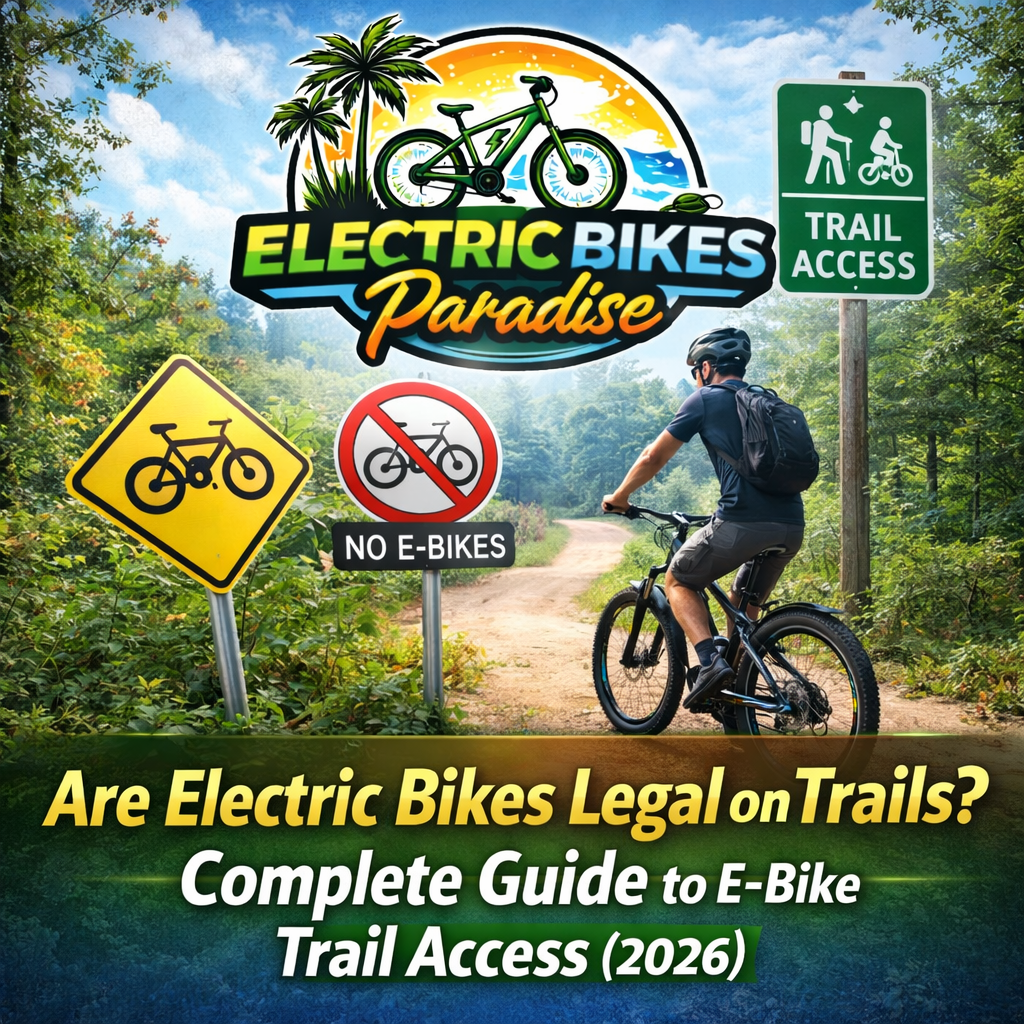
One of the most common questions new and prospective e-bike riders ask is: can I ride my electric bike on trails? It’s a completely reasonable question — and one that doesn’t have a simple yes or no answer. E-bike trail access in the United States varies significantly depending on which agency manages the land, which state you’re in, which class of e-bike you’re riding, and even which specific trail system you want to use.
The good news is that trail access for electric bikes has expanded dramatically over the past several years and continues to improve. Understanding the current legal landscape will help you ride confidently and legally — and help you choose the right class of e-bike for the riding you want to do.
In this comprehensive guide we’ll break down e-bike trail access rules by land management agency, explain how e-bike class affects where you can ride, cover state-by-state trends, and give you practical advice for finding out whether your local trails are open to e-bikes.
Why Is E-Bike Trail Access So Complicated?
Trail access for e-bikes is complicated for one primary reason: trails in the United States are managed by dozens of different agencies at the federal, state, and local level — and each agency sets its own rules.
A trail through a National Park is governed by the National Park Service. A trail through National Forest land is governed by the U.S. Forest Service. A trail on Bureau of Land Management land is governed by the BLM. A state park trail is governed by the state’s parks department. A city or county trail is governed by local government. And a trail on private land open to the public is governed by the landowner.
Each of these entities has made — or is still making — independent decisions about how to classify e-bikes and where they’re permitted. The result is a patchwork of rules that can feel overwhelming but follows some clear patterns once you understand the framework.
The three-class e-bike system, which we cover in detail in our Class 1 vs Class 2 vs Class 3 Electric Bike guide, is central to understanding trail access. In general, Class 1 e-bikes — pedal assist only, no throttle, up to 20 mph — have the broadest trail access of the three classes.
Federal Land: National Parks, National Forests, and BLM
National Parks
The National Park Service (NPS) manages more than 400 units across the United States, including national parks, monuments, recreation areas, and seashores. E-bike policy in the NPS has evolved significantly.
In 2019, the NPS issued a policy allowing individual park units to permit e-bikes wherever traditional bicycles are allowed, without requiring a formal rulemaking process. This opened the door for e-bike access across the NPS system but left the final decision to each individual park.
As of 2026, many national park units permit Class 1 e-bikes on paved roads, paved bike paths, and some unpaved multi-use trails where traditional bikes are allowed. However, rules vary significantly by park. Some parks have fully embraced e-bikes on all bike-legal routes, while others have been more restrictive.
Key points for national parks:
- Always check the specific park’s e-bike policy before visiting — rules vary by unit
- Class 1 e-bikes generally have the best access
- Class 2 and Class 3 e-bikes are more often restricted or excluded from non-motorized trails
- E-bikes are generally not permitted on trails designated as non-motorized or hiker-only regardless of class
- Contact the park’s visitor center or check their website for the most current information
National Forests (U.S. Forest Service)
The U.S. Forest Service manages 193 million acres of national forests and grasslands. In 2020, the Forest Service issued a directive allowing Class 1, 2, and 3 e-bikes to be used wherever traditional bicycles are permitted within national forests, unless a specific forest or district has prohibited them.
This was a landmark decision that opened up vast amounts of singletrack and multi-use trail mileage to e-bikes across the country. However, individual forests and ranger districts can still restrict e-bikes on specific trails or trail systems through local orders.
Key points for national forests:
- Class 1, 2, and 3 e-bikes are generally permitted where traditional bikes are allowed
- Individual forests and districts can restrict access on specific trails
- Trails designated as non-motorized may still exclude e-bikes depending on local interpretation
- Check with the local ranger district for current rules on specific trail systems
Bureau of Land Management (BLM)
The Bureau of Land Management oversees more than 245 million acres, primarily in the western United States. In 2020, the BLM issued a policy similar to the Forest Service, allowing Class 1, 2, and 3 e-bikes wherever traditional bicycles are permitted on BLM land, unless specifically prohibited by a local resource management plan or travel management plan.
BLM land is popular for electric fat tire bike and electric mountain bike riders exploring desert trails, canyon country, and backcountry routes.
Key points for BLM land:
- E-bikes are generally permitted where traditional bikes are allowed
- Local resource management plans may restrict access in specific areas
- Check with the local BLM field office for current rules
Army Corps of Engineers and Other Federal Agencies
Other federal land management agencies — including the Army Corps of Engineers, Bureau of Reclamation, and U.S. Fish and Wildlife Service — have their own e-bike policies, which vary by agency and often by individual unit. As a general rule, check with the specific managing agency before riding e-bikes on their trails.
State Parks and State Forests
State park e-bike policies vary enormously from state to state and sometimes from park to park within the same state. Here’s a general overview of the trend:
States with generally favorable e-bike trail access:
California, Colorado, Utah, Oregon, Washington, Arizona, and many other western states have been relatively progressive in opening state park trails to e-bikes, particularly Class 1 models. Many state park systems in these states now permit Class 1 e-bikes anywhere traditional bikes are allowed.
Florida has been particularly progressive, with most state parks permitting Class 1 and Class 2 e-bikes on bike-legal trails.
States with more restrictive policies:
Some eastern states and states with densely populated trail systems have been more cautious about e-bike access, particularly on singletrack trails shared with hikers and traditional mountain bikers. Policies are actively evolving in many of these states.
The general trend:
Across the country, state park systems are moving toward greater e-bike access, not less. The trend over the past several years has been consistent — more trails opening to e-bikes each year, with Class 1 leading the way. Many states are following the federal model of allowing e-bikes wherever traditional bikes are permitted.
Always check your specific state park system’s current policy before riding.
Local and Municipal Trails
City and county trail systems are the most varied and hardest to generalize about. In many urban and suburban areas, paved multi-use paths and greenways are fully open to e-bikes. Unpaved singletrack in urban parks may have different rules.
Many cities and counties have embraced e-bikes on their trail systems as part of broader transportation and recreation planning. Others have been more conservative, particularly for trails shared with pedestrians and dog walkers.
For local trails, the best approach is to check the managing agency’s website, look for posted signage at trailheads, or contact the parks and recreation department directly.
Private Trail Systems and Mountain Bike Trail Associations
Some of the best trail systems in the country are on private land or managed by mountain bike trail associations like IMBA (International Mountain Bicycling Association). These organizations set their own access policies.
IMBA has developed guidelines supporting Class 1 e-bike access on non-motorized trails and has worked with land managers across the country to develop sensible e-bike policies. Many IMBA-affiliated trail systems now permit Class 1 e-bikes on all or part of their trail networks.
Privately owned trail systems and ski resorts with bike parks have their own policies — some are e-bike friendly, others restrict e-bikes due to trail design, insurance, or liability concerns. Always check before riding.
How E-Bike Class Affects Trail Access
As we covered in our Class 1 vs Class 2 vs Class 3 Electric Bike guide, the class of your e-bike has a significant impact on where you can legally ride. Here’s a general summary for trail access:
Class 1 (pedal assist only, up to 20 mph): Class 1 e-bikes have the broadest trail access of the three classes. Because they only assist when pedaling and are capped at 20 mph — similar in speed and behavior to a fit traditional cyclist — most land management agencies are comfortable permitting them on non-motorized trails. Class 1 is the standard for most electric mountain bikes specifically because of this access advantage.
Class 2 (throttle up to 20 mph): Class 2 e-bikes are permitted on many of the same trails as Class 1, but some trail systems specifically exclude Class 2 because of the throttle. The ability to ride without pedaling is viewed by some land managers as fundamentally different from traditional cycling — particularly in national parks and some state park systems. On roads and bike lanes, Class 2 access is typically identical to Class 1.
Class 3 (pedal assist up to 28 mph): Class 3 e-bikes have the most restricted trail access. The higher top speed of 28 mph is a legitimate safety concern on trails shared with pedestrians and slower cyclists. Most non-motorized trail systems that have opened to e-bikes have done so for Class 1 and sometimes Class 2, but not Class 3. Class 3 bikes are primarily suited to roads and dedicated bike lanes.
What About Singletrack Mountain Bike Trails?
Singletrack trails — narrow, winding trails typically used by mountain bikers and hikers — represent the most contested terrain for e-bike access. The debate around e-bikes on singletrack is ongoing and nuanced.
Arguments in favor of e-bike singletrack access:
- Class 1 e-bikes travel at similar speeds to traditional mountain bikes
- E-bikes allow a wider range of riders to access and enjoy trails
- Studies suggest e-bikes don’t cause significantly more trail erosion than traditional bikes when ridden responsibly
- E-bike riders are still pedaling and engaging with the trail actively
Arguments against e-bike singletrack access:
- Higher speeds on technical trails can create safety concerns for shared-use trails
- Some rider behavior — using the motor to glaciate previously challenging sections — can lead to reckless riding
- Trail advocacy groups have mixed views, with some supporting access and others concerned about precedent
The practical reality in 2026 is that many singletrack trail systems — particularly on Forest Service and BLM land — are open to Class 1 e-bikes. This access continues to expand as land managers gain experience with e-bikes on trails and rider behavior proves to be largely responsible.
If you’re primarily a singletrack rider, a Class 1 electric mountain bike gives you the best access to these trails.
Practical Tips for Riding Trails Legally and Responsibly
Regardless of the official rules, how you ride matters enormously for the long-term future of e-bike trail access. Here are our recommendations:
Always verify before you ride. Don’t assume a trail is open to e-bikes because it’s open to traditional bikes. Check the land manager’s website, call the local ranger station, or look for posted signage at the trailhead. Riding where you’re not permitted — even unknowingly — sets back the e-bike access cause.
Ride the lowest appropriate class. If you have a configurable e-bike, set it to Class 1 mode when riding trails where Class 2 or 3 may not be permitted. Respecting the rules in spirit, not just the letter, builds goodwill with trail managers and other users.
Yield appropriately. On multi-use trails, yield to hikers and horses. Announce yourself when approaching from behind. Be courteous and patient — e-bike riders represent the entire e-bike community to every trail user they encounter.
Ride responsibly. Don’t use motor assistance to blast through technical sections at speeds that are unsafe for the conditions. Ride at speeds appropriate for the trail, your visibility, and the presence of other users.
Get involved. Join your local mountain bike association, participate in trail stewardship events, and engage constructively with land managers. The most effective advocates for e-bike trail access are responsible, engaged riders.
Stay on designated trails. Never ride off-trail to bypass obstacles or create shortcuts. This causes erosion and habitat damage that harms the trail for everyone.
How to Find Out If Your Local Trails Allow E-Bikes
Here are the most reliable ways to find out if a specific trail system is open to e-bikes:
Check the land manager’s website. Most federal and state agencies publish their e-bike policies online. Search for the trail system name plus “e-bike policy” or “electric bike rules.”
Look for trailhead signage. Many trail systems now post e-bike access information at trailheads alongside other rules and regulations.
Call the local ranger station or parks department. A quick phone call to the local ranger district or parks department will give you a definitive answer. Staff are generally helpful and appreciate riders who ask before showing up.
Check trail apps. Apps like Trailforks, MTB Project, and AllTrails increasingly include e-bike access information for individual trails and trail systems.
Ask local bike shops. Local bike shops are often excellent sources of current trail access information and can tell you which nearby trails are e-bike friendly.
The Future of E-Bike Trail Access
The trajectory for e-bike trail access in the United States is clearly positive. Every year, more trail systems open to e-bikes, more states adopt clearer e-bike policies, and the trail advocacy community develops a more nuanced and constructive approach to e-bike integration.
The keys to continued progress are responsible riding by e-bike users, constructive engagement with land managers, and continued education about the actual impacts of e-bikes on trails. The evidence increasingly supports the conclusion that Class 1 e-bikes — ridden responsibly by engaged trail users — are compatible with the non-motorized trail experience.
If you’re passionate about trail access, consider joining organizations like PeopleForBikes, your state’s mountain bike association, or local trail advocacy groups. The future of e-bike trail access is being shaped right now by the riders who show up and get involved.
Shop Electric Bikes at Electric Bikes Paradise
If trail riding is your primary goal, a Class 1 electric mountain bike or electric fat tire bike gives you the best combination of trail access and off-road performance. At Electric Bikes Paradise, we carry a premium selection of e-bikes for every type of rider — all backed by free shipping to the lower 48 states, our lowest price guarantee, and expert customer support.
Browse our categories:
- Electric Bikes
- Electric Mountain Bikes
- Electric Fat Tire Bikes
- Folding Electric Bikes
- Folding Fat Tire Electric Bikes
- Electric Trikes
- Step-Through Electric Bikes
- Electric Beach Cruiser Bikes
- Electric Hunting Bikes
- Electric Scooters
- Mobility Scooters
Have questions about which e-bike is right for the trails you want to ride? Our team of experts is available Monday–Friday, 9am–5pm MST.
Electric Bikes Paradise | Ecom Paradise LLC 5830 E 2nd St, Ste. 7000 #715, Casper, WY 82609, United States 📞 307-429-0021 ✉️ sales@electricbikesparadise.com Facebook | Pinterest | YouTube | Instagram | TikTok