When you or a loved one is dealing with mobility challenges, the choice between a mobility scooter and an electric wheelchair is really really important. These aren’t just transportation devices—they’re about independence, dignity, and the ability to live your life the way you want to. But they’re also different machines designed for different situations, and picking the wrong one can make your life harder instead of easier. Let me walk you through the actual differences so you can make the right choice for your specific situation.
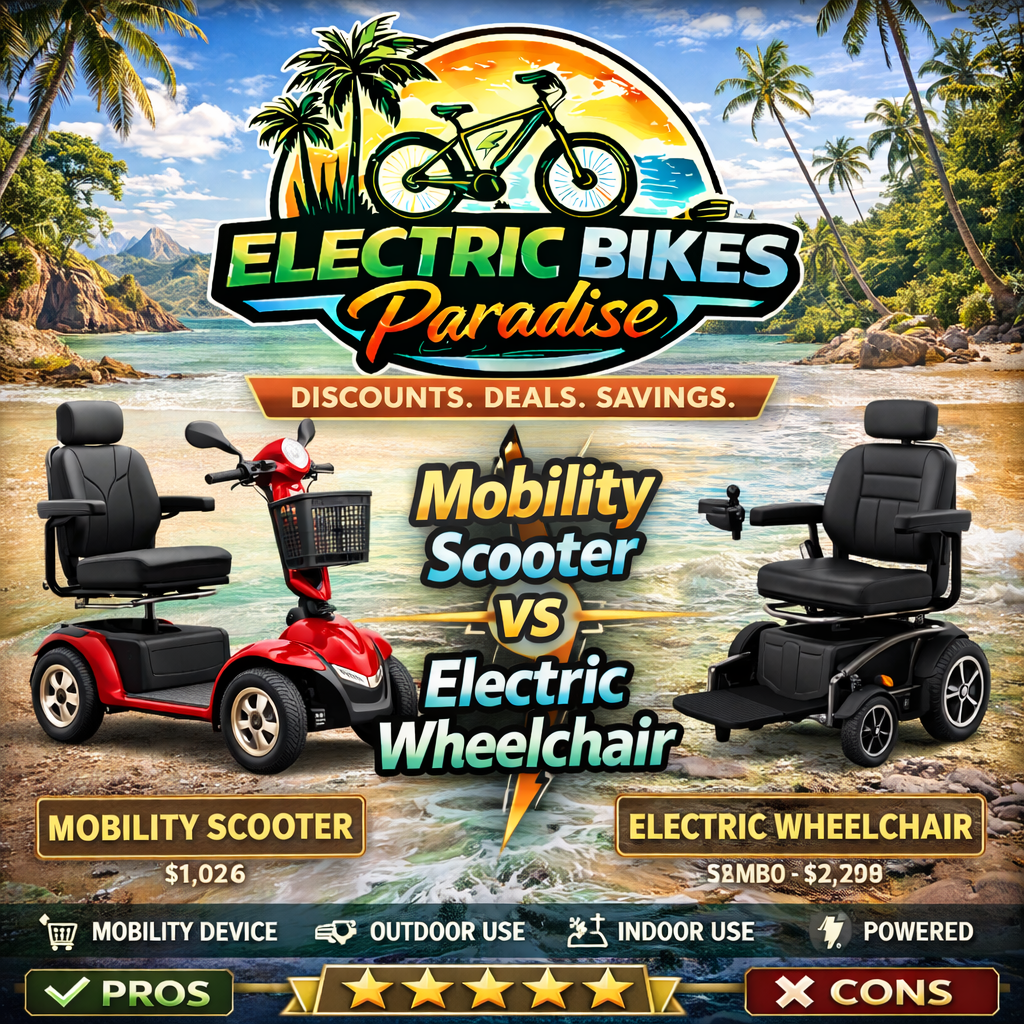
First, let’s talk about what these actually are because people mix them up all the time. A mobility scooter is like a motorized throne on three or four wheels. You sit on a cushioned seat, there’s a steering tiller or handles in front, and you use it kind of like a small motorcycle or scooter. You’re basically upright and you’re steering it as a separate vehicle. An electric wheelchair, on the other hand, is a wheelchair that’s been motorized. You sit in a chair with foot supports, armrests, a backrest, and it moves because of electric motors, usually controlled by a joystick or other control mechanism. The positioning is more like a traditional wheelchair, just powered.
Now let’s get into the real differences that matter in your daily life. Mobility scooters are generally better for outdoor use. They handle uneven terrain, slight inclines, and rough pavement better than electric wheelchairs. If you’re going to use it in parks, on sidewalks with some bumps, or in outdoor shopping areas, a scooter is probably your better bet. They usually have bigger wheels, more ground clearance, and they’re designed to be a bit more rugged. A lot of people use them for longer distances too. The average mobility scooter can go 15 to 30 miles on a charge, sometimes more. That makes them great for people who want to get out and explore a bit.
Electric wheelchairs are better for indoor use and navigating tight spaces. They’re narrower, they turn on a tighter radius, and they can fit through standard doorways without the hassle. If most of your time is spent indoors, or you need to navigate a house with narrow hallways and tight bathrooms, an electric wheelchair is the practical choice. You can also transfer in and out of an electric wheelchair more easily if you’ve got some mobility, because it’s essentially a wheelchair. The positioning is more familiar if you’ve used a manual wheelchair before. And here’s something really important: electric wheelchairs are more accessible at medical facilities, hospitals, and public buildings because the staff knows how to work with them.
The cost difference between the two is significant but not always what people expect. A basic mobility scooter costs between $800 and $3,000, depending on the quality, size, and features. A decent mid-range scooter with good battery life runs around $1,200 to $2,000. An electric wheelchair starts around $2,000 for a basic model and easily goes to $5,000 to $10,000 or more for a really high-end one with advanced features. So wheelchairs are generally more expensive, but here’s where it gets interesting. Insurance coverage is completely different between the two.
Insurance and Medicare coverage is where this gets really really complicated, and it matters because it can cover a huge chunk of the cost. Medicare Part B covers motorized wheelchairs, but it does not cover mobility scooters. That’s a crucial distinction. If you’re on Medicare and qualify for a motorized wheelchair, the government will cover 80% of the approved cost after you meet your deductible, leaving you responsible for just 20%. For a $5,000 wheelchair, that could mean Medicare pays $4,000 and you pay $1,000. But if you want a mobility scooter, Medicare won’t help at all, and you’re paying the full cost yourself. Some private insurance plans might cover wheelchairs but not scooters, though coverage varies wildly. We’ve got a full breakdown of Medicare coverage in our article about whether Medicare covers mobility scooters.
To qualify for Medicare coverage of an electric wheelchair, you need to meet some requirements. You have to be able to demonstrate a medical need, which typically means you have significant difficulty walking or standing. Your doctor needs to document this. You also usually need to demonstrate that you’ve tried using a manual wheelchair and it’s not adequate for your situation. Some conditions that qualify include severe arthritis, heart disease that causes shortness of breath, neurological conditions like Parkinson’s or MS, and various other medical situations. Mobility scooters, since Medicare won’t cover them, don’t have these qualification requirements. You just buy one if you want one and have the money.
Here’s something else that matters: the physical demands of using each one. Mobility scooters require that you can sit upright for extended periods, that you have some upper body strength and control to steer, and that you can get on and off the scooter somewhat independently or with help. If you have severe upper body limitations or you can’t sit upright reliably, a scooter might not work well. Electric wheelchairs are more flexible because they accommodate various positioning needs. You can get them with special backrests for people who can’t sit upright, they can be adjusted for people with limited arm movement, and they work better if you’re going to spend a lot of time just sitting and being moved around rather than actively driving yourself.
Maneuverability is really different between the two. A mobility scooter has a turning radius of maybe 3 to 6 feet depending on the model, and they’re not as tight as wheelchairs. An electric wheelchair turns on a much tighter radius, sometimes 2 to 3 feet, because the motors are at the wheels and the turning is more like a traditional wheelchair. If you’re navigating narrow hallways, tight bathrooms, or crowded rooms, a wheelchair wins. If you’re moving through open spaces or outdoor areas, the scooter’s slightly wider turning radius doesn’t really matter and the other features become more important.
Transportation is another practical consideration. Mobility scooters are heavier and bulkier than electric wheelchairs, which makes them harder to transport if you need to take them places. Some fold or disassemble, but most don’t come apart easily. Electric wheelchairs are designed to disassemble for transport and most of them fold up or have removable parts so you can fit them in a car. If you’re going to be traveling, visiting places, or need to transport your mobility device regularly, a wheelchair is more practical. A lot of people have a wheelchair for getting around at home and in tight spaces, and then they leave the scooter at a vacation home or storage unit because it’s too much trouble to move.
Battery life and range matter based on how you plan to use it. A mobility scooter with a decent battery gives you 15 to 30 miles per charge, sometimes more. That’s good for a full day of driving around if you’re not doing anything crazy. Electric wheelchairs typically give you 6 to 12 hours of use per charge, which translates to maybe 10 to 15 miles depending on speed and terrain. They need charging more often. If you’re going to be out for full days, a scooter works better. If you’re mostly around home or familiar locations, a wheelchair is fine and actually easier since charging is more frequent but for shorter times.
Now let’s talk about independence level, because this is really the heart of the decision. A mobility scooter is something you actively drive and control. It’s more like driving a car or operating a vehicle. This gives people a strong sense of agency and control. They’re moving themselves through space, not being moved. For people who value that independence and still have the capability to drive, a scooter feels really empowering. An electric wheelchair is a mobility device, similar to a powered version of something you might already know how to use if you’ve ever been in a wheelchair. Some people find wheelchairs embarrassing or feel less independent because they’re associated with disability in a way scooters aren’t. That’s a real psychological factor that matters. Other people are fine with wheelchairs and actually prefer them because they’re more integrated with medical settings and familiar to caregivers.
Safety considerations differ too. Mobility scooters are pretty safe if you’re using them as designed, but they can tip if you go on steep hills or uneven terrain. You’re also more exposed since you’re not enclosed in anything, so weather and other vehicles are factors. Electric wheelchairs don’t tip as easily if they’re sized right, they’re more stable on slopes, and they’re lower to the ground so they’re actually more visible to vehicles in some cases and less visible in others. It’s a trade-off. Both are safer than trying to walk when you’re not safe to do so, though, so the comparison is really about which one is safer for your specific situation rather than which is completely safe.
Maintenance costs are pretty similar between the two. Both have batteries that eventually need replacing, which costs $200 to $800 depending on the battery type. Both have motors that rarely need repair. Tires need replacing periodically. For a mobility scooter, you’re looking at $50 to $150 per tire. Wheelchair tires are usually smaller and cheaper, maybe $30 to $80. Overall maintenance is minimal for both if you take care of them. Regular charging, occasional cleaning, and checking the tires. That’s really it.
Let’s talk about specific scenarios where each makes more sense. If you’re someone who wants to go to the mall, do some shopping, move around a lot, and you want that feeling of actively operating a vehicle, a scooter is perfect. If you’re living in an apartment with narrow hallways, getting around indoors is your main concern, and you don’t do a lot of long-distance driving, a wheelchair is better. If you have arthritis in your hands and arms that makes steering difficult, a wheelchair with a good control system might work better than trying to handle a scooter’s tiller. If you’ve always been someone who loved driving and wants to keep that feeling of independence, a scooter is emotionally better for you even if a wheelchair would be more practical.
The insurance question is really important and worth repeating because it changes the math so much. Call your insurance company right now if you’re considering this. Ask them specifically whether they cover electric wheelchairs and whether they cover mobility scooters. Get the specifics in writing if you can. Medicare has clear answers for this, but private insurance varies all over the place. Some policies cover both, some cover one or the other, and some cover neither. Medicaid also covers different things depending on which state you’re in. This isn’t something to guess about. A phone call could save you thousands of dollars.
Here’s what I really really want you to understand: this isn’t about choosing between two identical products. This is about choosing between two different mobility solutions that each excel in different situations. A mobility scooter is an outdoor, long-range, active-driving device. An electric wheelchair is an indoor, tight-space, positioning-flexible device. Some people need both at different times in their life. Some people can make one work perfectly. Some people need something in between or something totally different.
If you’re reading this because you’re newly facing mobility challenges, I’m sorry you’re dealing with that. It’s a tough transition. But I’ve seen so many people get the right mobility device and suddenly get their independence back, reconnect with friends and activities, and really improve their quality of life. The key is understanding what you actually need and what your insurance will actually cover. Don’t just assume Medicare will cover a scooter because it makes sense. Don’t assume your insurance won’t cover something without asking.
Our homepage has resources and guides across different mobility situations. If you’re trying to understand the broader picture of mobility devices and what’s out there, that’s a good starting point. We’ve also got detailed information about insurance coverage at different price points and with different conditions. The medical system can be really really confusing about this stuff, and honestly, sometimes you have to do the research yourself because even the medical professionals don’t always know the insurance angles well.
Talk to your doctor about what they recommend. Let them know your home setup, your lifestyle, and your concerns. Visit a mobility device dealer if you can and actually sit in and on different options. Test out the maneuverability. See what feels right to you. Ask them about your insurance and what they can help you get coverage for. And then make the decision based on your real life, not based on what you think you should do or what sounds more impressive.
One last thing: neither a mobility scooter nor an electric wheelchair is an admission of defeat or the end of your independence. These devices give you independence. They let you move through your life without constant pain or risk of falling. They get you out of your house, back to activities you enjoy, and connected to people you care about. That’s the opposite of losing independence. That’s reclaiming it. Choose the device that’s going to help you live the life you want to live, and don’t worry about what it looks like to anyone else.