When you’re looking for a way to get around that’s faster than a regular bike but maybe not quite a full-on car, you’ve got options. A lot of people ask me whether they should get an electric bike or a motorcycle, and honestly, it’s not a simple answer. Both get you from point A to point B pretty quick, but they’re really really different in terms of cost, how they handle legally, and what your wallet looks like after the first year. Let’s break down the actual numbers and real-world differences so you can figure out which one makes sense for your life.
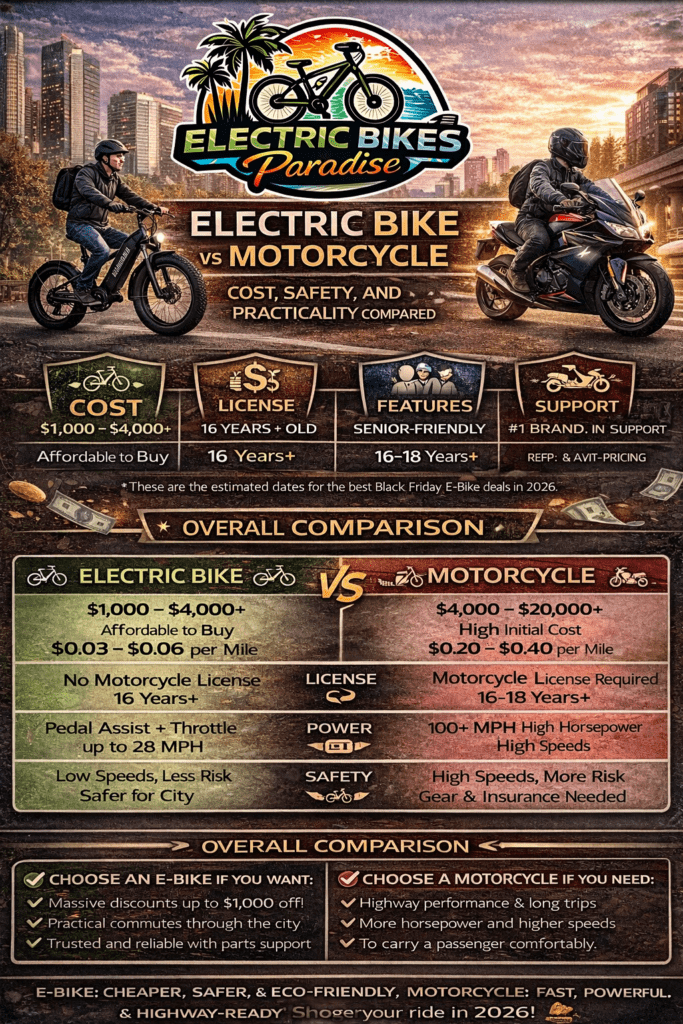
The biggest difference most people notice first is the price tag. You can get a solid, reliable electric bike for anywhere between $800 and $3,500 depending on what features you want. That’s the full range from decent commuters to really high-end models with premium components. A decent motorcycle? You’re looking at $4,000 to $8,000 minimum for something that’s not a total lemon, and that’s for used bikes. New motorcycles easily hit $6,000 to $15,000 or more. So right out of the gate, you’re spending roughly double or triple for a motorcycle.
But here’s where it gets interesting with insurance. Electric bikes don’t require any insurance in most US states, which saves you hundreds of dollars per year. Motorcycles absolutely require insurance, and that’s not optional. A basic motorcycle insurance policy runs you $400 to $800 annually, sometimes more if you’re young or have an accident on your record. That’s just for liability coverage, which is the bare minimum. If you want comprehensive coverage that actually protects your bike if it gets stolen, damaged, or in an accident, you’re looking at $600 to $1,200 per year. Over five years, that’s $3,000 to $6,000 in insurance alone. With an e-bike, that’s completely free.
Licensing is another huge deal that people sometimes forget about. You need a motorcycle endorsement on your driver’s license to legally ride a motorcycle in every state. That costs money to get, usually between $50 and $300 depending on where you live, and you need to take a test. Sometimes you need to take a safety course too, which can run another $150 to $300. That’s a one-time thing, sure, but it’s a pain in the butt to deal with. Electric bikes? No license, no test, no endorsement. You just hop on and ride.
Now let’s talk about what you can actually do with each machine. Most electric bikes top out around 28 mph on the motor assistance, though some go higher. A motorcycle is going to cruise at 45 to 70 mph depending on the model, and can go way faster if you’re looking at sport bikes. So if you need to get on the highway or go on really long commutes at faster speeds, a motorcycle makes sense. For most people’s daily transportation though, 28 mph is perfectly fine and gets you where you need to go without the stress of highway riding.
Maintenance costs are dramatically different between the two. Electric bikes are incredibly cheap to maintain. Your biggest recurring expenses are tires, which might need replacing every 2 to 4 years depending on usage and cost maybe $40 to $100 per tire, and brake pads if you do a lot of riding. The battery degrades slowly over time but usually keeps around 80% of its capacity after 5 years of normal use. You’re looking at maybe $100 to $300 per year in maintenance if you ride regularly. Motorcycles need oil changes every 3,000 to 5,000 miles, which costs $30 to $50 each time. They need tire replacements too, but motorcycle tires are more expensive, usually $150 to $300 per tire. Chain maintenance, transmission fluid, coolant, spark plugs, and various other components add up to $500 to $1,200 per year in maintenance costs for a motorcycle you ride moderately.
Charging versus fuel is another financial comparison worth doing. Charging an electric bike battery costs maybe $0.50 to $1.50 per charge depending on your local electricity rates, and that charge gets you somewhere between 20 to 60 miles depending on the bike and how much you’re using the motor. Gas for a motorcycle costs around $3 to $4 per gallon right now, and you might get 45 to 60 miles per gallon depending on the bike. So you’re spending roughly $2.50 to $4 per charge on a motorcycle to go the same distance. Over a year of regular commuting, that’s a huge difference. If you commute 10 miles each way five days a week, that’s 5,200 miles annually. An e-bike costs you maybe $150 to $300 per year in electricity. A motorcycle costs you $200 to $350 per year in gas. The difference sounds small until you add it up over time.
Safety is something I think about a lot with these comparisons. Motorcycles let you go really fast, but that speed comes with real risk. Motorcycle accidents are way more likely to result in serious injury or death than e-bike accidents. The fatality rate for motorcyclists is about 27 per 100,000, while it’s much lower for cyclists. That’s not to say e-bikes are totally safe either, because you can still get hit by cars or wipe out, but the speeds are lower and the consequences are usually less severe. You also don’t have a helmet requirement for electric bikes in most places, though I’d always recommend wearing one anyway. Motorcycles require a helmet in almost every state, which is actually a good thing for safety.
The weather factor is real too. Motorcycles give you some protection from the elements with full fairings on some models, but you’re still pretty exposed. Electric bikes leave you totally exposed to rain, wind, and cold, which can be annoying on long commutes. That said, more and more people are riding e-bikes year-round in all kinds of weather. You just need good rain gear and fenders. Most quality e-bikes come with fenders, but motorcycles obviously have better weather protection if that’s a priority for you.
Parking is surprisingly different. Electric bikes fit in places motorcycles can’t go. You can lock an e-bike to most bike racks, lean it against a building, or carry it inside. Motorcycles need dedicated parking or a secure spot, and they’re bigger so they take up more space. In urban areas where parking is tight, an e-bike wins hands down. You can also take a lot of e-bikes on public transit, trains, or buses if you need to combine transportation modes. Motorcycles can’t do that.
Let’s look at a full five-year cost of ownership comparison for someone doing a typical commute. With an electric bike costing $1,500, no insurance, no license, $150 annually in maintenance and electricity, you’re looking at about $2,250 total over five years. Add in maybe a battery replacement after five years at $400 to $800, and you’re at around $2,700 to $3,100. That’s it. For a motorcycle at $6,000 purchase price, $700 annually in insurance, $600 annually in maintenance, and $300 in gas, you’re looking at $9,500 to $10,000 over five years. That’s nearly four times as much money.
Range and speed are where motorcycles really shine. A typical mid-range motorcycle can go 150+ miles on a tank of gas, while an e-bike might get you 30 to 50 miles. For everyday commuting that’s fine, but if you need to take longer trips regularly, a motorcycle makes more sense. Some premium e-bikes with larger batteries can hit 60+ miles, which covers most daily needs, but motorcycles beat them for pure range.
The practical side of things matters too. An e-bike is way easier to use. You don’t need to learn how to ride a motorcycle, deal with a clutch or gear shifting if it’s automatic, or worry about stalling out at a red light. You pedal and the motor helps, or on some models you just twist the throttle. It’s simpler and less stressful. That’s perfect if you’re not super into vehicles and just want reliable transportation.
Social factors come up too, and I know that sounds weird but it’s real. A motorcycle signals something pretty specific. An e-bike is becoming increasingly normal and practical, and more people see them as smart transportation rather than extreme or dangerous. Depending on your community and what you’re going for, that might matter to you.
So here’s my honest take. If you’re looking for a daily commuter in an urban or suburban area, you want to keep costs low, you care about the environment, and you want something simple to maintain, an electric bike is really really the way to go. Check out our guide to the best electric bikes to see what actual models are out there. The electric bike buying guide will walk you through what features matter for your specific situation. And if you’re wondering about the financial side, our article on whether e-bikes are worth it breaks down the real economics.
If you need to regularly travel long distances, want to go on the highway, or just love the feeling of a real motorcycle, then a motorcycle is your thing. But understand that you’re spending significantly more money upfront, on insurance, on maintenance, and on fuel. You need a license endorsement, and there’s more risk involved. For a lot of people, that’s totally worth it. But for most daily commuting needs, an electric bike gets the job done for a fraction of the cost.
The middle ground is that some people keep both. They use an e-bike for the daily 5 to 10 mile commute and grab the motorcycle for weekend rides and longer trips. That’s perfect if you’ve got the storage space and budget for it. But if you can only get one thing, think hard about what you actually need. Most people are shocked at how well an e-bike handles their real-world transportation needs once they actually try one.
One more thing to consider is the environmental angle. Electric bikes produce zero emissions and use about 20 times less energy per mile than a car. A motorcycle uses fuel and produces emissions too, just way less than a car would. If reducing your environmental impact matters to you, e-bikes are the clear winner. But again, that’s only relevant if the e-bike can actually meet your transportation needs.
The bottom line is this. An electric bike is cheaper to buy, way cheaper to own and operate, requires no license or insurance, is easier to maintain, and perfectly handles 95% of daily commuting needs. A motorcycle gives you higher speeds, longer range, better weather protection, and that feeling of real performance. Both are better than cars for individuals who can make them work. Just don’t pretend they’re the same thing or make your decision based on anything other than your actual transportation needs and your actual budget.
If you’re leaning toward an e-bike, start with our homepage to see the different categories available. We’ve got commuter bikes, mountain bikes, cargo bikes, and folding bikes all covered. If you’re still on the fence about whether electric bikes make sense at all, read our honest look at how electric bikes actually work to understand the technology better. That sometimes helps people realize whether an e-bike fits their lifestyle or not.