Let me be really really honest about something that a lot of people don’t want to talk about: electric bike weight capacity matters. If you’re a heavier person or you’re carrying cargo, you need to know whether a specific bike can handle you safely. I’m going to walk you through everything you need to know about e-bike weight limits and help you find something that actually works for your situation.
Weight capacity isn’t just a number the manufacturer throws on spec sheets to sound official. It’s a real limit based on frame strength, motor power, braking ability, and wheel construction. Exceed the weight limit and the bike doesn’t just feel weird. It can actually break. The frame can crack. The wheels can collapse. The brakes might not stop you properly. That’s a pain in the butt and it’s dangerous.
Understanding How Weight Capacity Works
E-bike weight capacity is usually listed as “maximum total system weight” or something similar. That number includes YOU plus everything on the bike. Your clothes, your backpack, cargo, all of it.
So if an e-bike has a 250-pound weight limit and you weigh 220 pounds, you’ve got about 30 pounds left for your backpack, your water bottle, your keys, everything. That’s tight. If you’re carrying groceries or work equipment, you’re probably over.
That’s why knowing your actual weight matters. Not your weight at the gym or your weight when you’re feeling good. Your actual current weight. Be honest about this because your safety depends on it.
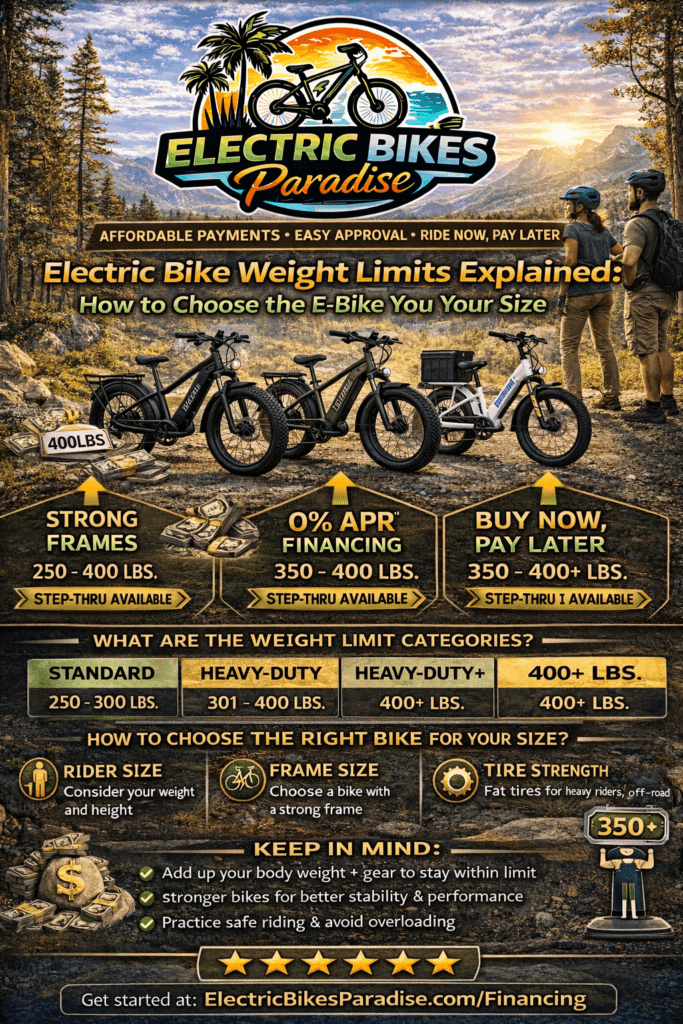
Most standard e-bikes have weight limits between 250 and 300 pounds. That covers maybe 80 percent of the population. But that doesn’t mean they’re not great bikes. It just means you need to know whether you fall within that range.
Why Weight Capacity Exists
The motor in an e-bike is sized for a certain amount of weight. If you’re heavier than expected, the motor has to work harder. It uses more battery power. It produces more heat. Over time, it can degrade faster.
The frame is designed to handle a certain amount of stress. Heavier riders put more stress on the frame. Exceed the design limit and you’re risking frame cracks or breaks.
The wheels need to support you without buckling. Heavier riders put more pressure on wheels. Too much pressure and the wheels can collapse. That’s terrifying when it happens.
The brakes need to stop you safely. More weight means more stopping power needed. If the brakes aren’t designed for your weight, your stopping distance increases. That’s a safety issue.
So weight capacity isn’t arbitrary. It’s about safety and reliability. Respect it.
Standard E-Bike Weight Limits
Most entry-level and mid-range e-bikes have weight limits of 250 to 275 pounds. These are solid bikes but they’re designed with an average rider in mind.
Better quality e-bikes often have limits of 275 to 300 pounds. These have stronger frames, better components, more powerful motors, and better brakes.
Cargo e-bikes often have limits of 300 to 350 pounds because they’re designed to carry cargo plus riders.
Heavy-duty e-bikes built specifically for heavier riders can have limits of 350 to 400 pounds or higher.
Don’t assume your bike falls into a category because it looks rugged. Check the actual spec sheet. A lightweight-looking mountain bike might have a 250-pound limit. A heavy commuter bike might have a 300-pound limit. You need to know for sure.
The Common Mistake: Ignoring Weight Capacity
A lot of people see an e-bike they like, they don’t check the weight limit, they buy it, and then they find out it’s not suitable for their weight. That’s a pain in the butt and it wastes money.
The weight limit is usually in the owner’s manual or on the manufacturer’s website. Sometimes it’s on the product listing. Always check before you buy.
And here’s the real talk: if you’re over the weight limit, the bike might still physically work for a while. You might ride it and nothing bad happens for months. But you’re risking failure, especially as the bike ages. That’s not worth the gamble.
Finding the Right Bike for Heavier Riders
If you’re a heavier person, you need to look specifically at bikes designed for heavier riders. These exist now and they’re actually really really good. Let me walk you through some real options.
Check out our complete guide to best electric bikes for heavy riders. This section covers everything you need to know about finding something that’ll actually work for you safely and reliably.
The Rattan LF/LM Ultra: 400-Pound Capacity
The Rattan LF/LM Ultra is built specifically for heavier riders and it does not mess around. This bike has a weight capacity of 400 pounds. That’s more than any standard commuter bike.
How do they achieve this? First, the frame is thicker and stronger. It’s built from reinforced aluminum that can handle stress. Second, the motor is more powerful, a 1,000-watt machine that can move heavier riders without struggling. Third, the wheels and brakes are industrial-grade, built for heavy-duty use.
The LF/LM Ultra is a cargo-style e-bike, which means it’s designed to carry weight. You get a solid platform in front for cargo or a wider, more comfortable seat for bigger riders. It’s not a speed demon, but it’s incredibly practical and reliable.
You’re spending about $2,500 to $3,000 for one of these, but here’s what you’re getting: a bike that’s actually designed for your weight and not a compromise. The motor won’t strain. The brakes will stop you properly. The wheels won’t buckle. That peace of mind is worth the investment.
The Velowave Brawny XM: 350-Pound Capacity
The Velowave Brawny XM is another excellent option for heavier riders. It’s got a 350-pound weight capacity and it’s built tough.
This one is more traditional-looking than the Rattan. It looks like a commuter e-bike, not a cargo bike. But the frame is reinforced and the components are all built for heavy use.
The motor is 1,000 watts, same as the Rattan. The battery is 52V, which means more power and better performance. The brakes are hydraulic, which gives you better stopping power than mechanical brakes.
The Brawny XM costs about $2,000 to $2,500 depending on where you buy it. It’s a bit cheaper than the Rattan and it looks less industrial if that matters to you.
The big difference here is that it’s more of a traditional commuter style instead of a cargo style. Some people prefer that look. The practicality is similar though.
The Eunorau DEFENDER-S: 350-Pound Capacity
The Eunorau DEFENDER-S is another really really solid option for heavier riders. It’s got a 350-pound capacity and it’s known for reliability.
This is a step-through design, which makes it easier to get on and off. That matters if you have any mobility issues. The frame is low, the seat is comfortable, and the whole geometry is designed for comfort over pure speed.
The motor is 750 watts, which is a bit less than the Rattan or Brawny, but it’s still plenty of power. The 48V battery gives you about 40 miles of range, which is solid.
The DEFENDER-S runs about $1,800 to $2,200. It’s one of the cheapest options for heavier riders, but it doesn’t sacrifice quality. Eunorau has a solid reputation for building reliable bikes.
This one is good if you want something comfortable, reliable, and not breaking the bank.
When a Standard Bike Won’t Work
Let me be clear: if you’re over 300 pounds, a standard e-bike is probably not going to work well for you long-term. You might be able to ride it for a bit, but you’re risking equipment failure.
That’s not judgment. It’s just physics. The bikes are engineered for a certain weight range. Go over that and you’re pushing components beyond their design limits.
The good news is that heavy-duty bikes exist now and they’re not terrible. You can find something suitable. It might cost a bit more, but it’ll last longer and it’ll be safer.
Understanding Weight Distribution on E-Bikes
Weight capacity is about total weight, but how that weight is distributed matters too. Most of your weight is on the seat and the pedals. Some goes to the handlebars.
If you’ve got weight distributed across a large surface, you’re fine. If you’re putting all your weight in one point, you can stress the frame.
That’s why cargo bikes have platforms. They distribute cargo weight across a wide area instead of putting it all on one spot. Same with pannier bags instead of a single heavy backpack.
When you’re shopping for a heavy-duty bike, think about how you’ll actually be riding. Are you carrying a backpack? Are you carrying cargo? Are you just riding your body weight? That affects what style of bike makes sense.
The Motor Power Question
Heavier riders benefit from more powerful motors. A 500-watt motor on a 250-pound rider works harder than a 500-watt motor on a 150-pound rider.
If you’re a heavier rider, look for bikes with 750-watt or 1,000-watt motors. These give you the power you need for good performance even at higher weights.
More motor power also means better hill climbing. If you live somewhere hilly, this is important. A weaker motor might struggle to get you up hills when you’re heavier. A stronger motor handles it easily.
The trade-off is that more powerful motors use more battery power. Your range might be shorter with a heavier rider on a high-power motor. But it’s better to have the power you need and less range than to have range but not enough power to climb hills.
Battery Size for Heavier Riders
Battery capacity is measured in watt-hours (Wh). A bigger battery gives you more range. For heavier riders, a bigger battery is often necessary because you’re using more power.
A standard e-bike might have a 500Wh battery. A heavier rider might need a 750Wh or even 1,000Wh battery to get decent range.
That sounds expensive but it’s actually worth it. A smaller battery will barely get you 20 miles with a heavier rider. A bigger battery will get you 40 to 50 miles. That’s the difference between a bike that barely works and one that’s actually practical.
Braking System Quality Matters
This is important: heavier riders need better brakes. Not all e-bike brakes are created equal.
Mechanical disc brakes are better than rim brakes for stopping power. Hydraulic disc brakes are even better because they modulate stopping power more smoothly.
For heavier riders, look specifically for hydraulic disc brakes. They give you confident stopping power in all conditions. You won’t worry about whether you can stop in an emergency.
Check the brake specs when you’re looking at bikes. Don’t assume a bike has good brakes just because it’s expensive. Some expensive bikes have mediocre brakes.
Wheel Quality for Heavier Riders
Wheels need to be strong enough to handle your weight. Heavier riders put more stress on wheels, so you need quality construction.
Look for bikes with double-walled rims instead of single-walled. Double-walled rims are stronger and less likely to dent or collapse.
The spoke count matters too. More spokes means stronger wheels. You want at least 32 spokes per wheel, preferably 36.
Tire width helps too. Wider tires distribute your weight over a larger area, reducing pressure on the rim. For heavier riders, look for tires at least 2 inches wide.
Frame Material Considerations
E-bike frames are usually aluminum, carbon fiber, or steel. For heavier riders, aluminum and steel are better than carbon fiber.
Carbon fiber can be strong, but it’s also more brittle. If it cracks, it’s often not repairable. Aluminum and steel can dent and bend, but they usually don’t crack catastrophically.
Aluminum frames are lighter and usually cheaper. Steel frames are heavier but stronger. Both are good for heavier riders.
Avoid cheap aluminum frames. They’re thin and prone to cracking under heavy stress. Pay for quality if you’re a heavier rider.
Suspension for Heavier Riders
Some e-bikes have suspension, some don’t. For heavier riders, suspension is actually nice because it helps absorb impacts.
You don’t need fancy full suspension. A simple front suspension works fine. It makes the ride more comfortable and it helps the bike handle bumps better.
Just make sure the suspension is rated for your weight. Some suspension systems have weight limits too. Check that it’ll handle you.
Seat Comfort for Heavier Riders
A good seat matters more for heavier riders because you’re putting more pressure on it. A cheap, thin seat is going to cause pain if you’re riding for more than 10 minutes.
Look for bikes with wide, thickly padded seats. Some higher-end bikes come with gel seats that are incredibly comfortable for longer rides.
You can always upgrade the seat later, but it’s nicer if it’s good from the start.
Testing Bikes in Person
If you’re a heavier rider, test riding is even more important than for regular riders. You need to feel how the bike handles your weight.
Sit on the seat fully. Bounce a little to see if it feels stable. Ride it, even if it’s just in the parking lot. Does it feel like the frame is strong? Does the steering feel solid? Do the brakes feel confident?
If a bike feels sketchy when you’re on it, trust that feeling. Don’t buy it hoping it’ll feel better at home. Pick a different bike.
Cargo Weight on Top of Body Weight
If you’re carrying cargo in addition to your body weight, you need to factor that into weight capacity calculations.
Let’s say you weigh 280 pounds and you have a 350-pound bike limit. You’ve got 70 pounds left for cargo. That’s about the weight of a full grocery load or a work laptop plus backup.
If you’re regularly carrying more cargo than that, you need a higher weight limit bike or a cargo-specific design.
Cargo bikes handle cargo better than regular bikes anyway. The cargo platform is designed for weight distribution. If you’re planning to carry stuff regularly, get a cargo bike, not a regular commuter bike with cargo added.
Maintenance Considerations for Heavier Riders
Heavier riders put more wear on bikes. You’re going to need maintenance more often.
Brake pads will wear faster. Plan on replacing them every 500 to 1,000 miles instead of 1,500 to 2,000 miles like lighter riders.
Tires might wear faster too. You’re putting more pressure on them.
Chains will wear normally, maybe a bit faster.
Budget for more frequent maintenance if you’re a heavier rider. It’s not shocking, but it’s worth knowing upfront.
Finding Bikes With Higher Weight Limits
If you’re looking for a bike with a high weight limit, here’s where to look:
Cargo e-bikes almost always have higher weight limits than commuter bikes. Even if you don’t want a cargo bike, looking at that category gives you bikes designed for more weight.
Mountain e-bikes often have higher weight limits than road bikes because they’re built tougher.
Fat tire bikes usually have higher limits because the bigger tires and heavier frame can handle it.
Brands that specifically market to heavier riders will have whole lines designed for high weight capacity. That’s actually a good sign because it means they’ve engineered the bikes properly.
Don’t Settle for the Wrong Bike
If you’re a heavier rider, don’t buy a standard e-bike that barely fits your weight limit. Pick something with actual room to spare. A 350-pound bike if you weigh 280 pounds is cutting it close. A 400-pound bike is much better.
The extra money for a properly-rated bike is worth it. You’ll be safer, the bike will last longer, and you’ll actually enjoy riding it instead of worrying whether you’re pushing the limits.
Check out the heavy riders section to see bikes that are actually designed for your needs.
The Reality of Second-Hand E-Bikes
If you’re looking at used e-bikes to save money, weight capacity still applies. Don’t buy a used bike that’s at or over its limit. Used components are more likely to fail.
You also don’t know how the previous owner used the bike. If they were over the weight limit, components might be stressed and ready to fail.
Buying used is okay if you’re under the weight limit with room to spare. But don’t use used bikes as an excuse to ignore weight limits.
Electric Motorcycles vs E-Bikes
If you’re really heavy or you want something that’s not a compromise, consider looking at electric motorcycles instead of e-bikes.
Electric motorcycles have much higher weight capacities, better suspension, and more powerful motors. They’re genuinely designed for bigger riders.
The downside is that they might require a motorcycle license in your area. Check your local laws.
They also cost more and take up more space. But if an e-bike just doesn’t fit your needs, this might be worth exploring.
The Misconception About Being Too Heavy
Let me be really clear: there’s no shame in being a heavier person or needing a heavy-duty e-bike. These bikes exist because they’re needed. A lot of people need them.
The bike companies that make high-capacity bikes aren’t doing it grudgingly. They’re doing it because it’s a real product category with real demand.
Don’t feel bad about needing a higher-capacity bike. Be glad it exists and get one that actually works for you.
Getting Expert Help
If you’re unsure about which bike is right for you, talk to someone who knows. Local e-bike shops often have experience with heavier riders and can guide you to the right choice.
Online, read reviews from people with similar weight to you. They’ll tell you if a bike actually works for their size.
Don’t just look at specs. Look at real reviews from real people with your weight who have owned the bike.
The Price Difference
Heavy-duty e-bikes cost more than standard bikes. Not crazy more, but noticeably more. A standard commuter might be $1,500. A heavy-duty commuter might be $2,200.
That extra money goes to stronger components, bigger motors, bigger batteries. It’s worth it.
Don’t try to save $500 by buying an undersized bike. You’ll spend way more replacing broken components.
Warranty Considerations
Heavy-duty bikes should come with good warranties because they’re expensive and they go through more wear. Look for a manufacturer warranty that covers the frame and major components for at least two years.
Some manufacturers are really really good about honoring warranties. Some are not. Buy from brands with good reputations for warranty service.
Long-Term Investment
A good heavy-duty e-bike should last you five to ten years with proper maintenance. That’s a long-term investment in your mobility and your health.
Spending $2,500 on a bike that lasts eight years is cheaper than buying three $1,000 bikes that each last three years and then break.
Invest in quality from the start. You’ll save money in the long run.
Getting Started with the Right Bike
If you’re a heavier rider, the right bike makes all the difference. You’re not making a compromise. You’re making a smart choice for your body and your needs.
Our heavy riders collection has bikes specifically designed for higher weight capacities. These aren’t compromise bikes. They’re the real deal.
Before you pick a specific bike, read our electric bike buying guide to understand all the features and what they mean for you.
Check out our guide to how electric bikes work so you understand the motor and battery stuff.
And if you want the real financial picture, check out our honest look at e-bike costs and benefits.
Once you’ve done that research, you’re ready to find your bike. Weight limits aren’t a limitation. They’re a specification that helps you pick the right tool for your body. Respect them and you’ll get a bike that lasts.