Published by Electric Bikes Paradise | Updated 2026
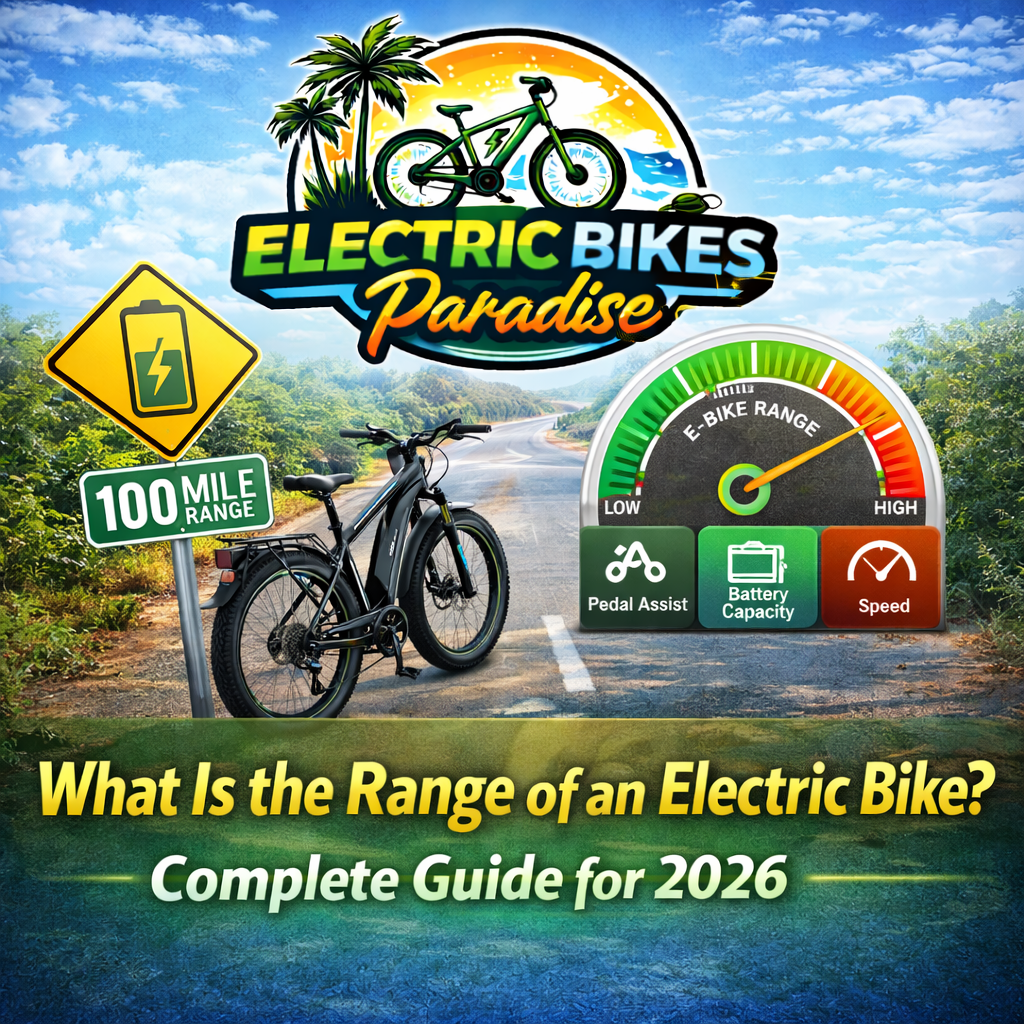
Range is one of the most important — and most misunderstood — specs when shopping for an electric bike. Ask ten different people how far an e-bike can go on a single charge and you’ll get ten different answers. That’s because e-bike range isn’t a fixed number. It’s a moving target influenced by a surprisingly large number of variables.
In this complete guide we’ll break down everything you need to know about e-bike range in 2026 — what the numbers actually mean, what affects range in the real world, how to calculate your expected range, how to maximize the miles you get from every charge, and what to look for when comparing e-bikes by range.
What Is E-Bike Range?
E-bike range refers to the distance you can travel on a single full battery charge before the motor assistance cuts out. Once the battery is depleted, the e-bike becomes a regular (though heavier) bicycle — you can still ride it, but entirely under your own power.
Most manufacturers publish a range estimate for their e-bikes, typically expressed in miles or kilometers. These estimates are generated under controlled testing conditions — usually flat terrain, moderate speed, a specific rider weight, and a specific assist level — and represent the best-case scenario for that battery.
Real-world range almost always differs from the manufacturer’s stated range. Understanding why is the key to setting realistic expectations and choosing the right battery for your needs.
How Far Can an Electric Bike Go? General Range by Battery Size
The most important factor in e-bike range is battery capacity, measured in watt-hours (Wh). Watt-hours are calculated by multiplying the battery’s voltage by its amp-hour rating:
Watt-Hours = Voltage × Amp-Hours
For example, a 48V 15Ah battery has 720Wh of capacity. A 52V 14Ah battery has 728Wh. The higher the watt-hour rating, the more energy the battery stores and the further you can ride.
Here’s a general real-world range guide by battery capacity for a rider of average weight (around 165 lbs) on mixed terrain at moderate assist:
| Battery Capacity | Estimated Real-World Range |
|---|---|
| 250–350Wh | 15–25 miles |
| 350–500Wh | 20–40 miles |
| 500–600Wh | 30–50 miles |
| 600–750Wh | 40–65 miles |
| 750Wh+ | 50–80+ miles |
These are real-world estimates — not manufacturer claims. Actual range in your specific situation could be higher or lower depending on the factors we’ll cover below.
What Affects Electric Bike Range?
1. Pedal Assist Level
The single biggest variable in your real-world range is how much motor assistance you use. E-bikes typically offer between three and five pedal assist levels, ranging from minimal help to maximum power.
Using your motor hard drains the battery fast. Here’s how assist level affects range as a rough multiplier on the bike’s rated range:
- PAS 0 (no assist): Unlimited range — you’re pedaling under your own power
- PAS 1 (eco mode): Up to 150–200% of rated range
- PAS 2–3 (tour/sport): Approximately rated range
- PAS 4–5 (high/turbo): 50–70% of rated range
- Throttle only: 30–50% of rated range
A rider who cruises on PAS 1 will get dramatically more range than one who hammers PAS 5 the entire ride. Learning to use your assist strategically — higher on climbs, lower on flats, none on descents — is the single most effective way to extend your range.
2. Terrain and Elevation
Flat terrain is far more energy-efficient than hilly terrain. Every hill requires the motor to work significantly harder, drawing more current from the battery. A 40-mile range on flat ground might shrink to 25–30 miles on a route with significant climbing.
Descents, on the other hand, require virtually no motor input. Skilled riders drop their assist to zero on downhills and let gravity do the work, conserving battery for the next climb.
If you ride in a hilly area, multiply your expected flat-terrain range by roughly 0.6–0.75 to get a realistic estimate for your typical route.
3. Rider and Cargo Weight
More weight requires more energy to move — it’s simple physics. Manufacturer range estimates are typically based on a rider weight of around 155–165 lbs. Heavier riders will see reduced range compared to these estimates.
As a rough guide:
- Under 150 lbs: Range may exceed rated estimate
- 150–200 lbs: Close to rated range
- 200–250 lbs: Expect 10–20% reduction
- Over 250 lbs: Expect 20–30% or more reduction
Adding cargo — panniers, a basket, a rear rack bag — also reduces range proportionally to the weight added.
4. Speed
Aerodynamic drag increases exponentially with speed. Riding at 20 mph requires roughly twice the energy of riding at 14 mph, even on perfectly flat terrain. This is why Class 3 e-bikes, ridden at their maximum 28 mph assisted speed, will get considerably less range than the same bike ridden at a more moderate pace.
If range is a priority, resisting the temptation to ride at maximum speed pays significant dividends. A comfortable cruising speed of 14–17 mph is far more efficient than pushing the motor to its limits.
5. Wind
Wind is one of the most underappreciated range factors. A strong headwind can reduce range by 20–30% or more — fighting the wind requires substantial additional motor effort. A tailwind, conversely, can meaningfully extend your range by reducing the work the motor needs to do.
If you regularly ride in windy conditions, plan your routes to ride into the wind on the way out and return with the tailwind, so you’re at full charge for the harder leg of the journey.
6. Temperature
Lithium-ion batteries — the type used in all modern e-bikes — are sensitive to temperature. Cold weather reduces battery efficiency and available capacity significantly.
- Below 32°F (0°C): Range can drop 20–40% compared to ideal conditions
- 32–50°F (0–10°C): Range reduced 10–25%
- 50–77°F (10–25°C): Optimal range — closest to rated figures
- Above 95°F (35°C): Mild efficiency loss; more concerning for long-term battery health than immediate range
To minimize cold-weather range loss, store the battery indoors overnight and install it on the bike just before your ride. A warm battery performs significantly better than a cold one.
7. Tire Pressure
Underinflated tires create more rolling resistance, which means the motor works harder to maintain speed — drawing more current and reducing range. This is one of the easiest range factors to control: check your tire pressure before every ride and keep tires inflated to the recommended PSI on the tire sidewall.
The effect is most pronounced on narrow, high-pressure commuter tires. Fat tire bikes already run at low pressures by design, so the relative impact is smaller — but still meaningful.
8. Tire Type and Width
Wider tires create more rolling resistance than narrower tires at the same pressure. Electric fat tire bikes with 4″+ tires will generally have lower range than a comparable bike with narrower tires, all else being equal. This is a trade-off — the traction, comfort, and versatility benefits of fat tires are significant, but range is one area where narrower tires have an advantage.
Tread pattern also matters. Aggressive knobbly tires designed for off-road traction create more rolling resistance on pavement than smoother, faster-rolling commuter tires.
9. Battery Age
As e-bike batteries go through charge cycles over time, they gradually lose capacity — a process called degradation. A battery that originally delivered 50 miles per charge may only deliver 38–42 miles after two to three years of regular use.
This is a normal and expected part of battery aging. Well-maintained batteries from quality manufacturers typically retain 70–80% of their original capacity after 500 charge cycles. For more on maximizing battery lifespan, see our How Long Do Electric Bike Batteries Last guide.
10. Braking Frequency
Every time you brake, you’re converting kinetic energy into heat — energy that was drawn from the battery. Riders who brake frequently (for example, in stop-and-go urban traffic) will use more battery per mile than riders who maintain a steady speed on open roads.
Smooth, anticipatory riding that minimizes unnecessary braking and acceleration is more energy-efficient and extends range.
11. Motor Type
Mid-drive motors generally achieve better range than hub motors of comparable power ratings, particularly on hilly terrain. This is because mid-drive motors work through the bike’s gears, allowing them to operate more efficiently across varying conditions. For a full comparison, see our Hub Motor vs Mid-Drive Electric Bike guide.
How to Calculate Your Expected E-Bike Range
Rather than relying solely on manufacturer claims, here’s a practical way to estimate your real-world range:
Step 1: Start with the manufacturer’s stated range.
Step 2: Adjust for your assist level. If you typically ride on PAS 3 and the manufacturer tested on PAS 2, reduce by 15–20%. If you mostly use PAS 1, increase by 20–40%.
Step 3: Adjust for terrain. If you ride hilly routes, multiply by 0.65–0.80 depending on severity.
Step 4: Adjust for weight. If you weigh significantly more than 165 lbs or carry regular cargo, reduce by 10–25%.
Step 5: Adjust for temperature if applicable. Cold weather riding in winter reduces range by 15–35%.
Step 6: The result is your realistic expected range under your typical conditions.
Example: A bike with a stated 60-mile range. You ride on PAS 3 (−15%), on moderately hilly terrain (×0.75), weigh 210 lbs (−15%), and it’s currently winter (−20%).
60 × 0.85 × 0.75 × 0.85 × 0.80 = approximately 26 miles
That’s a significant difference from the stated 60 miles — and exactly why understanding the variables matters when choosing an e-bike for your specific needs.
Manufacturer Range Claims: How to Read Them
E-bike manufacturers calculate their range estimates under conditions that favor maximum range — usually flat terrain, low assist, ideal temperature, and a lighter test rider. These figures represent a best-case scenario, not typical riding conditions.
When comparing e-bikes by range, look for:
Battery capacity in watt-hours: This is the most objective way to compare range potential between bikes. More watt-hours = more energy available.
Motor efficiency: A high-quality, efficient motor extracts more useful range from the same battery than a lower-quality motor. Mid-drive systems from brands like Bosch and Shimano are known for efficiency. Well-engineered hub motors from reputable brands also perform well.
The testing conditions: If a manufacturer specifies the conditions used for their range estimate (rider weight, assist level, terrain), you can make a more meaningful comparison. Many manufacturers don’t specify — apply healthy skepticism to claims that seem unusually high.
Real-world reviews: User reviews and independent tests are often the most reliable source of real-world range data. Look for reviews from riders with similar body weight and riding conditions to yours.
How to Maximize Your E-Bike Range
Getting the most range from every charge is partly about the bike you buy and partly about how you ride it. Here are the most effective strategies:
Use the lowest effective assist level. The single biggest range lever. Ride on PAS 1 or 2 whenever the terrain and your energy allow. Save higher assist for steep climbs and headwinds.
Pedal actively. The motor is most efficient when it’s supplementing your pedaling effort rather than doing all the work. The more you pedal, the less the motor has to do.
Maintain proper tire pressure. Check before every ride. Underinflated tires are a silent range killer.
Keep your battery warm. In cold weather, store the battery indoors and install it just before riding. A warm battery delivers noticeably more range than a cold one.
Anticipate stops. Smooth, anticipatory riding that avoids unnecessary braking and acceleration is more efficient than reactive, stop-and-go riding.
Reduce wind resistance. Tuck into a more aerodynamic position when riding at higher speeds. This matters more at 20+ mph than at lower speeds.
Charge smart. Keeping your battery between 20% and 80% for daily riding (not always charging to 100%) preserves long-term battery health and capacity. Full charges before long rides are fine.
Keep your drivetrain clean and lubricated. A dirty, dry chain and drivetrain create friction that the motor has to overcome. Regular maintenance keeps the drivetrain efficient. See our How to Maintain an Electric Bike guide for the full routine.
Reduce weight. Carry only what you need. Every pound of unnecessary cargo reduces range.
How Much Range Do You Actually Need?
Choosing the right battery size for your needs is one of the most important buying decisions you’ll make. Here’s a practical guide:
Short urban commute (under 10 miles each way): A 400–500Wh battery is more than adequate for most commuters in this category, with plenty of range to spare.
Medium commute (10–20 miles each way): A 500–600Wh battery provides comfortable margin for a 20–30 mile round trip, even accounting for real-world range reduction from hills and cold weather.
Long commute or recreational riding (20–40 miles): A 600–750Wh battery is recommended to ensure you have enough range for demanding conditions without range anxiety.
Extended adventure riding (40+ miles): Look for 750Wh+ batteries, dual-battery options, or bikes compatible with range extender batteries. Some riders carry a spare battery for very long rides.
A good rule of thumb is to choose a battery with at least 50% more capacity than your typical daily distance requires. This gives you buffer for hills, headwinds, cold weather, and battery aging over time.
What Is Range Anxiety — and How to Avoid It
Range anxiety is the worry that your battery will run out before you reach your destination. It’s a common concern for new e-bike riders but largely avoidable with a little planning.
Plan your route. Know the distance of your ride before you leave. If it’s close to your battery’s range, plan a charging stop or choose a more conservative assist level.
Check your battery level before you leave. Don’t start a long ride on a half-charged battery without a plan.
Learn your bike’s actual range in your conditions. After a few rides, you’ll have a realistic sense of how far your specific bike goes under your specific conditions. This practical knowledge is more valuable than any spec sheet.
Carry a charger on longer rides. A standard e-bike charger is relatively compact. Carrying one gives you the option to top up at a café, park, or any standard electrical outlet during longer adventures.
Use your display. Most e-bike displays show remaining battery percentage or bars. Keep an eye on it and adjust your assist level if you’re burning through charge faster than expected.
Frequently Asked Questions About E-Bike Range
How far can an electric bike go on one charge? Most quality e-bikes deliver 25–60 miles per charge under real-world conditions. High-capacity premium models can exceed 80 miles. Entry-level bikes with smaller batteries may deliver 15–25 miles.
What is the average range of an electric bike? The average consumer e-bike in 2026 has a battery in the 500–600Wh range and delivers approximately 30–50 miles per charge under typical real-world conditions at moderate assist.
How do I know how much battery I have left? Your e-bike’s handlebar display shows remaining battery level, typically as a percentage or bar indicator. Check it regularly during rides and recharge before it drops below 20%.
Can I ride my e-bike when the battery is dead? Yes — an e-bike with a depleted battery is still a functional bicycle. However, e-bikes are significantly heavier than regular bikes (45–75 lbs), so riding without motor assistance is considerably more effort than riding a standard bicycle.
Does regenerative braking extend e-bike range? Some e-bikes feature regenerative braking that captures energy during braking and feeds it back to the battery. The range gain from regenerative braking on an e-bike is modest — typically 5–10% in urban conditions — because e-bikes are much lighter than cars and the energy recovered is proportionally smaller.
Can I extend my range with a second battery? Yes — some e-bike models support dual batteries or range extender batteries that effectively double your range. If maximum range is a priority, look for bikes that offer this option.
Shop Electric Bikes by Range at Electric Bikes Paradise
Whether you need a compact commuter with enough range for a short daily ride or a long-range adventure bike for extended exploration, Electric Bikes Paradise has the right e-bike for your needs — all backed by free shipping to the lower 48 states, our lowest price guarantee, and expert customer support.
Browse our categories:
- Electric Bikes
- Electric Mountain Bikes
- Electric Fat Tire Bikes
- Folding Electric Bikes
- Folding Fat Tire Electric Bikes
- Electric Trikes
- Step-Through Electric Bikes
- Electric Beach Cruiser Bikes
- Electric Hunting Bikes
- Electric Scooters
- Mobility Scooters
Have questions about which e-bike has the right range for your needs? Our team of e-bike experts is available Monday–Friday, 9am–5pm MST.
Electric Bikes Paradise | Ecom Paradise LLC 5830 E 2nd St, Ste. 7000 #715, Casper, WY 82609, United States 📞 307-429-0021 ✉️ sales@electricbikesparadise.com Facebook | Pinterest | YouTube | Instagram | TikTok