Published by Electric Bikes Paradise | Updated 2026
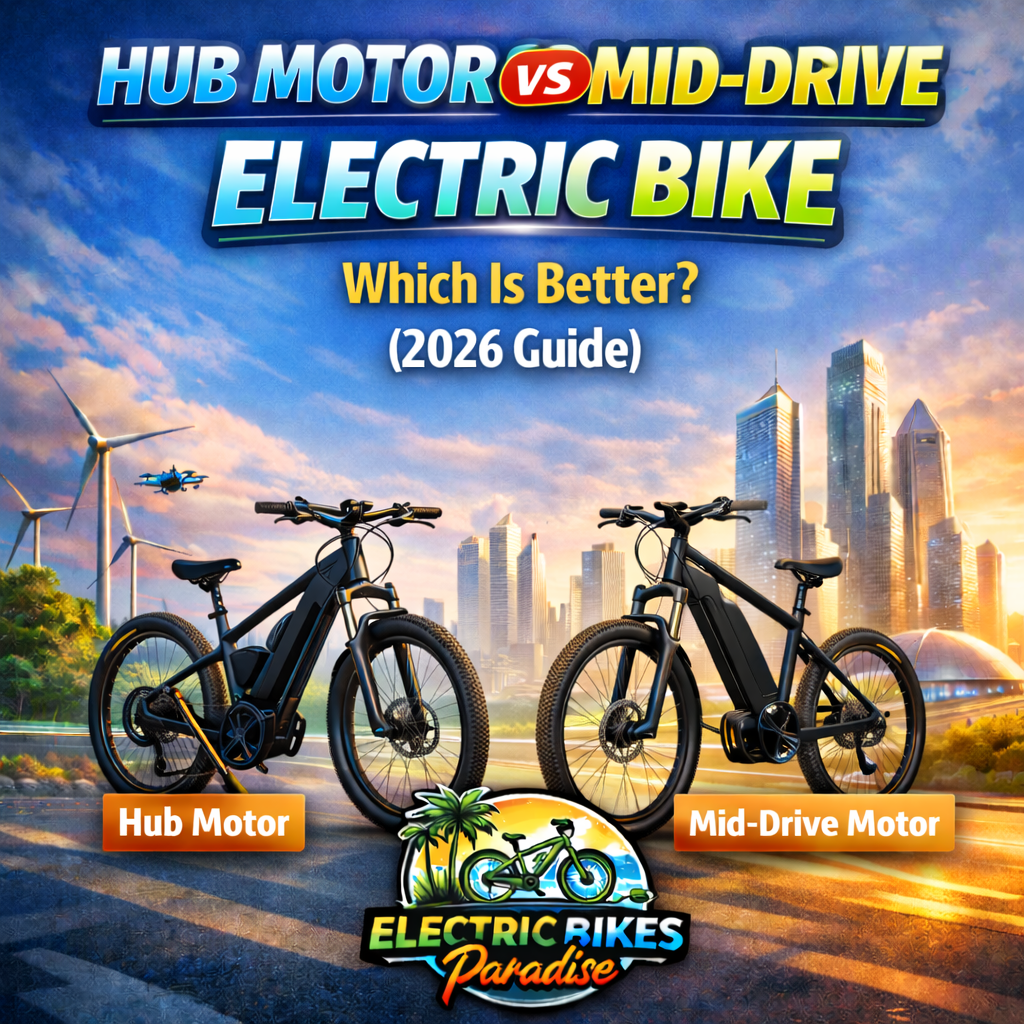
When shopping for an electric bike, one of the most important technical decisions you’ll face is choosing between a hub motor and a mid-drive motor. These two motor configurations represent fundamentally different approaches to how an e-bike delivers power, and each has distinct advantages and disadvantages depending on how and where you ride.
Understanding the difference between hub motors and mid-drive motors will help you make a smarter buying decision and ensure you end up with an e-bike that performs exactly the way you need it to. In this comprehensive guide, we’ll break down everything you need to know about both motor types — how they work, their pros and cons, cost differences, performance characteristics, and which type of rider each is best suited for.
How Do E-Bike Motors Work?
Before comparing the two types, it helps to understand the basics of how e-bike motors function. Both hub motors and mid-drive motors are electric motors that convert electrical energy from the battery into mechanical energy that propels the bike. The key difference is where on the bike the motor is located and how it delivers power to the drivetrain.
For a complete overview of how all e-bike components work together, see our How Do Electric Bikes Work guide.
What Is a Hub Motor?
A hub motor is an electric motor built directly into the center hub of either the front or rear wheel. When the motor activates, it spins the wheel directly — independently of the bike’s gears, chain, and drivetrain.
Rear hub motors are by far the most common configuration on consumer e-bikes. They provide a natural pushing sensation from the rear wheel, good traction on most surfaces, and integrate cleanly into the bike’s design.
Front hub motors are less common. They drive the front wheel and can feel somewhat unnatural — like being pulled forward — especially on steep climbs where front wheel traction is reduced. They’re occasionally used on conversion kits and entry-level bikes but are not widely favored.
For the purposes of this comparison, when we refer to hub motors, we’re primarily discussing rear hub motors, which are the dominant configuration in the market.
What Is a Mid-Drive Motor?
A mid-drive motor is positioned at the center of the bike, integrated into the frame at the bottom bracket — the same location where the pedal cranks are attached. Rather than driving the wheel directly, a mid-drive motor drives the bike’s chain and works in conjunction with the existing gears.
This means when you shift to a lower gear on a mid-drive e-bike, the motor also benefits from that lower gear, just like your legs do. The motor’s power is multiplied through the gearing system, allowing it to deliver more effective torque on hills without requiring a larger, heavier motor.
Mid-drive motors are found on premium e-bikes and are the standard configuration for high-performance electric mountain bikes and many high-end commuter models.
Hub Motor vs Mid-Drive: Performance
Hill Climbing
This is where the two motor types differ most significantly in real-world use.
Hub motors deliver a fixed amount of torque regardless of which gear the bike is in. On flat terrain, this works perfectly well. On steep hills, however, a hub motor must work much harder to maintain speed, drawing more current from the battery and generating more heat. Many hub motor e-bikes struggle on sustained steep climbs and may overheat on long, demanding ascents if the motor is underpowered for the terrain.
Mid-drive motors shine on hills because they work through the bike’s gears. Shift to a lower gear before a climb and the motor’s torque is multiplied just like your leg power would be. This allows mid-drive motors to tackle steep, sustained climbs with far less strain than hub motors of comparable rated wattage. The result is more efficient climbing, less battery drain on hills, and a more natural riding feel.
Winner for hill climbing: Mid-drive
Flat Terrain and Commuting
On flat roads and gentle terrain — which describes the majority of commuting scenarios — hub motors perform excellently. They deliver smooth, consistent power and require no special gear management from the rider. Many commuters find hub motor e-bikes perfectly adequate for their daily rides.
Mid-drive motors also perform well on flat terrain but their advantages are less pronounced compared to hilly conditions. The added complexity of coordinating gears with motor assist is more noticeable and requires slightly more rider engagement.
Winner for flat terrain: Hub motor (simpler, sufficient, less to manage)
Speed
Both motor types can achieve similar top speeds. The difference lies in how efficiently they reach and maintain those speeds across varying conditions. Mid-drive motors tend to maintain performance more consistently across a wider range of terrain, while hub motors may lose efficiency on grades.
Winner for speed: Roughly equal on flat terrain
Power Delivery and Ride Feel
Hub motors typically use cadence sensors — they detect when you’re pedaling and deliver a set level of power. This can feel somewhat mechanical, with a slight delay between pedaling and motor activation, and a consistent buzz of power that doesn’t always vary with your effort level.
Mid-drive motors often use torque sensors that measure how hard you’re pushing on the pedals and vary the motor output accordingly. The harder you push, the more assistance you get. This creates a riding experience that feels remarkably natural and intuitive — like having very strong legs rather than a motor strapped to your bike. Torque sensing mid-drive systems from brands like Bosch, Shimano Steps, and Bafang are widely praised for the quality of their power delivery.
Winner for ride feel: Mid-drive (especially with torque sensing)
Hub Motor vs Mid-Drive: Battery Efficiency and Range
Hub motors drive the wheel directly without the benefit of gearing, which means they operate at a fixed mechanical advantage. In conditions that don’t suit their optimum operating speed — particularly at very low speeds climbing steep hills — they become less efficient and draw more current from the battery.
Mid-drive motors leverage the bike’s gears to always operate near their optimum efficiency point. By shifting to the appropriate gear for the terrain, the motor works in its ideal power band more consistently, which translates to better battery efficiency and longer range per charge — particularly on mixed terrain.
In real-world testing, mid-drive e-bikes often deliver 10–30% more range than hub motor e-bikes with comparable batteries when ridden on hilly routes. On flat terrain, the efficiency difference is less pronounced.
Winner for battery efficiency: Mid-drive, particularly on hilly terrain
Hub Motor vs Mid-Drive: Weight and Handling
Hub motors add weight to the wheel — specifically unsprung weight at the rear axle. This can slightly affect the bike’s handling, particularly on rough terrain where the heavy wheel is slower to respond to surface changes. The effect is noticeable on technical off-road riding but largely imperceptible on pavement.
Mid-drive motors are centrally located in the bike’s frame, low and between the wheels. This central mass placement gives mid-drive e-bikes better weight distribution and handling characteristics compared to hub motor bikes. The bike feels more balanced and closer to the handling of a regular bicycle.
Winner for handling and weight distribution: Mid-drive
Hub Motor vs Mid-Drive: Maintenance
Hub motors are largely self-contained sealed units with very few moving parts exposed to the elements. Because the motor drives the wheel directly, the chain and drivetrain experience no additional stress from the motor — only from your pedaling. This means hub motor drivetrains wear more slowly than mid-drive drivetrains. Hub motors are also simpler to understand and repair, and flat tires on a rear hub motor wheel are the most significant maintenance complication (covered in detail in our How to Fix a Flat Tire on an Electric Bike guide).
Mid-drive motors route all of their power through the bike’s chain, which means the chain, cassette, and chainring wear significantly faster than on a hub motor bike — sometimes 2–3 times faster for riders who use high assist levels frequently. Chains on mid-drive e-bikes may need replacement every 500–1,000 miles rather than the 1,500–2,500 miles typical of a hub motor bike. This is an important ongoing cost consideration.
Mid-drive motors are also mechanically more complex and integrated into the frame, which makes repairs more involved and typically more expensive than hub motor servicing.
Winner for maintenance simplicity and cost: Hub motor
Hub Motor vs Mid-Drive: Cost
Hub motor e-bikes are significantly less expensive to manufacture, which translates to lower prices for consumers. Quality hub motor e-bikes are widely available in the $800–$2,500 range, making them the dominant choice at entry and mid-range price points.
Mid-drive e-bikes cost more — often significantly more — due to the greater engineering complexity, higher-quality components, and premium motor systems. Entry-level mid-drive e-bikes start around $1,500–$2,000, with most quality mid-drive models falling in the $2,500–$6,000+ range. Premium mid-drive systems from Bosch, Shimano, and Yamaha are found on bikes that represent a meaningful long-term investment.
Winner for cost: Hub motor
Hub Motor vs Mid-Drive: Noise
Hub motors are generally very quiet in operation — often nearly silent. This makes them a popular choice for riders who prefer a discreet, quiet riding experience.
Mid-drive motors tend to produce slightly more noise than hub motors, particularly under heavy load. The noise from mid-drive systems — a moderate hum or whir — comes from the motor engaging with the drivetrain. While not loud by any means, it is more noticeable than the near-silence of a quality hub motor.
This is particularly relevant for electric hunting bikes, where a quiet motor is essential for not spooking wildlife. Hub motors are the preferred choice for hunting applications.
Winner for quiet operation: Hub motor
Hub Motor vs Mid-Drive: Compatibility With Different Bike Types
Hub motors are compatible with virtually any bike frame and wheel size. They can be added to existing bikes as conversion kits and are found across every e-bike category from commuters to fat tire bikes to beach cruisers. The simplicity of hub motor integration makes them the default choice for a wide range of bike styles.
Mid-drive motors require a frame specifically designed around the motor’s bottom bracket housing. They cannot be retrofitted to standard bicycle frames without significant modification. Mid-drive systems are most commonly found on purpose-built e-bikes, particularly electric mountain bikes, trekking bikes, and premium commuter models.
Winner for compatibility: Hub motor
Real-World Scenarios: Which Motor Is Right for Your Riding Style?
Urban Commuter on Flat to Moderately Hilly Terrain
For the majority of commuters riding in cities and suburbs on relatively flat to gently rolling terrain, a rear hub motor e-bike is an excellent choice. It’s simpler to operate, quieter, more affordable, and requires less drivetrain maintenance. The power delivery is smooth and consistent, and the motor will handle moderate hills without difficulty.
Our electric bikes collection includes a wide range of hub motor commuter models perfect for this use case. Step-through electric bikes and folding electric bikes are particularly popular hub motor choices for commuters.
Mountain and Off-Road Rider
For technical trail riding, steep climbs, and demanding off-road terrain, a mid-drive motor is strongly recommended. The ability to leverage gears for climbing efficiency, combined with better weight distribution and more natural power delivery, makes mid-drive motors significantly better suited for electric mountain bikes than hub motor alternatives.
The performance difference on steep, technical terrain is substantial enough that serious off-road riders almost universally prefer mid-drive.
Recreational and Casual Rider
For casual recreational riding on bike paths, light trails, and neighborhood streets, a hub motor e-bike provides excellent performance at a significantly lower price point. Unless you’re regularly tackling demanding hills, the performance advantages of a mid-drive motor may not be worth the additional cost for a casual rider.
Electric fat tire bikes and electric beach cruiser bikes are popular hub motor choices for recreational riders.
Senior or Accessibility-Focused Rider
For seniors and riders focused on comfort, stability, and ease of use, hub motor e-bikes are typically the better fit. They’re simpler to operate, require no special attention to gear management, are quieter, and are available at more accessible price points. Electric trikes — which offer three-wheel stability — almost exclusively use hub motors and are an excellent choice for riders with balance concerns.
Hunter or Backcountry Rider
For hunting and backcountry access, where silence is essential and terrain can be demanding, the choice depends on the specific terrain. If your hunting ground involves significant climbing, a mid-drive motor’s efficiency advantage is meaningful. If the terrain is relatively flat, a hub motor’s near-silence may be the more important factor. Our electric hunting bikes are designed with these specific requirements in mind.
Long-Distance Rider
For riders covering significant distances — particularly on varied terrain — a mid-drive motor’s superior battery efficiency delivers real-world range advantages that matter on longer routes. If you regularly ride 40+ miles per charge or tackle extended climbs, a mid-drive system’s better efficiency translates to meaningful additional range.
Summary: Hub Motor vs Mid-Drive at a Glance
| Category | Hub Motor | Mid-Drive |
|---|---|---|
| Hill climbing | Good | Excellent |
| Flat terrain | Excellent | Excellent |
| Ride feel | Good | Excellent (with torque sensor) |
| Battery efficiency | Good | Excellent (especially on hills) |
| Weight distribution | Rear-heavy | Centered (better) |
| Maintenance | Simple, lower cost | More complex, higher cost |
| Drivetrain wear | Normal | Accelerated |
| Noise | Very quiet | Slightly more noise |
| Price | Lower | Higher |
| Best for | Commuting, recreational, casual | Mountain, demanding terrain, performance |
Which Motor Type Should You Choose?
Choose a hub motor if:
- You primarily ride on flat to moderately hilly terrain
- You’re a commuter, recreational rider, or casual cyclist
- Budget is an important consideration
- You want lower ongoing maintenance costs
- You prefer a quieter, simpler riding experience
- You’re shopping for a folding, step-through, trike, or beach cruiser style e-bike
Choose a mid-drive if:
- You regularly ride steep hills or demanding terrain
- You want the most natural, intuitive riding feel
- You’re an off-road or mountain bike rider
- Long range on hilly routes is a priority
- You’re willing to invest more upfront for superior performance
- You want the best weight distribution and handling
Shop Electric Bikes at Electric Bikes Paradise
Whether you’re looking for a hub motor commuter bike or a premium mid-drive mountain bike, Electric Bikes Paradise has the perfect e-bike for your riding style. We carry a carefully curated selection of electric bikes from trusted brands — all backed by free shipping to the lower 48 states, our lowest price guarantee, and expert customer support.
Browse our categories:
- Electric Bikes
- Electric Mountain Bikes
- Electric Fat Tire Bikes
- Folding Electric Bikes
- Folding Fat Tire Electric Bikes
- Electric Trikes
- Step-Through Electric Bikes
- Electric Beach Cruiser Bikes
- Electric Hunting Bikes
- Electric Scooters
- Mobility Scooters
Have questions about which motor type is right for your needs? Our team of e-bike experts is available Monday–Friday, 9am–5pm MST.
Electric Bikes Paradise | Ecom Paradise LLC 5830 E 2nd St, Ste. 7000 #715, Casper, WY 82609, United States 📞 307-429-0021 ✉️ sales@electricbikesparadise.com Facebook | Pinterest | YouTube | Instagram | TikTok