Published by Electric Bikes Paradise | Updated 2026
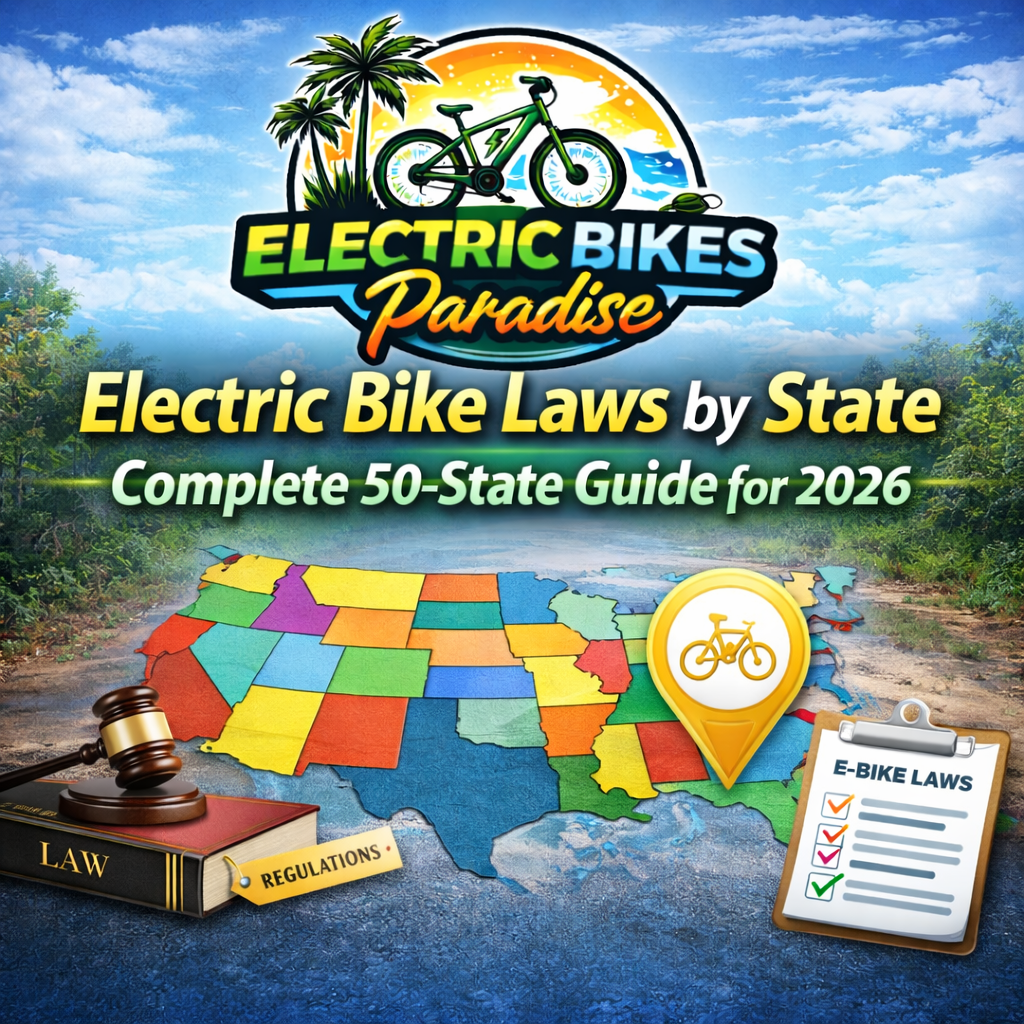
Electric bike laws in the United States vary significantly from state to state. While the majority of states have adopted the three-class e-bike framework and treat standard e-bikes as bicycles — requiring no license, registration, or insurance — the specifics around speed limits, age requirements, helmet laws, trail access, and where you can ride differ meaningfully depending on where you live.
This comprehensive state-by-state guide covers e-bike laws across all 50 states so you can ride confidently, legally, and safely in 2026. Before we dive in, here’s a quick refresher on the three-class system that forms the foundation of most state e-bike laws.
The Three-Class E-Bike System: A Quick Refresher
As we cover in detail in our Class 1 vs Class 2 vs Class 3 Electric Bike guide, the three-class framework categorizes e-bikes as follows:
- Class 1: Pedal assist only, no throttle, maximum assisted speed 20 mph
- Class 2: Pedal assist and throttle, maximum assisted speed 20 mph
- Class 3: Pedal assist only, maximum assisted speed 28 mph (some states permit a throttle limited to 20 mph)
Most states that have adopted this framework require no license, registration, or insurance for any of the three classes. The key differences between states come down to helmet requirements, minimum age for Class 3 bikes, where each class can be ridden, and whether the state has formally adopted the three-class system at all.
Important note: E-bike laws are actively evolving. Always verify the current rules in your specific state and municipality before riding, as regulations may have changed since this guide was published. This guide provides a general overview and should not be considered legal advice.
Alabama
Alabama has adopted the three-class e-bike framework. E-bikes are classified as bicycles and do not require registration, licensing, or insurance. Riders under 16 must wear a helmet. E-bikes are permitted on roads and bike paths where traditional bicycles are allowed.
Alaska
Alaska permits e-bikes and generally treats them as bicycles. No license or registration is required for standard e-bikes. Helmet laws apply to riders under 16. Given Alaska’s vast and varied terrain, local rules in specific municipalities and trail systems may vary.
Arizona
Arizona has adopted the three-class e-bike system. No license, registration, or insurance is required for Class 1, 2, or 3 e-bikes. There is no statewide helmet requirement for adult riders, though helmets are strongly recommended. E-bikes are permitted where traditional bicycles are allowed.
Arkansas
Arkansas has adopted e-bike legislation recognizing the three-class system. E-bikes are classified as bicycles and require no license or registration. Riders under 21 must wear a helmet. E-bikes are permitted on roads and bike paths open to traditional bicycles.
California
California was among the first states to formally adopt the three-class e-bike system and has some of the clearest, most comprehensive e-bike laws in the country.
- No license or registration required for Class 1, 2, or 3
- Class 3 e-bikes: minimum age 16, helmet required for all riders regardless of age
- Class 1 and 2: helmet required for riders under 18
- Class 3 e-bikes are not permitted on bike paths or trails where motor vehicles are prohibited unless local authorities grant permission
- Class 1 e-bikes have the broadest path and trail access
- A speedometer is required on Class 3 e-bikes
California’s trail access rules vary significantly by land management agency. Many state parks and trails are open to Class 1 e-bikes. Always check with the specific managing agency before riding.
Colorado
Colorado has fully adopted the three-class e-bike framework with clear, rider-friendly regulations.
- No license or registration required for any class
- Class 3 e-bikes: minimum age 16, helmet required for all riders
- Class 1 and 2: helmet required for riders under 18
- E-bikes permitted wherever traditional bicycles are allowed unless specifically restricted
- Colorado has been progressive in opening state trails to Class 1 e-bikes
- Denver and other municipalities may have additional local rules
Connecticut
Connecticut recognizes e-bikes and generally permits them where traditional bicycles are allowed. No license or registration is required for standard e-bikes. Helmet laws apply. Connecticut has been working toward fuller adoption of the three-class framework — verify current rules with the Connecticut DMV.
Delaware
Delaware has adopted e-bike legislation permitting Class 1, 2, and 3 e-bikes without requiring a license or registration. Helmets are required for riders under 18. E-bikes are permitted on roads and bike paths open to traditional bicycles.
Florida
Florida has adopted the three-class e-bike system with straightforward, permissive rules.
- No license, registration, or insurance required for any class
- Helmet required for riders under 16
- E-bikes permitted wherever traditional bicycles are allowed
- Florida has been particularly progressive in opening state park trails to e-bikes
- Class 1 and 2 e-bikes are permitted on most state park trails
- No minimum age requirement for Class 1 and 2; check local rules for Class 3
Florida’s warm climate and extensive trail network make it one of the most e-bike-friendly states in the country.
Georgia
Georgia recognizes e-bikes and treats standard models as bicycles. No license or registration is required. Helmet required for riders under 16. E-bikes are generally permitted where traditional bicycles are allowed. Georgia has been moving toward fuller adoption of the three-class framework.
Hawaii
Hawaii has adopted e-bike regulations permitting Class 1, 2, and 3 e-bikes without requiring a license or registration. Helmet required for riders under 16. Given Hawaii’s unique geography and trail systems, local rules vary significantly by island and municipality. Check with county-level authorities for specific trail access rules.
Idaho
Idaho has adopted the three-class e-bike system. No license or registration required. No statewide helmet requirement for adult riders. E-bikes are permitted where traditional bicycles are allowed. Idaho has significant BLM and Forest Service land where federal e-bike access policies apply.
Illinois
Illinois has adopted the three-class e-bike framework. No license or registration required for Class 1, 2, or 3 e-bikes. Helmet required for riders under 16. Class 3 minimum age is 16. E-bikes are permitted on roads and designated bike paths. Chicago and other municipalities may have additional local regulations.
Indiana
Indiana has adopted e-bike legislation recognizing all three classes as bicycles. No license or registration required. Helmet required for riders under 18. E-bikes are generally permitted where traditional bicycles are allowed.
Iowa
Iowa recognizes e-bikes and generally permits standard models where traditional bicycles are allowed. No license or registration required. No statewide helmet requirement. Iowa has been working toward fuller adoption of the three-class framework — verify current rules with the Iowa DOT.
Kansas
Kansas permits e-bikes and treats standard models as bicycles. No license or registration required. No statewide helmet requirement for adults. E-bikes are generally permitted where traditional bicycles are allowed.
Kentucky
Kentucky has adopted e-bike legislation recognizing the three-class system. No license or registration required. Helmet required for riders under 21. E-bikes are permitted where traditional bicycles are allowed.
Louisiana
Louisiana recognizes e-bikes and has adopted regulations permitting them without requiring a license or registration for standard models. Helmet required for riders under 12. E-bikes are generally permitted where traditional bicycles are allowed.
Maine
Maine has adopted e-bike regulations permitting Class 1, 2, and 3 e-bikes without requiring a license or registration. Helmet required for riders under 16. E-bikes are permitted on roads and bike paths open to traditional bicycles.
Maryland
Maryland has adopted the three-class e-bike framework.
- No license or registration required for any class
- Helmet required for all riders under 16
- Class 3 minimum age 16, helmet required for all Class 3 riders
- E-bikes permitted on roads and bike paths where traditional bicycles are allowed
- Local jurisdictions including Montgomery County and Baltimore may have additional rules
Massachusetts
Massachusetts has been slower than many states to fully adopt the three-class e-bike framework, but has regulations permitting e-bikes.
- No license required for standard e-bikes
- Helmet required for riders under 16
- Rules around Class 3 and throttle-equipped e-bikes have been more restrictive — verify current rules with the Massachusetts RMV
- Local rules in cities including Boston may differ from statewide regulations
Michigan
Michigan has adopted the three-class e-bike system with clear regulations.
- No license or registration required for Class 1, 2, or 3
- No statewide helmet requirement for adult riders
- Helmet required for riders under 18 on Class 3
- Class 3 minimum age 14
- E-bikes permitted on roads, bike lanes, and paths where traditional bicycles are allowed
- Local trail access varies — check with specific trail managers
Minnesota
Minnesota has adopted e-bike legislation recognizing all three classes as bicycles. No license or registration required. Helmet required for riders under 18. E-bikes are permitted where traditional bicycles are allowed. Minnesota has a growing network of bike trails — check with individual trail systems for e-bike access rules.
Mississippi
Mississippi recognizes e-bikes and generally permits standard models without requiring a license or registration. No statewide helmet requirement. Rules are less formally codified than in states with full three-class adoption — verify current rules locally.
Missouri
Missouri has adopted the three-class e-bike framework. No license or registration required. No statewide helmet requirement for adults. Helmet required for riders under 26 in some municipalities. E-bikes are permitted where traditional bicycles are allowed.
Montana
Montana permits e-bikes and treats standard models as bicycles. No license or registration required. No statewide helmet requirement. Montana has significant BLM and Forest Service land where federal e-bike access policies apply. Local trail rules vary — check with specific managing agencies.
Nebraska
Nebraska has adopted e-bike legislation recognizing the three-class system. No license or registration required. Helmet required for riders under 16. E-bikes are permitted where traditional bicycles are allowed.
Nevada
Nevada has adopted the three-class e-bike framework. No license or registration required for Class 1, 2, or 3. No statewide helmet requirement for adult riders. E-bikes are permitted on roads and bike paths where traditional bicycles are allowed. Las Vegas and Reno may have additional local regulations.
New Hampshire
New Hampshire recognizes e-bikes and permits standard models without requiring a license or registration. Helmet required for riders under 16. New Hampshire has been working toward fuller adoption of the three-class framework — verify current rules with the NH DMV.
New Jersey
New Jersey has adopted e-bike regulations permitting Class 1, 2, and 3 e-bikes.
- No license or registration required for standard e-bikes
- Helmet required for riders under 17
- Class 3 minimum age 15
- E-bikes permitted on roads and bike paths where traditional bicycles are allowed
- Local rules in Jersey City, Newark, and other municipalities may differ
New Mexico
New Mexico has adopted the three-class e-bike framework. No license or registration required. No statewide helmet requirement for adult riders. E-bikes are permitted where traditional bicycles are allowed. New Mexico has significant BLM land where federal e-bike access policies apply.
New York
New York has had a more complex e-bike regulatory history but has moved toward broader acceptance of the three-class framework.
- No license or registration required for Class 1, 2, and 3 e-bikes
- Helmet required for riders under 14
- New York City has specific rules for throttle-equipped e-bikes and delivery riders — verify current NYC-specific regulations before riding in the city
- Class 3 e-bikes permitted on roads; access to paths and trails varies by managing agency
- The state’s extensive trail network has its own rules — check with specific trail managers
North Carolina
North Carolina has adopted the three-class e-bike framework. No license or registration required. Helmet required for riders under 16. E-bikes are permitted where traditional bicycles are allowed. Local rules may vary by municipality.
North Dakota
North Dakota recognizes e-bikes and generally permits standard models where traditional bicycles are allowed. No license or registration required. No statewide helmet requirement. Rules are less formally codified — verify current rules locally.
Ohio
Ohio has adopted the three-class e-bike framework. No license or registration required for any class. No statewide helmet requirement for adult riders. Helmet required for riders under 18. E-bikes are permitted on roads and bike paths where traditional bicycles are allowed.
Oklahoma
Oklahoma recognizes e-bikes and permits standard models without requiring a license or registration. No statewide helmet requirement for adults. Oklahoma has been working toward fuller three-class adoption — verify current rules with the Oklahoma DPS.
Oregon
Oregon has adopted the three-class e-bike framework with clear, progressive regulations.
- No license or registration required for any class
- Helmet required for all riders under 16
- E-bikes permitted on roads, bike lanes, and most bike paths
- Oregon has been progressive in opening state trails to e-bikes, particularly Class 1
- Class 3 e-bikes may have more restricted access on some shared-use paths
- Portland and other municipalities may have additional local rules
Pennsylvania
Pennsylvania has adopted e-bike legislation recognizing the three-class system. No license or registration required. Helmet required for riders under 12. E-bikes are permitted on roads and bike paths where traditional bicycles are allowed. Philadelphia and Pittsburgh may have additional local regulations.
Rhode Island
Rhode Island recognizes e-bikes and permits standard models without requiring a license or registration. Helmet required for riders under 16. Rhode Island has been working toward fuller three-class adoption — verify current rules locally.
South Carolina
South Carolina has adopted e-bike regulations permitting Class 1, 2, and 3 e-bikes without requiring a license or registration. No statewide helmet requirement for adults. E-bikes are permitted where traditional bicycles are allowed.
South Dakota
South Dakota recognizes e-bikes and generally permits standard models where traditional bicycles are allowed. No license or registration required. No statewide helmet requirement. Rules are less formally codified — verify current rules locally.
Tennessee
Tennessee has adopted the three-class e-bike framework. No license or registration required for any class. No statewide helmet requirement for adults. Helmet required for riders under 16. E-bikes are permitted on roads and bike paths where traditional bicycles are allowed.
Texas
Texas has adopted the three-class e-bike framework with clear, permissive regulations.
- No license, registration, or insurance required for any class
- No statewide helmet requirement for adult riders
- Helmet required for riders under 18 in some municipalities
- E-bikes permitted on roads, bike lanes, and paths where traditional bicycles are allowed
- Texas has significant BLM land and state park trails — access varies by specific location
- Local rules in Houston, Dallas, Austin, and San Antonio may differ
Utah
Utah has adopted the three-class e-bike framework. No license or registration required. No statewide helmet requirement for adults. Utah has been progressive in opening state and BLM trails to e-bikes, particularly Class 1. Moab and other popular riding destinations have developed specific e-bike access policies — check before riding.
Vermont
Vermont recognizes e-bikes and permits standard models without requiring a license or registration. Helmet required for riders under 16. Vermont has been working toward fuller three-class adoption — verify current rules with the Vermont DMV.
Virginia
Virginia has adopted the three-class e-bike framework. No license or registration required for any class. No statewide helmet requirement for adults. Helmet required for riders under 14. E-bikes are permitted on roads and bike paths where traditional bicycles are allowed. Northern Virginia jurisdictions near Washington D.C. may have additional local regulations.
Washington
Washington state has adopted the three-class e-bike framework with clear regulations.
- No license or registration required for any class
- Helmet required for all riders regardless of age
- E-bikes permitted on roads, bike lanes, and most bike paths
- Washington has been progressive in opening state trails to e-bikes
- Class 1 e-bikes have the broadest trail access; Class 3 may be restricted on some shared-use paths
- Seattle and other municipalities may have additional local rules
West Virginia
West Virginia recognizes e-bikes and permits standard models without requiring a license or registration. Helmet required for riders under 15. E-bikes are generally permitted where traditional bicycles are allowed. West Virginia has been working toward fuller three-class adoption — verify current rules locally.
Wisconsin
Wisconsin has adopted e-bike legislation recognizing the three-class system. No license or registration required. Helmet required for riders under 16. E-bikes are permitted on roads and bike paths where traditional bicycles are allowed. Milwaukee and Madison may have additional local regulations.
Wyoming
Wyoming recognizes e-bikes and generally permits standard models where traditional bicycles are allowed. No license or registration required. No statewide helmet requirement. Wyoming has significant BLM and Forest Service land where federal e-bike access policies apply.
As the home state of Ecom Paradise LLC, Wyoming is part of our community — and we’re proud to support riders across the Cowboy State and beyond from our Casper headquarters.
Federal Lands: National Parks, National Forests, and BLM
Beyond state laws, riders on federal land must follow the rules set by the relevant land management agency. As we cover in our Are Electric Bikes Legal on Trails guide:
- National Forests (USFS): Class 1, 2, and 3 e-bikes generally permitted where traditional bikes are allowed, subject to local orders
- Bureau of Land Management (BLM): Class 1, 2, and 3 e-bikes generally permitted where traditional bikes are allowed, subject to local management plans
- National Parks (NPS): Rules vary by park unit — Class 1 most commonly permitted; always check the specific park’s current policy
Key Takeaways: What’s the Same Across Most States
Despite the variation, there are consistent themes across the majority of U.S. states:
No license required for Class 1, 2, or 3 e-bikes in almost all states.
No registration required for standard e-bikes in almost all states.
No insurance required (though recommended) in all states for standard e-bikes.
Helmets required for minors in virtually every state — typically riders under 16 or 18 depending on the state.
Class 3 has more restrictions than Class 1 and 2 in most states — minimum age requirements, helmet mandates for all riders, and restricted path access are common for Class 3.
Class 1 has the broadest access to trails, paths, and parks in virtually every state that has adopted the three-class system.
Tips for Staying Legal on Your E-Bike
Know your bike’s class. Understanding whether your e-bike is Class 1, 2, or 3 is the foundation of knowing where you can ride and what rules apply to you. Check our Class 1 vs Class 2 vs Class 3 Electric Bike guide for a full breakdown.
Check local rules. State law is just the starting point. Cities, counties, trail systems, and parks all have the authority to set their own rules. Always verify local regulations before riding somewhere new.
Wear a helmet. Regardless of what the law says, wearing a properly fitted helmet is the single most important safety decision you can make as an e-bike rider.
Follow traffic laws. In most states, e-bikes follow the same rules as regular bicycles — stop at red lights, yield to pedestrians, ride in the correct direction, and use lights when riding at night.
Ride responsibly on trails. Your behavior as an e-bike rider directly affects the future of trail access for all e-bike riders. Yield to hikers and horses, stay on designated trails, and ride at speeds appropriate for the conditions.
Keep your bike legal. Never modify your e-bike to exceed its class speed limits. Doing so can reclassify it as a motor vehicle and expose you to significant legal and financial liability.
Shop Electric Bikes at Electric Bikes Paradise
No matter which state you ride in, Electric Bikes Paradise has a premium selection of Class-compliant electric bikes for every type of rider — all backed by free shipping to the lower 48 states, our lowest price guarantee, and expert customer support.
Browse our categories:
- Electric Bikes
- Electric Mountain Bikes
- Electric Fat Tire Bikes
- Folding Electric Bikes
- Folding Fat Tire Electric Bikes
- Electric Trikes
- Step-Through Electric Bikes
- Electric Beach Cruiser Bikes
- Electric Hunting Bikes
- Kids Electric Dirt Bikes
- Electric Scooters
- Mobility Scooters
Have questions about e-bike laws in your state or which model is right for you? Our team of e-bike experts is available Monday–Friday, 9am–5pm MST.
Electric Bikes Paradise | Ecom Paradise LLC 5830 E 2nd St, Ste. 7000 #715, Casper, WY 82609, United States 📞 307-429-0021 ✉️ sales@electricbikesparadise.com Facebook | Pinterest | YouTube | Instagram | TikTok