Published by Electric Bikes Paradise | Updated 2026
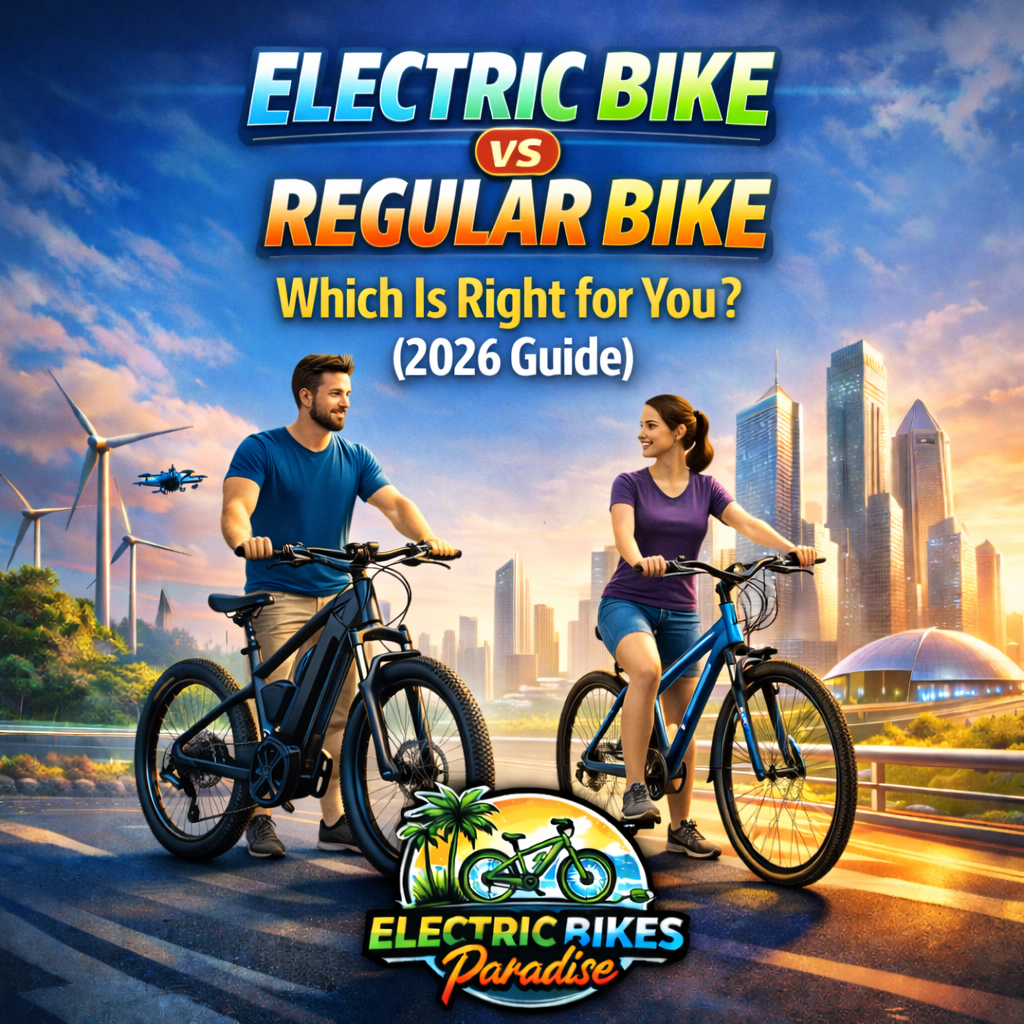
The debate between electric bikes and regular bikes has never been more relevant. With e-bike sales surging across the United States and new models hitting the market every year, more and more people are weighing the pros and cons of going electric versus sticking with a traditional pedal-powered bicycle. Whether you’re a seasoned cyclist considering an upgrade or a complete beginner trying to figure out which type of bike to buy first, this guide will give you a thorough, honest comparison to help you make the right decision.
Let’s break down every major category — cost, health benefits, speed, range, practicality, maintenance, and more — so you can decide which type of bike fits your lifestyle best.
What Is the Difference Between an Electric Bike and a Regular Bike?
At their core, both electric bikes and regular bikes are bicycles. They have the same basic components — frame, wheels, handlebars, brakes, and gears. The key difference is that an electric bike adds three components that a regular bike doesn’t have: a battery, a motor, and a controller.
These three additions allow an e-bike to provide powered assistance to the rider, either through pedal assist (where the motor helps amplify your pedaling effort) or through a throttle (where the motor powers the bike independently of pedaling). A regular bike relies entirely on human power.
Everything else about how the bikes look, feel, and function is largely the same. You still steer, brake, shift gears, and balance on an e-bike exactly as you would on a regular bike.
Cost: Electric Bike vs Regular Bike
One of the most significant differences between e-bikes and regular bikes is price. Let’s look at what you can expect to pay in each category.
Regular Bike Cost
A quality regular bicycle can be purchased across a wide price range:
- Entry-level: $300–$600 for a basic commuter or hybrid bike
- Mid-range: $600–$1,500 for a quality road, mountain, or hybrid bike with good components
- Premium: $1,500–$5,000+ for high-performance road, mountain, or gravel bikes
Regular bikes have no electrical components to fail or replace, which keeps long-term maintenance costs lower. Consumables like chains, tires, and brake pads are the main ongoing costs.
Electric Bike Cost
E-bikes are significantly more expensive than comparable regular bikes:
- Entry-level: $800–$1,500 for basic hub motor e-bikes
- Mid-range: $1,500–$3,000 for quality e-bikes with good components and reliable electrical systems
- Premium: $3,000–$8,000+ for high-end electric mountain bikes, cargo e-bikes, and performance models
Beyond the initial purchase price, e-bikes have additional ongoing costs including electricity for charging (typically less than $0.10 per charge), battery replacement every 3–5 years ($200–$600), and occasional electrical component servicing.
Which Is More Cost-Effective?
For pure upfront cost, regular bikes win hands down. However, when you factor in the broader picture — particularly for commuters replacing car trips — e-bikes can be highly cost-effective. The average American spends $10,000–$12,000 per year owning and operating a car. An e-bike that replaces even some of those trips pays for itself quickly.
For recreational riders who already own a car and are choosing between a bike for fun, a regular bike offers more value per dollar if budget is the primary concern.
Speed: Electric Bike vs Regular Bike
Regular Bike Speed
The average recreational cyclist on a regular bike rides at 10–16 mph on flat terrain. Fit, experienced cyclists can sustain 18–25 mph on road bikes. Speed on a regular bike is limited entirely by the rider’s fitness and effort.
Electric Bike Speed
E-bikes in the United States are classified by their top assisted speed:
- Class 1 and Class 2: Motor assistance up to 20 mph
- Class 3: Motor assistance up to 28 mph
Once you exceed the motor’s speed limit, the motor cuts out and you’re pedaling under your own power — exactly like a regular bike. You can still pedal faster than the motor limit if you’re fit enough.
The practical effect is that most e-bike riders cruise effortlessly at 18–25 mph with moderate pedaling effort, regardless of their fitness level. On flat ground, a Class 3 e-bike ridden by a casual cyclist can keep pace with a fit road cyclist on a regular bike.
Winner
E-bikes are faster for most riders in most real-world situations, especially over longer distances and on hilly terrain where fatigue becomes a factor on a regular bike.
Physical Exercise and Health Benefits
This is perhaps the most debated aspect of the e-bike vs regular bike comparison. Many traditional cyclists worry that e-bikes eliminate the health benefits of cycling. The reality is more nuanced.
Regular Bike Exercise
Regular bikes provide a pure cardiovascular and muscular workout. The effort required is determined entirely by the rider, making regular bikes excellent for structured exercise, training, and calorie burning. A moderately paced hour-long ride on a regular bike burns 400–600 calories depending on the rider’s weight and intensity.
Regular cycling builds cardiovascular fitness, lower body strength, and endurance over time. For athletes and fitness-focused riders, a regular bike offers complete control over training intensity.
Electric Bike Exercise
Here’s the thing that surprises many people: e-bikes still provide meaningful exercise. Studies consistently show that e-bike riders get significant cardiovascular benefit from riding — not as much as regular cycling at the same speed, but far more than sitting in a car or at a desk.
The key insight from research is that e-bike riders tend to ride more often and for longer distances than regular cyclists. The reduced effort barrier means people who might skip a ride due to tiredness, hills, or time constraints actually get on the bike and ride. More frequent riding, even at lower intensity, adds up to significant health benefits over time.
E-bikes are also transformative for riders who might not be able to ride a regular bike at all due to age, injury, or health conditions. The ability to dial back the effort to a manageable level means people with knee problems, heart conditions, or limited fitness can still enjoy cycling and gain real health benefits.
Winner
Regular bikes provide a more intense workout per hour of riding. E-bikes provide more total exercise for most people because they ride more often. For overall population health, e-bikes are a net positive. For structured athletic training, regular bikes win.
Range and Endurance
Regular Bike Range
The range of a regular bike is limited by the rider’s fitness and endurance. A casual rider might comfortably ride 10–20 miles before fatigue sets in. A fit cyclist can cover 60–100+ miles in a day. Range on a regular bike is a direct reflection of physical condition and training.
Hilly terrain, headwinds, and heat significantly reduce how far most people can comfortably ride on a regular bike.
Electric Bike Range
An e-bike’s range per charge is typically 20–80 miles depending on battery capacity, assist level, terrain, and rider weight. Importantly, the e-bike makes the distance feel much more achievable — a 30-mile ride on an e-bike feels like a much shorter ride on a regular bike in terms of effort expended.
For commuters, the e-bike’s range is more than sufficient for most daily rides. For recreational riders, the ability to tackle hilly terrain and longer distances without exhaustion opens up routes that would be impractical or impossible on a regular bike.
The one limitation is that the e-bike’s range is finite and battery-dependent. If you run out of charge, you’re still riding a heavy bicycle home under your own power — which is much harder than riding a light regular bike.
Winner
E-bikes win for practical range in real-world conditions, particularly on hilly terrain. Regular bikes win for unlimited range (as long as the rider has the fitness and fueling to keep going).
Weight
Regular Bike Weight
Regular bikes are significantly lighter than e-bikes. A quality road bike weighs 15–20 lbs. A mountain bike or hybrid typically weighs 22–30 lbs. The lightest performance road bikes can weigh under 15 lbs.
This light weight makes regular bikes easier to carry, transport, lift onto a rack, and maneuver in tight spaces.
Electric Bike Weight
E-bikes are considerably heavier due to the added motor, battery, and supporting hardware. Most e-bikes weigh between 45–75 lbs. Premium lightweight e-bikes using carbon fiber frames and compact battery systems can get down to 35–40 lbs, but these models are expensive.
The extra weight is most noticeable when carrying the bike up stairs, loading it into a vehicle, or riding without motor assistance. A flat battery on a heavy e-bike is a much less pleasant experience than riding a light regular bike.
Winner
Regular bikes win on weight by a significant margin. This matters most for urban riders who frequently carry their bike, apartment dwellers without elevator access, and anyone who needs to transport the bike in a vehicle regularly.
Hill Climbing
Regular Bike on Hills
Hills are the great equalizer for regular bike riders. Casual or unfit riders may find even moderate hills challenging, and steep climbs can be genuinely difficult. Hill climbing on a regular bike is a skill that takes time and fitness to develop.
Many regular cyclists plan routes specifically to avoid steep hills, particularly for commuting when arriving sweaty is a problem.
Electric Bike on Hills
E-bikes make hills almost irrelevant. Even on a steep grade, cranking up the assist to PAS 4 or 5 turns a challenging climb into a pleasant ride. This is one of the most transformative aspects of e-bike riding for people who live in hilly areas.
For commuters, the ability to arrive at work without being soaked in sweat — regardless of hills on the route — is a game-changer that makes e-bike commuting practical for a much wider range of people.
Winner
E-bikes win by a wide margin on hills. This is arguably the single greatest practical advantage of an e-bike over a regular bike for most riders.
Practicality for Commuting
Regular Bike for Commuting
Regular bikes are excellent commuting tools for fit, motivated riders on relatively flat routes. They’re lighter, cheaper, and require no charging. However, commuting on a regular bike comes with real limitations: hills require significant effort, longer distances are tiring, and arriving sweaty is a common problem.
Regular bikes also require secure storage at both ends of the commute, which can be an issue at some workplaces.
Electric Bike for Commuting
E-bikes are arguably the ideal commuting vehicle for urban and suburban environments. They eliminate the sweat problem, make hills easy, extend the practical commuting distance, and allow riders to choose their effort level based on how they feel that day. On busy urban routes, e-bikes can also be faster than cars stuck in traffic.
The main commuting disadvantages of e-bikes are higher theft risk (due to higher value), the need for charging, and heavier weight if you need to carry the bike.
Winner
E-bikes win for commuting in most real-world scenarios, particularly for longer distances, hilly routes, and riders who can’t afford to arrive at work looking like they just ran a race.
Environmental Impact
Both regular bikes and electric bikes produce zero direct emissions while riding. The environmental comparison comes down to manufacturing and energy source.
Regular Bike Environmental Impact
Regular bikes have a very low environmental footprint. They require no energy to operate, have no battery to manufacture, and can last decades with proper maintenance. From a lifecycle perspective, regular bikes are among the most environmentally friendly transportation options available.
Electric Bike Environmental Impact
E-bikes have a higher manufacturing footprint than regular bikes due to the battery and motor production. However, they are still dramatically cleaner than cars — even electric cars — over their lifecycle. The electricity used to charge an e-bike is minimal (equivalent to a few cents per charge), and as the U.S. electrical grid becomes greener, the environmental benefit of e-bikes over cars continues to improve.
Studies show that e-bikes have a carbon footprint roughly 10–50 times lower than cars per mile traveled, and about 3–10 times lower than electric cars.
Winner
Regular bikes have a slightly lower environmental impact than e-bikes when comparing the two directly. Both are dramatically more environmentally friendly than any motor vehicle.
Maintenance
Regular Bike Maintenance
Regular bikes require standard bicycle maintenance: chain lubrication, brake adjustments, tire pressure checks, and periodic drivetrain servicing. Most of this can be done at home with basic tools and a little knowledge. Professional tune-ups are affordable and typically needed once or twice a year for regular riders.
Electric Bike Maintenance
E-bikes require all the same mechanical maintenance as regular bikes, plus attention to the electrical components: battery care, motor cable inspection, connector cleaning, and display maintenance. The motor itself is largely maintenance-free, but when electrical issues do arise, they can be more expensive and complicated to diagnose and repair than mechanical problems.
Battery replacement every 3–5 years is an additional maintenance cost unique to e-bikes.
For a full breakdown of e-bike maintenance, see our How to Maintain an Electric Bike guide.
Winner
Regular bikes are simpler and cheaper to maintain. E-bikes require the same mechanical care plus additional electrical component attention.
Theft Risk
E-bikes are significantly more valuable than regular bikes, making them higher-value theft targets. A stolen e-bike is a much more costly loss than a stolen regular bike. Using a high-quality lock, storing the bike securely, and removing the battery when leaving the bike unattended are essential precautions for e-bike owners.
Regular bikes also get stolen — bike theft is a problem everywhere — but the financial impact of a stolen $400 regular bike is far less devastating than losing a $2,500 e-bike.
Winner
Regular bikes carry lower theft risk due to their lower value.
Who Should Choose an Electric Bike?
An e-bike is likely the better choice for you if:
- You commute and want to arrive without sweating
- You live in a hilly area
- You want to ride longer distances than your current fitness allows
- You’re returning to cycling after a long break or recovering from an injury
- You’re a senior who wants to stay active but needs assistance
- You want to replace car trips with cycling
- You want to keep up with faster, fitter riding companions
- You’re interested in electric fat tire bikes for all-terrain adventure
- You need the stability of an electric trike
- You want a folding e-bike for multimodal commuting
Who Should Choose a Regular Bike?
A regular bike is likely the better choice for you if:
- Budget is the primary concern
- You ride primarily for athletic training and want maximum exercise
- You frequently need to carry or transport your bike
- You want the simplest, lightest, most maintenance-free option
- You enjoy the pure mechanical simplicity of a traditional bicycle
- You ride primarily on flat terrain where motor assistance isn’t needed
- You’re a competitive cyclist or racer
The Verdict: Electric Bike vs Regular Bike
There’s no universal right answer — both types of bikes serve important purposes and both can bring enormous joy and benefit to riders’ lives. The best bike is the one you’ll actually ride.
That said, for the majority of new riders and commuters in 2026, an electric bike offers a more accessible, practical, and versatile riding experience than a regular bike. The ability to dial in exactly how much effort you want to put in — from a full workout to a relaxed cruise — makes e-bikes uniquely adaptable to real life in a way that regular bikes simply can’t match.
For athletes, competitive cyclists, and riders on tight budgets, a regular bike remains the gold standard.
Explore Our Full Range of Electric Bikes
If you’ve decided that an e-bike is right for you, Electric Bikes Paradise has a premium selection of electric bikes for every rider and every budget — all backed by free shipping to the lower 48 states, our lowest price guarantee, and expert customer support.
Browse our categories:
- Electric Bikes
- Electric Fat Tire Bikes
- Electric Mountain Bikes
- Folding Electric Bikes
- Folding Fat Tire Electric Bikes
- Electric Trikes
- Step-Through Electric Bikes
- Electric Beach Cruiser Bikes
- Electric Hunting Bikes
- Electric Scooters
- Mobility Scooters
Have questions? Our team of e-bike experts is available Monday–Friday, 9am–5pm MST.
Electric Bikes Paradise | Ecom Paradise LLC 5830 E 2nd St, Ste. 7000 #715, Casper, WY 82609, United States 📞 307-429-0021 ✉️ sales@electricbikesparadise.com Facebook | Pinterest | YouTube | Instagram | TikTok