Published by Electric Bikes Paradise | Updated 2026
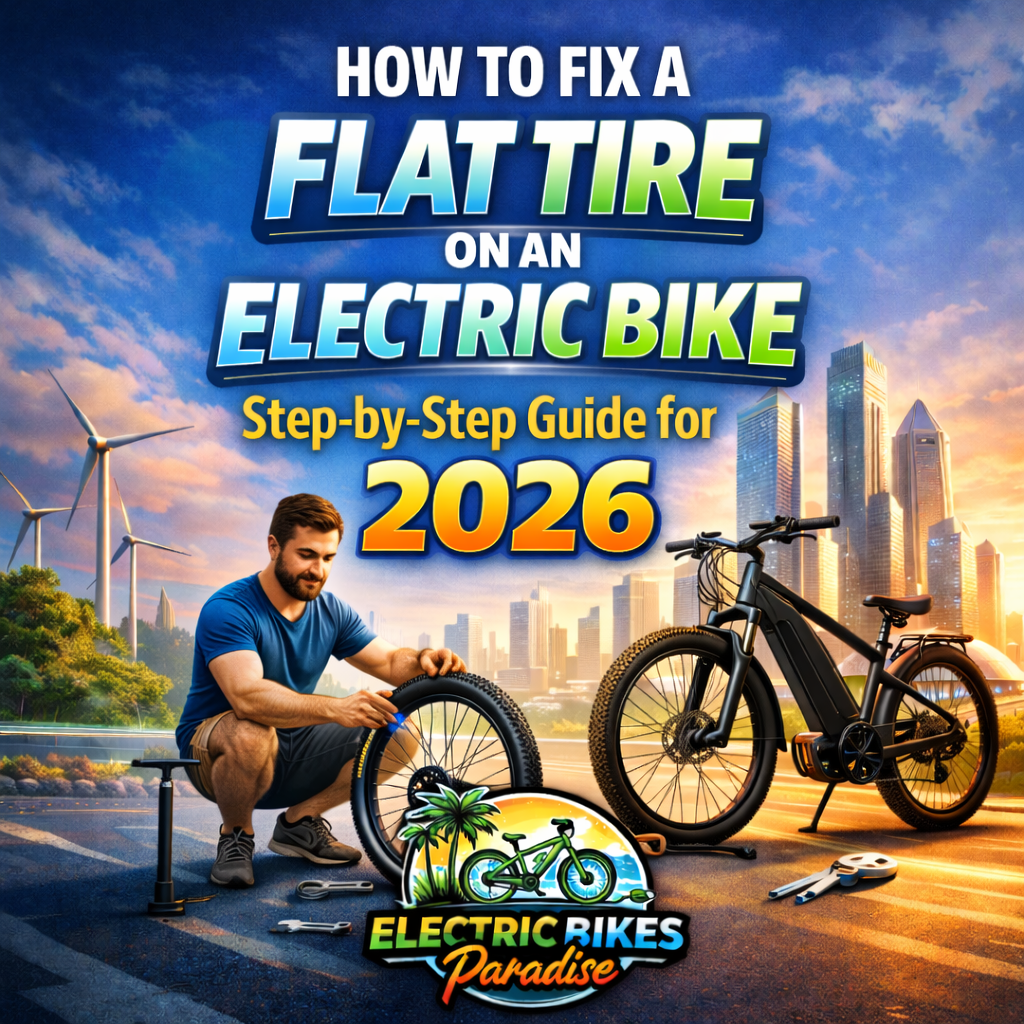
Getting a flat tire on an electric bike is one of those inevitable moments every rider will eventually face. The good news is that fixing a flat on an e-bike isn’t much different from fixing one on a regular bicycle — with a few important considerations specific to e-bikes, like motor wiring, heavier wheels, and torque specs for axle nuts. With the right tools and a little know-how, most riders can change a flat in 20–30 minutes on the side of the road.
In this complete guide, we’ll walk you through everything you need to know about fixing a flat tire on an electric bike — from identifying the type of flat to removing the wheel, patching or replacing the tube, and getting back on the road safely.
Types of E-Bike Tires and Inner Tubes
Before diving into the repair process, it helps to understand what type of tire setup your e-bike has. There are three main configurations:
Clincher tires with inner tubes — The most common setup on e-bikes. The tire clips onto the rim and an inner tube inside holds the air. This is the easiest setup to repair and the focus of most of this guide.
Tubeless tires — Increasingly common on premium electric mountain bikes and fat tire e-bikes. These tires seal directly to the rim without an inner tube and use liquid sealant to self-heal small punctures. Repairing a tubeless flat is slightly more involved and typically requires adding sealant or installing a tubeless plug.
Solid or foam-filled tires — Found on some commuter and mobility-focused e-bikes. These tires can never go flat but offer a harsher ride and cannot be repaired — they must be replaced when worn.
For the purposes of this guide, we’ll focus on the most common scenario: a clincher tire with an inner tube.
Tools You’ll Need
Having the right tools on hand makes fixing a flat much easier. We recommend carrying a small repair kit with you on every ride:
- Tire levers (2–3 plastic levers)
- Patch kit (patches, sandpaper, vulcanizing glue) or a self-adhesive patch kit
- Spare inner tube (the easiest and fastest solution)
- Portable pump or CO2 inflator
- Adjustable wrench or the correct size box wrench for your axle nuts (if applicable)
- Torque wrench (recommended for proper axle reinstallation)
- Gloves (optional but helpful)
- A clean cloth or rag
For riders with hub motor e-bikes, also carry a small bag or something to rest the motor wheel on during the repair to avoid straining the motor cable.
Step 1: Safety First — Stop and Move Off the Road
As soon as you feel a flat tire developing, gradually slow down and pull off the road or trail to a safe location. Riding on a flat tire even for a short distance can damage the rim and make the repair more difficult.
Turn off your e-bike before beginning any repair work. This prevents any accidental motor activation while you’re working near the wheel.
Step 2: Identify Which Tire Is Flat
Squeeze both tires firmly. The flat tire will feel noticeably softer — or completely deflated — compared to the other. In most cases you can tell immediately by sight or feel. If you’re not sure, press the tires against the ground and compare how much they compress.
Step 3: Remove the Wheel
This is where e-bikes differ most significantly from regular bicycles. The process varies depending on whether your flat is on the front or rear wheel and whether your bike has a hub motor.
Removing a Front Wheel (Non-Motor Wheel)
If your front wheel is the one with the flat — and your motor is in the rear — the removal process is similar to a standard bicycle:
- Shift to the smallest gear before removal to make reinstallation easier
- Disconnect the brake cable or open the brake caliper if needed to clear the tire
- Loosen the quick release skewer by flipping the lever open, or use a wrench to loosen the axle nuts
- Lift the bike slightly and the wheel will drop free
Removing a Rear Wheel (Non-Motor Wheel)
- Shift to the smallest rear cog before removal
- Disconnect the rear brake if needed
- Loosen the quick release or axle nuts
- Pull the derailleur back to release tension on the chain and allow the wheel to drop free
- Guide the chain off the smallest cog and set it aside
Removing a Hub Motor Wheel
Removing a wheel with an integrated hub motor requires extra care because of the motor cable and connector:
- Before loosening the axle, locate the motor cable running from the motor to the frame. Most cables have a waterproof connector near the dropout — disconnect this carefully by pulling the connector straight apart. Never yank on the cable itself.
- Loosen the axle nuts on both sides. Hub motor axles typically use nuts rather than quick releases and require a wrench — usually 15mm for most hub motors.
- Note the position of any anti-rotation washers or torque arms on the axle before removing them. These are important safety components that prevent the motor from spinning in the dropout under power. Take a photo before disassembly so you can reinstall them correctly.
- Carefully lower the wheel while managing the motor cable to avoid straining the wires.
- Set the wheel down on a clean surface. If possible, rest it motor-side up to avoid scratching the motor housing.
Step 4: Deflate the Tire Completely
If the tube isn’t already fully flat, deflate it completely by removing the valve cap and pressing the center pin of a Schrader valve, or unscrewing the locknut and pressing the valve stem on a Presta valve.
Step 5: Remove the Tire From the Rim
This step requires tire levers and a bit of technique.
- Starting opposite the valve, insert a tire lever between the tire bead and the rim edge
- Hook the other end of the lever onto a spoke to hold it in place
- Insert a second tire lever 2–3 inches away from the first and lever the bead over the rim edge
- Work the second lever around the rim until one side of the tire bead is completely off the rim
- Pull out the inner tube, starting at the opposite side from the valve and working the valve out last
Be careful not to use metal screwdrivers or sharp tools as tire levers — they can damage the rim or puncture a new tube.
Step 6: Find the Cause of the Flat
Before installing a new tube or patching the old one, find out what caused the flat. Failing to identify and remove the cause means your new tube will go flat again almost immediately.
Run your fingers carefully around the inside of the tire to feel for anything sharp — a piece of glass, a thorn, a staple, or a wire. Go slowly and be careful not to cut yourself. If you find something embedded, use pliers or a pick to remove it completely.
Check the rim tape. The rim tape covers the spoke nipples inside the rim. If it’s worn, shifted, or has a hole, a spoke nipple can puncture the inner tube from the inside. If the rim tape looks damaged, replace it before installing a new tube.
Inspect the old tube. Inflate the old tube slightly and listen or feel for where air is escaping. The location of the puncture relative to the tube can tell you where to look on the tire or rim:
- Hole on the outer surface of the tube: caused by something sharp penetrating the tire from outside
- Two small holes close together (snake bite): caused by pinch flatting from underinflated tire hitting a sharp edge
- Hole on the inner surface of the tube: caused by a spoke nipple or sharp edge on the rim
Step 7: Patch or Replace the Inner Tube
You have two options: patch the existing tube or replace it with a spare.
Option A: Replace With a Spare Tube (Fastest)
If you carry a spare tube — which we strongly recommend — simply install the new tube. This is the fastest solution on the road and you can patch the old tube at home at your leisure.
Make sure your spare tube matches the diameter and width of your tire. E-bike tubes are available in the same sizes as standard bicycle tubes (e.g., 26″ × 4.0″ for fat tire bikes, 27.5″ × 2.4″ for mountain bikes). Also confirm the valve type matches your rim — Schrader (the wider car-style valve) is most common on e-bikes.
Option B: Patch the Tube
If you don’t have a spare tube, you can patch the puncture:
Traditional patch kit:
- Rough up the area around the puncture with the sandpaper included in your patch kit
- Apply a thin, even layer of vulcanizing cement and allow it to become tacky (1–2 minutes)
- Peel the foil backing from the patch and press it firmly over the puncture
- Hold firm pressure for 1–2 minutes
- Inflate slightly to check the seal before reinstalling
Self-adhesive (glueless) patches:
- Rough up the area slightly with sandpaper
- Peel and press the adhesive patch firmly over the puncture
- Hold for 60 seconds
- These are convenient but slightly less durable than traditional patches for a permanent fix
Step 8: Reinstall the Inner Tube and Tire
- Inflate the new or patched tube just enough to give it shape — a very slight amount of air prevents pinching during installation
- Starting at the valve, tuck the tube inside the tire
- Insert the valve through the valve hole in the rim
- Working from the valve outward in both directions, push the tire bead back onto the rim by hand
- The last section of bead near the valve is often the hardest — use your thumbs to roll the final section of bead over the rim edge. Avoid using tire levers for this step if at all possible, as they can pinch and puncture the new tube
Check for pinching: Before inflating, run your fingers around both sides of the tire and gently pull the tire sidewall away from the rim to make sure the tube isn’t pinched between the tire bead and the rim. A pinched tube will blow out immediately when inflated.
Step 9: Inflate the Tire
Inflate to the recommended PSI printed on the tire sidewall. E-bike tire pressures vary significantly by tire type:
- Fat tires (4″+ wide): 5–20 PSI
- Mountain bike tires: 20–35 PSI
- Commuter/hybrid tires: 50–80 PSI
Inflate gradually and check that the tire is seating evenly on the rim all the way around. If you see the tube bulging out from under the tire bead, deflate immediately and reseat the tire before reinflating.
Step 10: Reinstall the Wheel
Reinstalling the wheel is the reverse of removal, with a few important details:
Reinstalling a Hub Motor Wheel
- Guide the wheel carefully back into the dropout, managing the motor cable to avoid pinching or kinking it
- Reinstall the anti-rotation washers and torque arms in the correct orientation — the tab should engage the slot or notch in the dropout
- Reinstall the axle nuts and tighten securely. For most hub motors, the recommended torque is 25–40 Nm. Use a torque wrench if available — overtightening can damage the dropout and undertightening can allow the motor to spin, which will damage the wiring
- Reconnect the motor cable connector, pressing firmly until it clicks or seats fully
- Reconnect the brake cable if you disconnected it
Reinstalling a Standard Rear Wheel
- Hook the chain back onto the smallest cog
- Guide the wheel into the dropouts while pulling the derailleur back to allow clearance
- Make sure both sides of the axle are seated fully and evenly in the dropouts
- Tighten the quick release or axle nuts firmly and evenly
- Reconnect the brake if needed
Step 11: Test Before Riding
Before setting off, always perform a quick safety check:
- Squeeze the tire to confirm it’s properly inflated
- Spin the wheel and confirm it runs true (not wobbling)
- Apply the brakes firmly and confirm they engage correctly
- Give the wheel a gentle side-to-side shake to confirm the axle is secure
- Power on the e-bike and confirm the motor and display function normally
How to Prevent Flat Tires on an E-Bike
Prevention is always better than repair. Here are the most effective ways to reduce your chances of getting a flat:
Maintain proper tire pressure. The single biggest cause of preventable flats is underinflated tires. Check your pressure before every ride. Low pressure makes tires much more susceptible to pinch flats and punctures.
Use puncture-resistant tires. Many tire manufacturers offer reinforced tires with added puncture protection layers. Brands like Schwalbe, Continental, and Maxxis offer puncture-resistant models that significantly reduce flat frequency without adding much weight.
Install tire liners. Tire liners are thin strips of protective material that sit between the tire and the inner tube, blocking sharp objects from penetrating to the tube. They add a small amount of weight but can dramatically reduce puncture frequency on routes with road debris.
Use slime or sealant in your tubes. Tube sealant — a liquid injected into the inner tube through the valve — can self-seal small punctures before they cause a flat. This is particularly effective for small thorn or glass punctures.
Go tubeless. If your e-bike’s rims support a tubeless setup, converting to tubeless with liquid sealant is the most effective puncture prevention strategy available. Tubeless tires can self-seal punctures up to about 6mm in diameter without any rider intervention.
Inspect your tires regularly. Before each ride, visually inspect your tires for embedded glass, thorns, or cuts. Removing debris before it works its way through the casing saves you from a flat later.
Avoid obvious hazards. Stay away from the edge of the road where glass and debris accumulate, and avoid riding through broken glass, thorns, or construction debris whenever possible.
Special Considerations for Fat Tire E-Bikes
Electric fat tire bikes have oversized tires that are generally more resistant to punctures due to their larger air volume and lower operating pressure. However, when they do flat, the larger tire and tube make removal and reinstallation slightly more work.
Fat tire e-bikes also typically run very low pressures (5–15 PSI), which means a flat can be harder to detect by feel — the tire may just feel softer than usual rather than completely deflated. Get in the habit of checking fat tire pressure with a gauge rather than relying on feel alone.
Special Considerations for Electric Mountain Bikes
Electric mountain bikes often come tubeless-ready from the factory. If you’re still running tubes on a tubeless-ready rim, consider converting to tubeless — it’s one of the best upgrades you can make for trail riding. Tubeless setups eliminate pinch flats entirely and allow you to run lower pressures for better traction without the risk of flatting.
Special Considerations for Electric Trikes
Electric trikes typically have three wheels, any of which can flat. Trike wheel removal can be more complex than a standard two-wheel bike depending on the drivetrain configuration. Consult your owner’s manual for the specific procedure for your model, and don’t hesitate to contact our support team if you need guidance.
When to See a Professional
While most flats are DIY-friendly, there are situations where it’s best to seek professional help:
- The rim is damaged or bent
- The tire has a large gash or blowout that can’t be safely repaired
- The motor cable was damaged during removal
- The wheel won’t run true after reinstallation
- You’re unsure about the correct torque for the axle nuts on your hub motor
Our customer service team at Electric Bikes Paradise is always happy to provide guidance and connect you with the right support resources for your specific bike model.
Shop Electric Bikes at Electric Bikes Paradise
Flat tires are a minor inconvenience, not a dealbreaker. With the right tools and a bit of practice, you’ll be back on the road in no time. At Electric Bikes Paradise, we carry a premium selection of electric bikes for every rider and every terrain — all backed by free shipping to the lower 48 states, our lowest price guarantee, and expert customer support.
Browse our categories:
- Electric Bikes
- Electric Fat Tire Bikes
- Electric Mountain Bikes
- Folding Electric Bikes
- Folding Fat Tire Electric Bikes
- Electric Trikes
- Step-Through Electric Bikes
- Electric Beach Cruiser Bikes
- Electric Hunting Bikes
- Electric Scooters
- Mobility Scooters
Have questions? Our team of e-bike experts is available Monday–Friday, 9am–5pm MST.
Electric Bikes Paradise | Ecom Paradise LLC 5830 E 2nd St, Ste. 7000 #715, Casper, WY 82609, United States 📞 307-429-0021 ✉️ sales@electricbikesparadise.com Facebook | Pinterest | YouTube | Instagram | TikTok