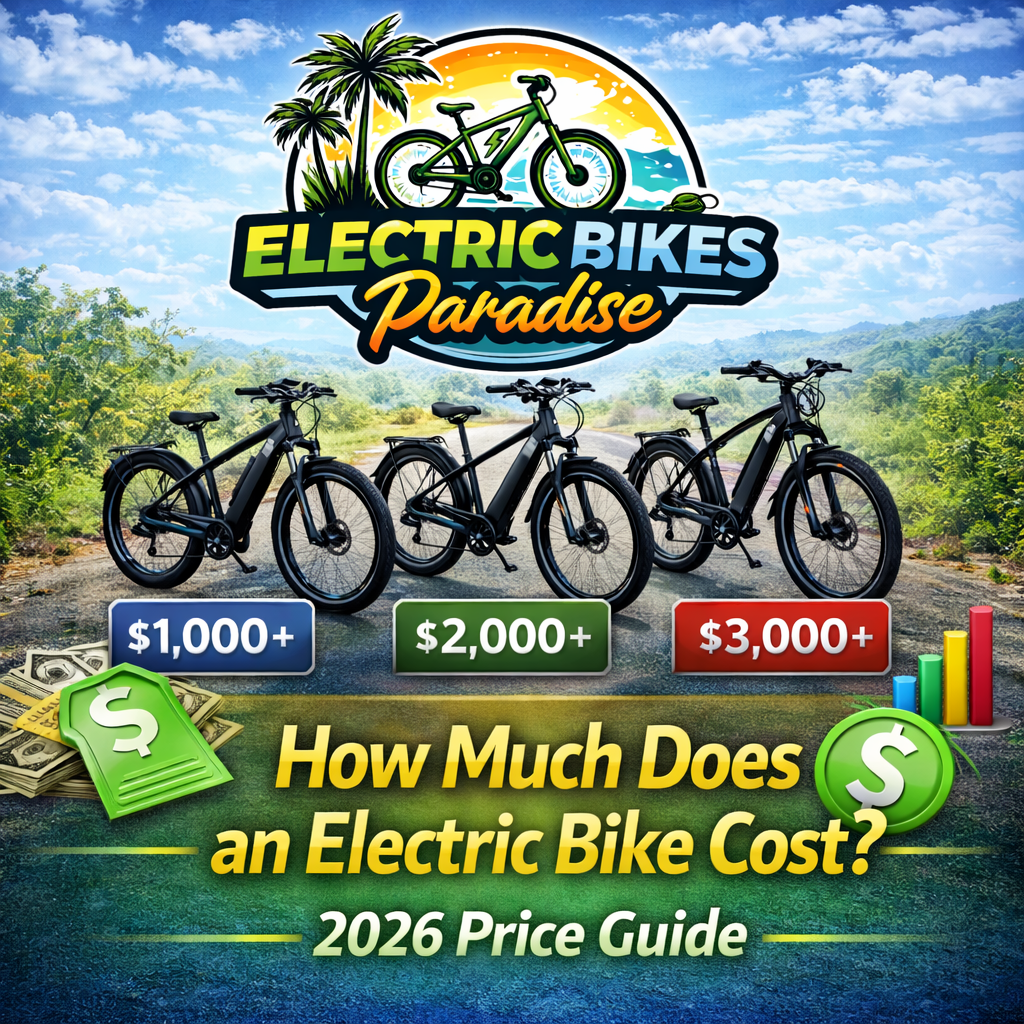
How Much Does an Electric Bike Cost? 2026 Price GuideIf you are thinking about buying an electric bike, the first question on your mind is probably: how much is this going to cost me? The answer spans a surprisingly wide range, from around $600 for a basic entry-level model to well over $5,000 for a premium build with top-tier components. Most riders, however, find excellent options between $1,000 and $2,500, which is where the best balance of quality, performance, and value tends to land.
Understanding what you get at each price point is critical, because buying too cheap often means frustration and wasted money, while buying more than you need means paying for features you will never use. This guide breaks down electric bike pricing tier by tier, explains exactly what drives the cost, covers the ongoing expenses of ownership, compares ebike costs to other transportation, and helps you figure out the right budget for your riding style.
At Electric Bikes Paradise, we carry electric bikes across every price range from trusted brands like Rattan, Eunorau, Velowave, Nakto, and more. We also offer financing options to make any bike more affordable.
Electric Bike Price Ranges: What You Get at Every Level
Electric bike prices cluster into four main tiers, each with distinct trade-offs in components, performance, and longevity. Here is what to expect at each level.
Under $1,000: Entry-Level Electric Bikes
Electric bikes under $1,000 are designed to make ebike ownership accessible to first-time buyers and budget-conscious riders. At this price, you will typically find 250W to 500W hub motors, smaller batteries in the 36V 10Ah range (360Wh), basic mechanical disc brakes, cadence-sensor pedal assist, and steel or entry-level aluminum frames.
These bikes work well for short, flat commutes, casual neighborhood rides, and riders who want to try electric biking without a large financial commitment. The trade-offs are real, though: shorter range (15 to 30 miles), slower acceleration, heavier frames, and components that wear faster under regular use.
Who should buy at this level: Casual riders, short-distance commuters on flat terrain, and anyone testing the waters before investing more.
What to watch out for: At the very low end (under $600), you may encounter bikes with questionable build quality, uncertified batteries, and poor customer support. Stick with established brands that offer warranties and have a track record of standing behind their products.
$1,000 to $1,500: The Value Sweet Spot
This is where electric bikes start to get genuinely good. In the $1,000 to $1,500 range, you will find 500W to 750W motors, 48V batteries with 10Ah to 13Ah capacity (480 to 624Wh), mechanical disc brakes (sometimes hydraulic on higher-end models), front suspension forks, Shimano 7-speed drivetrains, and aluminum alloy frames.
Range typically stretches to 25 to 45 miles per charge, which covers most daily commutes and recreational rides with room to spare. Fat tire models become available at this price, opening up all-terrain riding on sand, gravel, and light trails. Folding models also start appearing with genuinely functional designs.
Brands like Nakto and Ancheer offer strong options in this range, delivering reliable performance without stretching the budget.
Who should buy at this level: Daily commuters, recreational riders, and anyone who wants a reliable ebike they can depend on for regular use without overspending.
$1,500 to $2,500: Mid-Range Performance
The mid-range tier is where most serious riders find their ideal bike. In this bracket, you get 750W motors (often with 1,200W to 1,500W peak), 48V batteries with 13Ah to 20Ah capacity (624 to 960Wh), hydraulic disc brakes on many models, more refined suspension, Shimano 7 to 9-speed drivetrains, and better-quality aluminum frames with improved welds and finish.
Range extends to 35 to 65 miles per charge, and the overall ride quality improves significantly. Pedal assist feels smoother, brakes inspire more confidence, and the frame handles higher speeds and rougher terrain without flex or rattling. You will also find more variety in bike styles, from fat tire all-terrain models to sleek urban commuters, folding bikes with full-size performance, and step-through frames with premium components.
Brands like Rattan, Eunorau, Velowave, and Vanpowers deliver excellent value in this tier, with models that rival bikes costing significantly more from mainstream brands.
Who should buy at this level: Riders who depend on their ebike for daily transportation, anyone riding in hilly terrain, heavier riders who need more power, and riders who plan to keep their bike for several years.
$2,500 to $4,000: Premium Builds
Premium electric bikes offer top-tier components and a noticeably refined riding experience. Expect mid-drive motors from brands like Bosch, Brose, or Bafang, torque-sensor pedal assist for a natural ride feel, hydraulic disc brakes with larger rotors, full suspension (front and rear), high-capacity batteries (20Ah+) with 60 to 100+ miles of range, and higher-quality drivetrains with 8 to 11 speeds.
The ride quality at this level is a clear step above mid-range bikes. Torque sensors deliver power proportional to your pedaling effort, creating a smooth and intuitive experience that feels like riding a supercharged traditional bicycle. Full suspension absorbs trail impacts and rough roads, and the overall build quality suggests a bike that will last many years with proper care.
Who should buy at this level: Serious commuters who ride daily in all conditions, mountain and trail riders, cargo haulers, and anyone who wants the best possible ride quality and long-term durability.
$4,000 and Above: High-Performance and Specialty
Above $4,000, you enter the territory of high-performance ebikes, specialized cargo bikes, premium electric mountain bikes, and luxury commuter models. These bikes feature the best available motors, carbon fiber or high-end aluminum frames, advanced electronics, massive batteries with 80 to 120+ miles of range, and components that rival those found on high-end traditional bicycles.
Who should buy at this level: Enthusiasts, professional riders, families who are replacing a car with a cargo ebike, and anyone who wants the absolute best performance and build quality available.
What Drives the Price of an Electric Bike?
The price tag on an electric bike is determined primarily by five components. Understanding these helps you evaluate whether a bike is fairly priced or overpriced for what it offers.
The Motor
The motor is the most defining component of an electric bike. Hub motors (mounted in the wheel) are less expensive to produce and maintain, making them the standard on bikes under $2,500. Mid-drive motors (mounted at the crankset) cost more but deliver better hill-climbing efficiency and a more natural ride feel, which is why they appear primarily on premium models.
Motor wattage also affects price. A 250W motor costs less than a 750W motor, and peak wattage (the burst power for acceleration and hills) adds cost as well. Higher-quality motors also run quieter, generate less heat, and last longer, all of which contribute to the price.
The Battery
The battery is typically the single most expensive component on an electric bike, often accounting for 30% to 40% of the total cost. Battery price scales directly with capacity: a 36V 10Ah battery (360Wh) costs far less than a 48V 20Ah battery (960Wh), which costs far less than a 48V 40Ah dual-battery setup (1,920Wh).
Cell quality matters too. Premium batteries use branded cells from manufacturers like Samsung, LG, or Panasonic, which offer better energy density, longer lifespan, and safer chemistry than generic cells. Certified batteries (UL 2271) have passed rigorous safety testing, which adds cost but significantly reduces the risk of battery-related issues.
The Frame
Frame material and construction quality directly affect weight, durability, and ride feel. Entry-level bikes use basic aluminum or steel frames. Mid-range and premium bikes use higher-grade 6061 aluminum alloy with better welding, smoother finishes, and more refined geometry. Carbon fiber frames appear only on high-end models and dramatically reduce weight while increasing cost.
Frame design also matters. Step-through frames, folding mechanisms, and integrated battery compartments all add manufacturing complexity and cost compared to a simple traditional frame.
The Braking System
Mechanical disc brakes are affordable and effective, making them standard on bikes under $1,500. Hydraulic disc brakes cost more but deliver significantly better stopping power, better modulation, and automatic pad adjustment. On a heavier, faster electric bike, hydraulic brakes are a meaningful safety upgrade worth the additional cost.
The Drivetrain and Electronics
The quality of the shifting system (Shimano Tourney vs. Shimano Altus vs. Shimano Deore), the pedal assist sensor type (cadence vs. torque), the display quality, and the wiring and connector quality all contribute to the final price. Premium bikes use sealed connectors, better displays with Bluetooth connectivity, and torque sensors that deliver a smoother, more intuitive ride.
The Real Cost of Owning an Electric Bike
The purchase price is the biggest expense, but it is not the only one. Here is what ongoing ownership actually costs.
Charging
Electricity to charge an electric bike is remarkably cheap. A full charge on a typical 48V 13Ah battery (624Wh) costs approximately 5 to 12 cents, depending on your local electricity rate. Even if you charge every day, your annual electricity cost will be under $50. Compare that to the hundreds or thousands of dollars you would spend on gasoline for a car.
Routine Maintenance
Electric bikes require slightly more maintenance than traditional bicycles but far less than a car. Budget approximately $100 to $250 per year for routine maintenance, which includes tire replacements ($20 to $50 per tire), brake pad replacements ($10 to $30 per set), chain replacement ($15 to $30), and periodic tune-ups if you take the bike to a shop ($50 to $100).
Most of this maintenance is simple enough to do at home with basic tools. Keeping your tires inflated, your chain clean and lubricated, and your brakes adjusted covers the vast majority of what an ebike needs.
Battery Replacement
The battery is the one significant future expense to plan for. A quality lithium-ion ebike battery lasts 500 to 1,000 charge cycles, which translates to roughly 3 to 5 years of regular use. When the battery’s capacity degrades noticeably (typically to 70 to 80% of its original range), you will want to replace it.
Replacement batteries typically cost $300 to $800 depending on the voltage, capacity, and whether the battery uses a proprietary housing. Brands that use standard battery formats make replacements easier and more affordable. This is worth considering when choosing a bike, because a proprietary battery from a small brand that goes out of business could be difficult or impossible to replace.
Insurance (Optional)
Electric bike insurance is not required in most states, but it is worth considering for bikes valued above $1,500. Policies typically cost $10 to $30 per month and cover theft, damage, and liability. Some homeowner’s or renter’s insurance policies may also cover ebikes, though coverage limits and deductibles vary.
Accessories
Most riders spend an additional $100 to $300 on accessories when they buy their first ebike. Common purchases include a helmet ($30 to $100), a quality lock ($30 to $80), lights if not included ($20 to $50), a phone mount ($15 to $30), a rear rack or panniers ($30 to $80), and a pump and basic tool kit ($20 to $40).
Electric Bike Cost vs. Other Transportation
One of the strongest arguments for an electric bike is how little it costs compared to other forms of transportation.
Car ownership in the United States averages over $10,000 per year when you factor in loan payments, insurance, fuel, maintenance, registration, and depreciation. Even a modest commuter car costs $5,000 to $7,000 annually. An electric bike costs $1,000 to $2,500 upfront with under $300 per year in ongoing costs, and it requires no insurance, registration, fuel, or parking fees.
Public transit costs vary by city, but monthly passes typically run $50 to $150, adding up to $600 to $1,800 per year. An ebike eliminates the need for transit in most cases and offers door-to-door convenience without waiting for schedules.
Ride-sharing services like Uber and Lyft can easily cost $200 to $500 per month for regular commuters. A single year of ride-sharing can cost more than a quality electric bike that lasts 5 to 10 years.
Traditional bicycles are cheaper upfront, but many people find that the motor assistance on an ebike motivates them to ride more frequently, ride farther, and replace more car trips than they would on a traditional bike. The health, environmental, and financial benefits compound over time.
How to Choose the Right Budget for Your Needs
Matching your budget to your actual riding needs is the key to making a smart purchase. Here is a practical framework.
Spend under $1,000 if you ride occasionally on flat terrain for short distances, you are testing whether ebike ownership is right for you, and you understand the trade-offs in range, power, and component longevity.
Spend $1,000 to $1,500 if you commute regularly on mostly flat to moderate terrain, you want a reliable bike that handles daily use without constant maintenance issues, and you are looking for the best value per dollar spent.
Spend $1,500 to $2,500 if you ride daily and depend on your bike for transportation, your route includes hills or rough terrain, you want the bike to last 5+ years with good performance, or you are a heavier rider who needs a more powerful motor and battery.
Spend $2,500+ if you ride in demanding conditions (mountain trails, steep hills, heavy cargo), you want the smoothest and most natural ride quality, you are replacing car trips and need maximum range and reliability, or you simply want the best available components and build quality.
We offer financing options at Electric Bikes Paradise to help make any price tier more accessible, along with regular coupons and discounts and a low price guarantee.
Tips for Getting the Best Deal on an Electric Bike
Shop during sales events. Black Friday, spring sales, and end-of-season clearances often bring significant discounts. We run regular promotions at Electric Bikes Paradise and post current deals on our coupons page.
Consider financing. Spreading the cost over monthly payments can make a mid-range bike affordable on almost any budget. Our financing options let you ride now and pay over time.
Focus on the components that matter to you. If you ride on flat terrain, you do not need to pay extra for a mid-drive motor. If you ride short distances, a smaller battery saves money without sacrificing your experience. Match the specs to your actual riding, not to the maximum possible scenario.
Buy from a reputable retailer. A reliable warranty, responsive customer support, and clear return policies protect your investment. At Electric Bikes Paradise, we back every purchase with a warranty policy, a clear returns and refunds policy, and free shipping.
Think long-term. A $1,500 bike that lasts 5 years and performs reliably is a better investment than a $700 bike that needs replacing after 2 years. When possible, buy the best bike your budget allows.
Frequently Asked Questions
What is the average cost of a good electric bike in 2026?
Most riders find excellent options between $1,000 and $2,500. The sweet spot for daily commuters and recreational riders is $1,200 to $1,800, where you get a 750W motor, a 48V battery with 25 to 50 miles of range, disc brakes, and a reliable Shimano drivetrain.
Are cheap electric bikes worth buying?
Bikes under $1,000 can work well for casual, short-distance riding on flat terrain. However, they typically compromise on range, motor power, braking quality, and long-term durability. If you plan to ride regularly or depend on the bike for commuting, spending a bit more delivers significantly better value over time.
Why are electric bikes so expensive compared to regular bikes?
The motor, battery, controller, display, and reinforced frame add significant cost. The battery alone can account for 30 to 40% of the price. These components require specialized engineering, safety certification, and heavier-duty construction to support the added weight and speed.
How much does it cost to charge an electric bike?
Very little. A full charge typically costs 5 to 12 cents in electricity. Even daily charging adds up to less than $50 per year, making ebikes one of the cheapest forms of powered transportation available.
How much does electric bike maintenance cost per year?
Budget $100 to $250 per year for routine maintenance including tires, brake pads, chain, and occasional professional tune-ups. Battery replacement every 3 to 5 years adds $300 to $800. Overall, annual ownership costs are a small fraction of what a car or motorcycle requires.
Is there a tax credit for electric bikes in 2026?
Tax incentives for electric bikes vary by jurisdiction. Some states and cities offer rebates or tax credits for ebike purchases. The federal E-BIKE Act framework has been proposed to offer incentives up to $1,500 for qualifying purchases, though availability depends on current legislation. Check your state and local programs for current offerings.
Can I finance an electric bike?
Yes. Many retailers, including Electric Bikes Paradise, offer financing options that let you spread the cost over monthly payments. This makes mid-range and premium bikes accessible to riders who prefer not to pay the full amount upfront.
How long does an electric bike last?
A quality electric bike lasts 5 to 10 years with proper maintenance. The battery typically needs replacement after 3 to 5 years (500 to 1,000 charge cycles). The motor, frame, and mechanical components can last much longer with routine care.
Is an electric bike worth it compared to a car?
For short to medium-distance commuting (under 15 to 20 miles each way), many riders find that an ebike can fully replace a car. The savings on fuel, insurance, parking, and maintenance add up to thousands of dollars per year. Even as a supplement to a car (replacing some trips), an ebike delivers strong financial returns.
What is the best electric bike brand for the money?
The best value depends on your budget and riding needs. At Electric Bikes Paradise, we carry brands that consistently deliver strong value across price ranges, including Nakto and Ancheer for budget-friendly options, Rattan and Velowave for mid-range performance, and Eunorau and Rambo for premium and specialty models.
Shop Electric Bikes at Every Price Point
Ready to find the right electric bike for your budget? Browse our collection by brand to discover models at every price range, all with free shipping and U.S.-based customer support.
Shop Electric Bikes by Brand
- Ancheer
- Dahon
- DWMEIGI
- Eunorau
- G-Force
- GlareWheel
- GoPowerBike
- Micargi
- Nakto
- Qualisports
- Rambo
- Rattan
- Vanpowers
- Velowave
- Voltaic
- View All Brands
Shop by Category
Why Shop With Us?
At Electric Bikes Paradise, we are a U.S.-based electric mobility store committed to helping you find the right ride at the right price. Every order includes free shipping, secure checkout, and real customer support from people who actually know electric bikes. We also offer a low price guarantee, financing options, and regular coupons and discounts to make your purchase even easier.
Have Questions? We’re Here to Help.
- Phone: +1 (307) 429-0021 (Mon-Fri, 9am-5pm MST)
- Contact Page: electricbikesparadise.com/contact
- FAQ: electricbikesparadise.com/faq
- Customer Reviews: electricbikesparadise.com/reviews
Start shopping today and find the perfect electric bike for your budget. Browse All Electric Bikes Now.