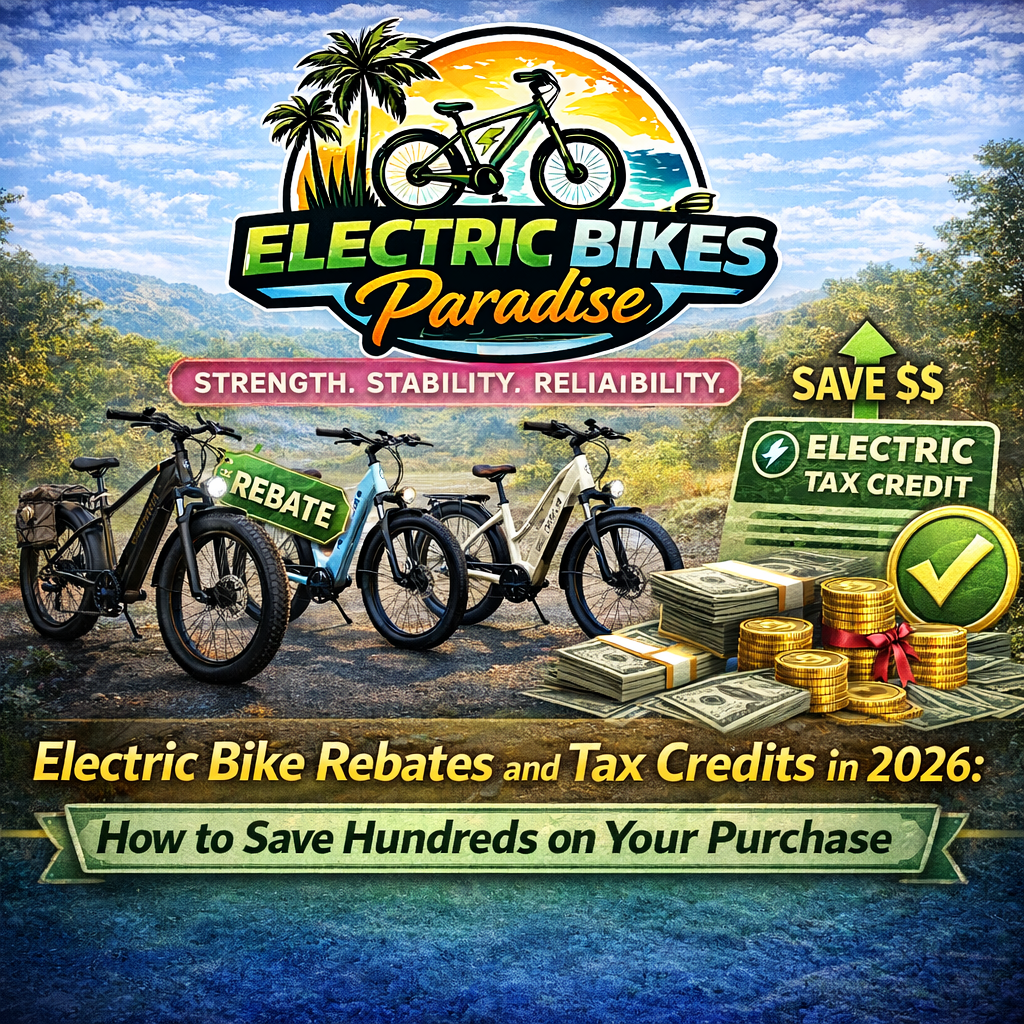
So you’re thinking about buying an electric bike, but that $2,000-$4,000 price tag is making you nervous. Here’s the really really good news: there are more ways to save money on an e-bike purchase right now than there ever have been before. We’re talking federal tax credits, state rebates, local programs, and utility incentives that could knock hundreds or even over a thousand dollars off what you actually pay out of pocket.
I’ve been covering electric bikes for years, and honestly, the rebate landscape in 2026 is more favorable than I expected. The challenge isn’t that the money isn’t there—it’s that you’ve got to know where to look and how to navigate the process correctly. Get it wrong, and you might miss out on serious savings. Get it right, and that dream bike suddenly becomes way more affordable.
Let me walk you through everything you need to know about federal tax credits, state rebates, local programs, and how to actually claim them. By the end of this article, you’ll know exactly how much money you can realistically save and which programs you actually qualify for.
The Federal E-Bike Tax Credit Status in 2026
The big question everyone asks me is: “Is there a federal tax credit for electric bikes?” The answer is complicated, so let me be straight with you about where things stand right now in 2026.
The good news is that there IS a federal tax credit available for e-bikes. The IRS currently allows a 30% tax credit (up to a maximum of $900) for qualified electric bikes under Section 30D of the tax code. This isn’t hypothetical—it’s real money you can claim when you file your taxes. But here’s the pain in the butt part: you have to purchase the bike in the correct tax year and meet specific income limits to qualify.
Now, let’s talk about the E-BIKE Act. This is the proposed legislation that’s been floating around Congress for years, and it keeps getting reintroduced because people want a better federal incentive. The E-BIKE Act would expand the tax credit to up to $900 per bike (or potentially 30% of purchase price, whichever is lower) and would make the credit more accessible by offering it as a point-of-sale rebate instead of making you wait until tax time. It would also remove some of the income restrictions that currently apply.
Here’s what you need to know: as of 2026, the E-BIKE Act has NOT passed. It’s been proposed multiple times but hasn’t become law yet. That means you’re working with the existing Section 30D credit, not the expanded version. This is important because people sometimes hear rumors about expanded credits and then get disappointed when they file their taxes.
The current federal credit has some real limitations. First, you need to have earned income that year—it’s not a refundable credit, which means you can’t get it back if you don’t owe taxes. Second, there are income phase-outs that apply. If you’re single and make more than about $300,000 per year, you start losing eligibility. If you’re married filing jointly and make more than $600,000, same deal. For most people reading this, that’s not an issue, but it’s worth knowing.
Third, the credit phases out partially if you’re above $240,000 (single) or $480,000 (married filing jointly). This is another reason why it’s worth talking to a tax professional if you’re in that income range—you might still qualify for partial credit.
The maximum credit is $900, which applies to e-bikes with a purchase price of $3,000 or more. If you buy a $1,500 e-bike, you get 30% of $1,500, which is $450. If you buy a $4,000 e-bike, you cap out at $900 regardless of how much you spent. This is really important to understand because spending more on a bike doesn’t automatically get you more credit.
One more thing about the federal credit: you need to file your taxes to claim it, and the process has been a bit of a mess. You’ll need to fill out Form 8936 when you file your return. Keep your receipts and documentation from your bike purchase, because the IRS might ask for them if they audit your return.
State-by-State Rebate Programs That Are Actually Worth Your Time
Here’s where it gets really exciting. States are stepping up in a big way with e-bike rebates because they recognize that electric bikes reduce traffic congestion, improve air quality, and give people healthier transportation options. Some state programs are genuinely generous, and we’re talking real money here.
California’s Electric Bike Rebate Program
California has been leading the charge on e-bike incentives. The state offers a rebate of $200 to $1,500 depending on which program you qualify for. The amount varies based on where you live, your income level, and which type of e-bike you’re buying.
California’s rebate structure is income-based, which means lower-income individuals can qualify for larger rebates. If your household income is below 80% of the area median income, you can potentially get up to $1,500 off. If you’re between 80% and 120% of area median income, you might get $1,000. Above that threshold, you could still get $500. Every region in California is different, so you need to check your specific area.
The catch is that this is administered by local air agencies, not the state directly. You need to find your air quality management district and apply through them. It’s a little bit of a hassle, but the money is worth the effort. Check the electricbikesparadise.com resources page for links to your local agency, or search “[your county] air quality management district e-bike rebate.”
Colorado’s Rebate Program
Colorado offers e-bike rebates through several programs, with the state rebate covering up to $400 or 30% of the purchase price (whichever is less). This is a nice round number that doesn’t have a ton of income restrictions attached, which makes it more accessible than some other programs.
The Colorado program is focused on e-bikes purchased for personal use in Colorado, and they’ve been pretty generous about which bikes qualify. You buy the bike, then submit your receipt and application to the state, and they process your rebate. The whole process typically takes a few months, but it’s straightforward.
Vermont’s Electric Bike Incentive
Vermont has been really supportive of e-bike adoption, and they offer rebates up to $1,000 for qualified purchases. Vermont’s program is one of the more generous ones, and the application process is relatively simple—you buy the bike, then apply for your rebate.
The Vermont program has some income limits (household income needs to be under $150,000 for the full rebate, with partial rebates available above that), but for most households, this is a really solid program. Vermont prioritizes purchases of Class 1 and Class 3 bikes (we’ll explain what those are in a minute), and they’ve got a good approval rate.
Oregon’s Initiatives
Oregon offers e-bike rebates through multiple programs, with amounts ranging from $300 to $900 depending on which program and where you live. Portland has its own city program that stacks on top of the state incentives, so you could potentially get more money if you live in the right area.
Oregon’s programs are often income-based, with higher rebates available for lower-income households. The specific details vary by program and by city, so you’ll need to check directly with the State of Oregon or your local government for current details.
Connecticut’s Rebate Program
Connecticut offers rebates up to $500 for electric bikes purchased from Connecticut retailers. This is one of the more straightforward programs because it doesn’t have super strict income limits and it covers a good chunk of the purchase price for most e-bikes.
The Connecticut program requires that you purchase from an approved retailer and that your e-bike meets their specifications. They focus on commuter and recreation bikes, and they’re pretty flexible about what qualifies.
New York’s Growing Programs
New York has been expanding its e-bike incentives significantly. The state offers rebates, and New York City has added its own programs on top. You could be looking at up to $500 from the state plus additional city funding if you’re in New York City. The programs are relatively new, so details are still being finalized, but this is a state definitely worth checking.
Other States Worth Checking
Beyond the big programs I mentioned, keep an eye on Massachusetts, Minnesota, Michigan, and Washington state—they all have active e-bike rebate programs. The best way to find out if your state has a program is to visit your state’s transportation or environmental agency website and search for “electric bike rebate.” You can also check with People for Bikes, which maintains a list of active state and local programs.
Local and City Programs That Can Really Add Up
Here’s something a lot of people miss: your city or county might have its own e-bike rebate or subsidy program on top of state-level incentives. This is where you can really maximize your savings by stacking programs.
Denver’s Program
Denver offers rebates up to $1,500 for e-bike purchases. The program is income-based, with higher rebates for lower-income households. Denver’s program is one of the most generous in the country, and the application process is managed through the city’s Department of Transportation.
The cool thing about Denver is that they’ve really invested in this because they want to reduce car trips and congestion. If you live in Denver, definitely check if you qualify for their program.
Portland’s Initiatives
Portland, Oregon has been a pioneer in e-bike incentives. They offer city rebates that can reach $900, and when you stack that on top of Oregon state programs, you could potentially get really close to covering half the cost of a decent e-bike.
Portland’s program has been running for years and they’ve learned how to make it work smoothly. The application process is straightforward, and they process applications regularly.
Austin’s Programs
Austin has been working on expanding e-bike incentives, though the specific programs have been evolving. Austin city government recognizes that e-bikes are a major part of reducing vehicle miles traveled in the city, so they’ve been investing accordingly. Check with the City of Austin Department of Transportation for the latest details on what’s available.
Other Cities to Check
Seriously, check with your city first. I’ve seen rebate programs pop up in cities you wouldn’t expect—some smaller cities have gotten really aggressive with e-bike incentives because they see them as a transportation solution. Call your city’s planning or transportation department, or search “[your city name] e-bike rebate” online. You might be surprised what’s out there.
Understanding Which Bikes Qualify: Class 1, 2, and 3
Not every e-bike qualifies for rebates and tax credits, and this is something people get wrong all the time. You need to understand the three classes of e-bikes to know what you can actually claim.
Class 1 E-Bikes (Pedal Assist Only)
Class 1 e-bikes have a motor that only provides power when you’re pedaling. The motor cuts off at 20 miles per hour. These are the most universally accepted bikes for rebate programs because they encourage pedaling and aren’t considered motorized by most regulations.
Class 1 bikes are the really really safe choice if you want to maximize your chances of qualifying for incentives. Almost every rebate program accepts Class 1 bikes, and they’re also legal on bike paths and trails in most places.
Class 2 E-Bikes (Throttle Assist)
Class 2 bikes have a throttle that lets you power the motor without pedaling. The motor also cuts off at 20 miles per hour. Some programs accept Class 2 bikes, but not all. This is the tricky one because some states and cities are skeptical about the throttle feature.
Before buying a Class 2 e-bike specifically to qualify for a rebate, check the specific program requirements. Some programs say they only accept Class 1 bikes, which would disqualify your throttle-assist bike.
Class 3 E-Bikes (Speed Pedal Assist)
Class 3 e-bikes provide pedal assistance up to 28 miles per hour but don’t have a throttle. These are faster than Class 1 and Class 2 bikes. Some programs accept them, but many don’t, especially programs that focus on utility or recreational riding.
Class 3 bikes are legal on roads everywhere, but not on all bike paths. For rebate purposes, check the specific program—some accept them, some don’t, and some give you a lower rebate for Class 3 bikes than for Class 1.
The Purchase Price Limits
Here’s another thing people miss: many programs have a maximum purchase price cap. For example, a state might say they’ll rebate e-bikes up to $3,000, but they won’t rebate bikes that cost more than $5,000. This is designed to make sure the rebates go to practical transportation choices, not ultra-luxury bikes.
Before you fall in love with a $6,000 e-bike, check the price caps on available rebates. You might be better off with a $3,000 to $4,000 bike that qualifies for the full incentive.
How Much Can You Actually Save? Real Numbers
Let’s talk about the numbers because that’s what really matters. How much money are we actually talking about here?
If you’re buying a mid-range e-bike in the $2,000 to $3,000 range, here’s what a realistic savings scenario might look like:
Federal tax credit: $600 (30% of a $2,000 bike). State rebate: $400 to $1,000 depending on your state and income. Local program: $200 to $500 if your city has one. Total potential savings: $1,200 to $2,100 on a $2,500 bike. That’s nearly 50% off the purchase price. Really really significant.
If you’re buying a higher-end bike in the $3,500 to $4,500 range, the federal credit maxes out at $900, but state and local programs might give you more. You could still easily save $1,200 to $1,800 total.
For a budget e-bike under $1,500, the federal credit would be smaller (maybe $400-$450), but state and local programs might still bring your total savings to $600-$900. That’s 40-60% off a more affordable bike, which makes e-bikes accessible to people who couldn’t otherwise afford them.
The reality is that if you’re smart about stacking programs and buying in the right jurisdiction, you can bring that effective e-bike price down to $1,200 to $2,500 for a really solid bike. That’s affordable transportation that’s going to last you years.
Income Qualifications and Who Actually Qualifies
Here’s where things get a little messy because the income limits vary wildly depending on which program you’re looking at. Let me break down the typical ranges.
The federal tax credit has those income phase-outs I mentioned: you start losing eligibility above $240,000 (single) or $480,000 (married). For most people, this isn’t a limiting factor. If you make that much money, you probably weren’t buying a $2,000 e-bike anyway.
State programs are much more income-focused. California’s program prioritizes lower-income households and gives bigger rebates to people making less money. Vermont caps full rebates at $150,000 household income. Denver and Portland have their own thresholds.
Here’s the honest truth: if you’re in a lower-income household, rebate programs are much more generous to you. Many programs literally double or triple the rebate amount for people below the federal poverty line or at 100% of area median income. This is intentional—these programs are designed to make e-bikes accessible to people who most need transportation alternatives.
To find out your area median income, search “[your county] area median income” or visit HUD.gov. Most programs will tell you exactly how much of the AMI you’re at, which determines your rebate amount.
The good news is that if you don’t qualify for income-restricted programs, you’ll usually still qualify for the federal credit and any general state/local programs that don’t have income limits. You’ll just get a smaller rebate.
How to Actually Apply: The Step-by-Step Process
Here’s where the rubber meets the road. Let me walk you through how to actually claim these rebates and credits.
For the Federal Tax Credit
First, buy your qualified e-bike. Keep your receipt—you need this for documentation. When you file your taxes (either through a tax professional or on your own), you’ll fill out Form 8936, which is the calculation sheet for the qualified two-wheeled vehicle credit.
You’ll report the purchase date, the bike’s purchase price, and the amount of the credit you’re claiming (30% of price, up to $900). File it with your tax return. That’s it. The credit reduces your tax liability when the IRS processes your return.
Pro tip: if you’re not comfortable filing this yourself, an accountant or tax preparer can handle it for you. The cost of having someone do it is usually worth it to make sure you’re doing it right.
For State Programs
State programs are all different, but the general process is usually: buy bike, wait for delivery, gather documentation (receipt, proof of purchase, sometimes photos of the bike), submit application to the state agency managing the program, wait for approval (usually 4-12 weeks), receive rebate.
Find your state’s specific program by searching “[state name] e-bike rebate” on the state government website. Most have online application portals. Some require mailed applications, which is annoying but manageable.
When you apply, you’ll typically need: the receipt/invoice from the bike purchase, proof that the bike meets the program’s class requirements (this is usually on the receipt or the bike’s spec sheet), your household income documentation (tax return or pay stubs), and proof of residency.
For Local Programs
City and county programs vary even more than state programs, but the principle is the same. Find your local program (usually on your city’s transportation or planning department website), gather documentation, apply, and wait.
Some cities like Denver and Portland have slick online systems. Others might require you to fill out a form and email it to someone. It’s a pain in the butt sometimes, but the money is worth the effort.
The Timeline You Should Expect
Rebate programs are not fast. Here’s a realistic timeline: buy your bike in March, apply for state rebate in April, hear back in June or July, and get your check in August. Federal credit takes until tax time the following year.
This is important to know if you’re tight on cash. You might need to pay for the bike upfront and wait months to get the rebate money back. Some programs are faster than others—California’s programs vary from a few weeks to several months—but budget for 3-6 months of waiting time to be safe.
A few progressive cities are experimenting with point-of-sale rebates where you get the discount right at the bike shop, but this is still rare. Most programs require you to buy the bike, then apply for reimbursement later.
Common Mistakes People Make (and How to Avoid Them)
I’ve seen people mess up rebate applications in predictable ways. Let me help you avoid these mistakes.
Mistake 1: Buying the Wrong Class of Bike
This is the most common mistake. Someone wants a Class 3 speed bike because it’s faster, buys one, then finds out their local program only covers Class 1. Now they can’t claim the rebate on a bike they already own.
Check program requirements BEFORE you buy. I know you want that faster bike, but if it costs you $1,000 in foregone rebates, was it worth it? Read the class requirements carefully.
Mistake 2: Losing Your Receipt
You need that receipt for documentation. I’ve seen people who bought a bike months ago, lost the receipt, and then can’t apply for rebates because they can’t prove what they paid or when they bought it.
Take a photo of your receipt as soon as you buy the bike. Email it to yourself. Store it somewhere safe. This is annoying to think about, but losing a receipt could cost you $600-$1,500.
Mistake 3: Missing Deadlines
Some programs have open-and-close periods. California’s programs, for example, sometimes fill up and close to new applications. If you miss the window, you’re out of luck for that year.
The federal tax credit doesn’t have strict application deadlines—you file it with your taxes whenever you file. But state and local programs might. Check when applications close and apply early, not late.
Mistake 4: Not Stacking Programs
This is a mistake of omission. People apply for one program, get their rebate, and don’t realize they could also apply for another program. Some programs explicitly allow stacking; others have language that’s ambiguous.
Read the rules carefully. If a program doesn’t specifically say you can’t stack it with other incentives, ask before you buy. Contact the program administrator and ask: “Can I use this rebate in combination with the state rebate and federal tax credit?”
Mistake 5: Buying Too Expensive a Bike
You fall in love with a $6,000 cargo e-bike, but your state’s rebate program maxes out at a $5,000 purchase price. Now you get zero rebate on that bike. Meanwhile, a $4,500 cargo bike would have qualified for the full rebate.
Before you commit to a pricey bike, check if it exceeds the purchase price caps in available programs. Sometimes you’re better off getting an excellent $3,500 bike with a big rebate than a fancier $6,000 bike with no help.
Mistake 6: Not Confirming Your Income Status
If a program is income-based, verify your income level matches their definition before you apply. Some programs define “low-income” as 80% of area median income, which in expensive areas might be $80,000. Others use federal poverty guidelines, which is different.
Calculate your actual AMI status before applying. If the program says you don’t qualify at a higher rebate tier, don’t argue—they have specific definitions. But make sure you’re calculating it correctly.
Tips for Maximizing Your Rebate Savings
Now that you understand the landscape, here are some strategies to really maximize what you save.
Buy at the Right Time of Year
If you’re trying to maximize a federal tax credit, buy your bike in the same calendar year you’re going to file taxes. If you buy in December 2026 and file taxes in April 2027, that’s still one tax year, so it works. But understand the timeline and plan accordingly.
For state programs, buy when programs are actively accepting applications, not at the very end of their fiscal year when they might be running out of money.
Consider Timing Around Your Income
This is a bit strategic, but hear me out. If you’re buying an e-bike in a year when your income is lower (say, you switched jobs mid-year or had a lower business income year), that might be a better year to buy from a program perspective. You’ll qualify for better rebates.
I’m not recommending tax fraud or gaming the system—just noting that if you’re flexible about when you buy, buying in a lower-income year means better rebates.
Research Combined Programs
Some employers offer e-bike subsidies. Some utility companies (especially in climate-forward states) offer rebates. Some nonprofits have partnerships with local governments to offer additional incentives.
A Google search for “[your city] e-bike incentive” or “[your employer] bike benefit” might surface opportunities you didn’t know about.
Don’t Buy Too Budget
I know this seems counterintuitive, but if you’re getting a $600 federal credit plus a $500 state rebate, you’ve got $1,100 to work with. Buying a $999 e-bike means you’re essentially paying $0 after rebates (you’ll actually be owed money on the federal credit, though it caps at $900).
A $1,500 quality e-bike is going to be much better than a $999 Amazon special. If you can access $1,100 in rebates, that effectively brings a $1,500 bike down to $400 out of pocket. That’s a smarter way to think about the purchase.
Factor in Timing of Rebate Payouts
If you need the bike sooner and the rebate wait is 6 months, plan for that. Maybe buy the bike, use it for a few months, and then enjoy getting a financial cushion when the rebate comes through. Or if you’re tight on cash, see if you can find a zero-interest financing option from the bike manufacturer and pay it off when your rebate arrives.
Check for Used Bike Programs
Some communities have rebate programs specifically for used e-bikes because they’re trying to expand access. These programs usually offer smaller rebates ($200-$500), but they’re a really really good option if you’re on a tight budget. A used e-bike for $1,200 with a $400 rebate means you’re at $800 out of pocket.
Using Your Rebate Strategically
Once you get your rebate check, what should you do with it? Here are some ideas beyond just celebrating.
Invest in accessories and maintenance. Get a good lock (seriously, don’t cheap out on this), lights, a helmet, and some fenders if your bike didn’t come with them. These add another $200-$500 to your total investment but make your bike actually practical.
Put it toward a service plan. Getting your battery serviced every few years extends its life. Using rebate money to prepay for maintenance makes sense.
Save it for the next maintenance need you know is coming. If you know your car needs new tires in 6 months, putting that rebate money aside now means you’re not scrambling later.
The Future of E-Bike Incentives
Here’s what I’m watching for. The E-BIKE Act gets reintroduced every couple of years. If it ever passes, it would significantly expand federal incentives. Point-of-sale rebates instead of tax-time claims would be a game-changer because you’d get the discount immediately at the bike shop.
More states are adding programs every year. States that didn’t have e-bike rebates three years ago now do. This trend is likely to continue as more governments recognize that e-bikes are effective transportation infrastructure.
Watch for utility company programs to expand, especially in areas focused on reducing vehicle miles. Some electric utilities are starting to offer e-bike rebates as part of transportation electrification initiatives.
The downside is that as programs become popular, some get overwhelmed with applications and have to raise income limits or lower rebate amounts to manage demand. This happened in California where some programs ran out of money mid-year. If you see a program you qualify for, it’s better to apply sooner rather than later.
The Right Bike for Your Needs
Before you start the rebate application process, make sure you’re buying the right e-bike for your situation. Check out our electric bike buying guide to figure out what class and style of bike actually matches your needs.
If you’re mainly commuting, check out our commuter e-bikes collection. If you live in an apartment and need something compact, our folding e-bikes collection might be right. For serious off-road riding, we’ve got electric mountain bikes. And if you’re dealing with snow or sand, our electric fat-tire bikes collection is worth looking at.
If you want to see what’s actually available at different price points, check out our guides to the best e-bikes under $1,000 and the best e-bikes under $1,500. These give you realistic options in different price ranges, which helps when you’re calculating what rebates will actually get you to.
And if you’re still not sure whether an e-bike makes sense for your situation, we’ve got an honest article about whether e-bikes are worth it that doesn’t shy away from the downsides. We also have more details about how e-bikes actually work if you want to understand the technology better.
Other E-Bike Transportation Options to Consider
If you’re looking for different riding experiences, we’ve got a broader selection guide at our collection of the best e-bikes. We’ve also got a great step-thru e-bikes collection if you prefer that style of frame for easier mounting and dismounting.
Bottom Line: This Is Real Money You Can Actually Claim
Here’s the honest truth: right now in 2026 is actually a really really good time to buy an e-bike from a financial perspective. The federal tax credit is available, most states have programs in place, and many cities have added their own incentives. The system isn’t perfect—it’s sometimes a pain in the butt to navigate and the reimbursement timelines are slow—but the money is real.
If you’re buying a $2,500 e-bike and you take advantage of available programs, you could realistically end up paying $1,200 to $1,400 out of pocket. That’s genuinely affordable transportation that’ll last you for years.
The key is doing your homework before you buy. Know your state’s program, know your city’s program, understand which class of bike qualifies, keep your receipts, and apply promptly. Do those things and you’re going to save serious money.
Start by identifying what programs exist in your area. Then use that information to decide what kind of e-bike makes sense for your budget and needs. Get the bike that qualifies for the most rebates, apply for everything you’re eligible for, and enjoy the fact that you’re saving a ton of money on transportation that’s good for you and good for the environment.
Need help finding the right bike to match these incentive programs? Visit electricbikesparadise.com to browse our collection and find something that fits your needs and your budget after rebates. We can help you pick the right bike, and you can handle getting the rebate money back.