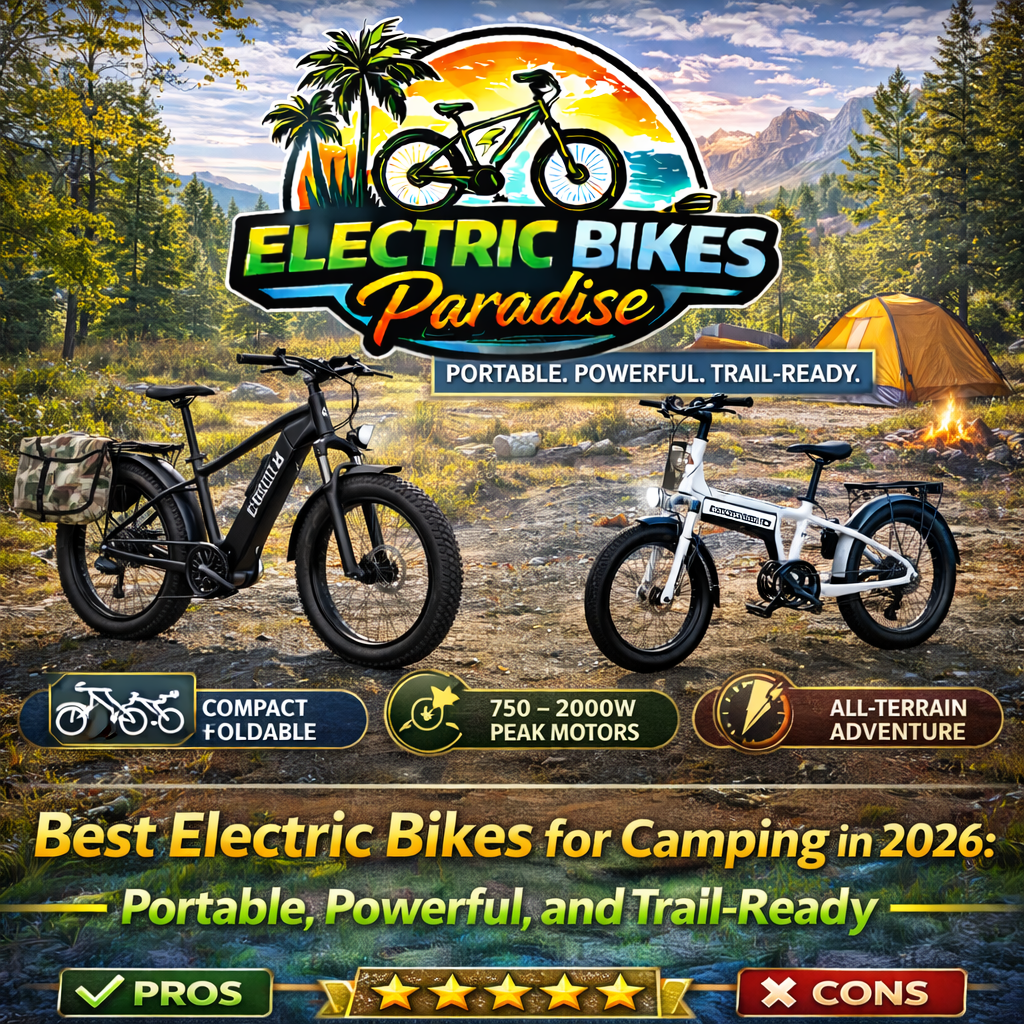
Electric bikes and camping is a combination that hardly anyone talks about but honestly should be talked about more. Think about it: you get to a campground in the middle of nowhere. You want to explore the area. You want to get to that scenic lookout or that trailhead or that little town 10 miles away. You could hike, you could bring a car, or you could bring an electric bike.
An electric bike for camping is maybe the best-kept secret in outdoor recreation. It gives you range without effort. It lets you explore without getting destroyed by the terrain. It folds or breaks down smaller than a regular bike if you’ve got one of the right models. It’s quiet so you’re not disturbing wildlife or other campers. It doesn’t require gas or charging infrastructure you might not have access to in remote areas.
The thing is: not every electric bike is good for camping. Some are too heavy. Some require specific infrastructure to recharge. Some can’t handle rough terrain. So I spent the last few months figuring out which e-bikes actually make sense if you’re serious about bringing one camping. Let me share what I found.
The Camping E-Bike Challenge
Okay, so what makes a good camping e-bike different from a good commuting e-bike or a good trail e-bike? Let me break down the actual requirements.
One: you need to be able to carry it somehow. Either it needs to fold small enough to fit in a car, or you need to be able to break it down and pack it. A 70-pound full-suspension mountain bike doesn’t fit that criterion unless you’ve got a truck and a bike rack.
Two: you need decent range because you’re not gonna have convenient charging access. You’re gonna charge at night at your campsite and then ride all day. You need a battery that goes 50-60 miles at minimum, ideally more.
Three: you need the bike to handle different terrain because campsites aren’t always on perfect pavement. You might be riding gravel roads, dirt roads, single track, whatever. A narrow-tire commuter bike is pain in the butt on rough surfaces.
Four: you need the bike to actually FIT in your camping setup. If you’re going in a normal car, you need something that packs small. If you’ve got an RV or truck, you’ve got more options.
Five: you need to think about weight and durability because you’re carrying this thing and using it in potentially harsh conditions. A bike that’s nice in town might fall apart when it gets wet and sandy.
The bikes I’m gonna recommend all solve these problems in different ways. Some fold down small. Some are just light enough that you can actually carry them. Some are built so tough they handle anything. Let me walk you through the options.
Rattan Pinus: The Compact Folder
The Rattan Pinus is probably the best folding electric bike specifically designed with camping in mind. It’s a 20-inch wheel folding e-bike at around $1,200-$1,400, and when it’s folded, it takes up roughly the space of a large suitcase. You can actually fit it in a car trunk. You can actually carry it.
The Pinus uses a 250W hub motor, which is small but fine for a light folding bike. The battery is 36V 7.5Ah, which gives you around 25-35 miles of range. That sounds short, but here’s the thing: you’re at a campsite. You’re doing 8-mile loops around the area, not 40-mile expeditions. 25-35 miles is plenty to explore a region and get back.
The frame is aluminum, which keeps the weight down. When you fold it up, the whole bike is probably 30-35 pounds. You can actually carry this. You can throw it over your shoulder. You can fit it in a trunk. This is genuinely portable.
What I like about the Pinus: it’s simple. Simple means it works. Simple means there’s not much to break. Simple means even if you’re not mechanically inclined, you can figure out what’s wrong if something happens. The components are basic but solid. The build quality is honest, no extra fancy stuff you don’t need.
The thing about the Pinus: the range is really the limiting factor. 25-35 miles is fine for a day trip, but if you’re doing a full day of exploration, you might want more battery. But you can’t have everything at this price point and portability.
For exploring the world of folding electric bikes, we’ve got a whole collection at https://electricbikesparadise.com/folding-electric-bikes/. The Pinus is on the budget end, but there are folding bikes at different price points if you want more range or features.
Rattan LF/LM Ultra: The Premium Folder
If you want to step up from the Pinus and get more capability, Rattan also makes the LF and LM Ultra models. These are premium folding bikes at around $2,500-$2,900. They’re more expensive, but you get more range and more features.
The LF and LM Ultra come with 500W hub motors and 48V 10Ah batteries. That’s a significant step up in power and capacity. You’re looking at 40-60 miles of real-world range, which changes how you can use the bike. You can do full-day exploration. You can ride further from your campsite. You can actually take the bike to multiple campsites in a trip.
The frame is still aluminum, still folds, still portable. But the bike itself is heavier and bulkier when folded because of the larger battery and motor. You’re looking at 40-45 pounds, which is still portable but less easy to carry than the Pinus.
What makes the Ultra models special: the components are actually decent. They come with real Shimano derailleurs and Tektro brakes. The build quality feels premium. This is a bike that will last years if you take care of it.
Here’s the honest truth about the Ultra models: they’re really really good camping bikes IF you’ve got the space and don’t mind the weight. The range makes them genuinely useful. The components make them reliable. The price is high, but you get what you pay for.
If you want to explore all the folding options more deeply, check out our collection at https://electricbikesparadise.com/folding-electric-bikes/. There are folding bikes at every price point with different motor sizes and battery capacities.
Velowave Ranger: The Fat Tire Specialist
Here’s a different approach to camping bikes: instead of folding, just get something built really really tough. The Velowave Ranger is a fat-tire electric bike at around $2,200-$2,500, and it’s designed to handle rough terrain and harsh conditions.
Fat-tire bikes have huge tires, way wider than regular bikes. The Ranger has 4-inch wide tires, which sounds extreme, but they’re actually perfect for camping. They handle sand, gravel, dirt, rocks, mud. You can ride on surfaces that would destroy a skinny-tire bike. And because the tires are so wide, they grip really really well, which matters if you’re on uneven ground.
The Ranger comes with a 750W hub motor and 48V 14Ah battery. That’s serious power and serious capacity. You’re looking at 50-70 miles of real-world range. That’s enough to explore a large area and still get back to your campsite comfortably.
The frame is aluminum, sturdy, and designed around the fat tires. The whole bike weighs 60-65 pounds, which is heavy. But here’s the thing: because the tires are so wide and the ride is so stable, the weight doesn’t feel as bad as it might on a regular bike. It’s easier to ride than you’d expect.
What I love about the Ranger for camping: you can ride it ANYWHERE. Campground roads that are just dirt and gravel? No problem. Trails that are loose and rocky? No problem. Wet conditions where a skinny-tire bike would sink? The fat tires float right over. You’re not limited to nice smooth paths. You can actually explore.
The weight is the tradeoff. If you’re planning to carry this onto public transportation or throw it in a small car, it’s a pain in the butt. But if you’re driving to a campsite and leaving the bike there? The weight doesn’t matter. You’re rolling it, not carrying it.
If fat tires are interesting to you, our collection of fat tire bikes is at https://electricbikesparadise.com/electric-fat-tire-bikes/. The Ranger is a great camping-specific fat bike, but there are fat bikes at different price points if you want to explore options.
Rambo Ranger Folding: The Heavy Duty Folder
Rambo makes the Ranger Folding, which is really really interesting for camping specifically. It’s a folding fat-tire electric bike at around $2,800-$3,200. So it combines the benefits of fat tires with the portability of a folding design. That sounds like the best of both worlds, and honestly for camping, it kind of is.
The Ranger Folding comes with a 750W motor and 48V 14Ah battery, so you get the same power and range as the non-folding Velowave Ranger. But it folds up. It’s a fat-tire bike that you can actually fit in an RV or large SUV. That’s actually really cool.
The tradeoff is that it’s heavier when folded because of the fat tires and the folding mechanism. You’re looking at around 70-75 pounds. That’s not carry-friendly, but it’s truck-friendly. If you’ve got a truck or RV, this is basically perfect.
Here’s what makes the Rambo special: it’s American-made. That might sound like marketing hype, but it actually matters when you’re far from civilization and something breaks. You can call Rambo and they’ll walk you through a fix over the phone. You can find parts at a local bike shop because the components are mainstream brands.
The Ranger Folding is expensive, but if you’re serious about camping and exploration, it might be worth it. Fat tires plus folding plus good range plus American quality. That checks a lot of boxes.
Why Fat Tires Matter for Camping
Let me explain why I keep bringing up fat tires for camping. A regular e-bike has tires maybe 2 inches wide. A fat bike has tires 4 inches wide or more. That’s not just a cosmetic difference.
Fat tires change how the bike rides. They’re lower pressure, so they absorb bumps better. They’re wider, so they grip on loose surfaces. They float on sand instead of sinking. They don’t slip on rocks. They handle mud without clogging up.
For pavement and nice bike paths? Fat tires are slower and a pain in the butt. For anything off-road? Fat tires are absolutely awesome. If you’re camping, you’re probably gonna encounter at least SOME off-road or rough conditions. Fat tires make that way less frustrating.
If you want to explore fat tire bikes more deeply, our collection at https://electricbikesparadise.com/electric-fat-tire-bikes/ shows the full range of options. From budget fat bikes to premium ones, from electric to human-powered. There are a lot of options at different price points.
The Range Game
Let me be clear about range because this matters for camping specifically. When I say “50 miles,” I mean “actual miles in actual conditions, not marketing conditions.”
On a camping trip, your actual conditions are gonna be: you’re carrying some gear, you’re riding on rough terrain, you’re probably at a slightly higher elevation than you’re used to. That all reduces range. If a bike claims 60 miles, you might actually get 40. That’s not the bike’s fault, that’s just physics.
Here’s how to think about it: plan your camping trips assuming you get 50% of the claimed range if you’re riding on rough terrain, 70% if you’re on smooth paths. So a bike claiming 60 miles? Plan for 30-40 miles if you’re doing rough terrain riding. That’s still plenty for exploring a campground area, but it changes how you plan your days.
This is why battery size matters more than motor size for camping. A smaller motor on a bigger battery is better than a bigger motor on a smaller battery. The Rattan LF Ultra has a 500W motor on a 48V 10Ah battery. The Velowave Ranger has a 750W motor on a 48V 14Ah battery. More battery capacity = more range, and range is what matters for camping.
Charging at Camp
Here’s the practical reality of camping with an electric bike: you need a way to charge the battery. Most campgrounds have electric hookups. Some don’t. You need to plan around this.
If your campground has electric, great. You just plug in. If it doesn’t, you need a plan B. Some people bring a portable solar charger. Some people ride into town and charge in a cafe. Some people just don’t ride the second day and let the bike charge from the campfire’s heat or something (just kidding, you can’t do that, but wouldn’t it be nice).
The Rattan Pinus and Rattan LF Ultra both have removable batteries. That’s helpful because you can charge the battery inside your tent or RV instead of trying to charge the whole bike. That’s a practical advantage worth having.
For a camping trip, I’d budget maybe 4-6 hours for a full charge from empty, depending on the charger and the battery size. Most of the bikes I’m recommending come with reasonable chargers, but check the specs to be sure.
Weather and Durability
When you’re camping, your bike is gonna get wet. It’s gonna get muddy. It’s gonna spend nights in damp conditions. You need to think about durability.
All of the bikes I’m recommending have sealed motors and sealed batteries, so water isn’t gonna destroy the core components. But everything else? The cables, the connectors, the bearings? That stuff can corrode if you don’t dry it off and maintain it.
Here’s my camping bike maintenance routine: after a muddy ride, I dry the bike with a towel. I make sure the cable connectors are dry. I don’t leave the bike wet overnight. In the morning, I wipe it down again. That takes 10 minutes and it keeps the bike healthy.
The good news: these are all e-bikes that exist in the real economy. If something breaks, you can fix it. They use real components from real brands. You don’t need proprietary parts from overseas.
Weight and Transportation
Let’s be real about how you’re getting these bikes to your campsite. You’re probably driving. You’ve got a car or truck or RV. The bike needs to fit somehow.
Folding bikes: pack in the trunk or in the RV. They take up space equivalent to a large suitcase. They’re portable if you need to move them, but you don’t usually move them once you’re camping.
Fat bikes: need a truck bed or bike rack. If you’ve got a truck or a vehicle with a rear hitch rack, fine. If you’ve got a sedan, it’s tight. The Rambo Ranger Folding is the compromise: it folds, so it fits in an RV or SUV, but it’s heavy when folded.
Think about your actual vehicle and what actually fits. That’s gonna drive which bike makes sense for you more than anything else.
Specific Camping Scenarios
Let me walk through some actual camping scenarios and what bike makes sense.
Scenario one: you’re car camping at a developed campground with nice roads. You want to explore a 10-20 mile radius. The Rattan Pinus is perfect. It’s light, portable, good enough range. You’re not doing anything crazy, just exploring.
Scenario two: you’re RV camping and you want to go on actual trail rides and explore rough terrain. The Velowave Ranger or Rambo Ranger Folding. You need the fat tires and the power. You’ve got the space to store a heavier bike.
Scenario three: you’re backpacking and you want a bike that you can carry as backup. This is hard because e-bikes are heavy. Even the lightest folding bike is 30 pounds. That’s a lot to carry along with camping gear. Honestly, for backpacking, a regular bike might make more sense than an e-bike. But if you want an e-bike, the Rattan Pinus is the lightest option.
Scenario four: you’re doing a bike packing trip, traveling between campsites, and you want real capability. The Rattan LF Ultra. It folds for packing, it’s got good range, the components are decent. You can set up at multiple campsites and explore from each one.
The Best Bike Depends on Your Setup
Here’s the honest truth: there’s no single “best” camping e-bike. The best one depends on:
Your vehicle and how much space you have
How far you want to ride from camp
What terrain you’ll encounter
Your budget
Your mechanical skills
Whether you want to fold or just load it on a rack
The Rattan Pinus: best if you want the most portable, lightest option. You sacrifice range for portability.
The Rattan LF Ultra: best if you want to balance range and portability. You can ride further, but the bike is heavier.
The Velowave Ranger: best if you want to ride rough terrain. You get the fat tires for traction, but you need the truck space.
The Rambo Ranger Folding: best if you want everything: fat tires, range, and portability. You pay premium prices for the combination.
The Money Question
Okay, so is it actually worth buying an electric bike specifically for camping? Let me think about this honestly.
If you camp 4+ times a year and you want to explore from each campsite, yeah, it’s worth it. The e-bike opens up options that you wouldn’t have otherwise. You can explore 50 miles from your site instead of 5.
If you camp once a year and you’re mostly just sitting around the campfire, probably not worth it. You’d be better off renting a bike locally if you need one.
If you’re already committed to electric bikes for other reasons and you want one that also works for camping, then pick one and use it for both. That makes financial sense.
Here’s what I’d do: if you’re genuinely interested in this, rent an e-bike on a camping trip first. See how you like it. See what range you actually need. See what features matter. Then decide whether to buy.
Integration with Your Camping Lifestyle
An e-bike doesn’t have to be ONLY for camping. These same bikes work great for commuting, casual riding, exploring your hometown. If you buy a camping-capable e-bike, you’re buying something you can use year-round.
If you want to explore how e-bikes work in general and whether they make sense for your life, check out our honest assessment at https://electricbikesparadise.com/are-electric-bikes-worth-it-an-honest-look-at-the-costs-benefits-and-trade-offs-in-2026/. That article walks through the real economics and use cases.
Our full buying guide at https://electricbikesparadise.com/electric-bike-buying-guide/ walks through all the decisions: motor type, battery size, frame style, everything. That’s useful whether you’re buying specifically for camping or for general use.
And our collection of best electric bikes is at https://electricbikesparadise.com/best-electric-bikes/. That shows you what’s available across all price points and styles.
Camping-Specific Collections
We’ve got specific collections that are relevant to camping:
Folding electric bikes at https://electricbikesparadise.com/folding-electric-bikes/ if portability is your priority.
Fat tire electric bikes at https://electricbikesparadise.com/electric-fat-tire-bikes/ if rough terrain is your priority.
Step-through bikes at https://electricbikesparadise.com/step-thru-electric-bikes/ if you want easier mounting and dismounting when you’re potentially carrying gear.
If you’re camping AND commuting, our commuter bikes at https://electricbikesparadise.com/commuter-electric-bikes/ might be interesting.
For serious trail camping, electric mountain bikes at https://electricbikesparadise.com/electric-mountain-bikes/ give you full suspension and trail-specific geometry.
A Realistic Camping Trip
Let me paint a realistic picture of what a camping trip with an e-bike actually looks like, just so you have real expectations.
Day one: you arrive at the campground in the evening. You unload your camping gear and your e-bike. You set up camp. You charge the bike if the battery is low. Maybe you ride around the immediate area a bit to get a feel for how the bike handles the terrain.
Day two: you wake up, make coffee, and you’ve got a full battery. You ride out to explore. Maybe you go 20 miles, maybe 30. You check out a lake or a overlook or a trail. The bike makes the trip way less effort than hiking would be. You’re back by afternoon, maybe you ride to a nearby town for ice cream. You’re back at camp by dinner. You plug in the bike.
Day three: repeat. Or relax around camp. Or try different trails. The e-bike opens up options. You don’t have to ride, but you CAN if you want to.
That’s the actual value of a camping e-bike. It’s freedom of movement without exhaustion. It lets you see more while exerting less.
Final Thoughts on Camping and E-Bikes
An electric bike for camping is honestly underrated. People talk about hiking, about driving to scenic spots, about sitting around the campfire. Nobody talks about the e-bike option, which is weird because it’s genuinely good.
The bikes I’ve recommended all solve the core problem: how do you get mobility and exploration capability without a lot of effort, and how do you carry it to where you’re going. The Rattan Pinus solves it with portability and low cost. The Rattan LF Ultra adds range. The Velowave Ranger adds capability for rough terrain. The Rambo Ranger Folding adds all three but at a higher price.
Pick the one that matches your actual camping style and your vehicle, and you’re gonna have a really really good time. Camping with an e-bike is better than camping without one. I’m not exaggerating. The ability to explore distances that would be exhausting without assistance changes your whole camping trip.
And these bikes aren’t just for camping. You use them for commuting, for casual riding, for errands. They’re good year-round. So buying a good one isn’t just an investment in camping, it’s an investment in how you move through the world.
If you want to understand how electric bikes work in general and whether they’re worth the money at all, check out https://electricbikesparadise.com/how-do-electric-bikes-work/ for the technical stuff and https://electricbikesparadise.com/are-electric-bikes-worth-it-an-honest-look-at-the-costs-benefits-and-trade-offs-in-2026/ for the economics.
For understanding what to buy and how to choose, our buying guide at https://electricbikesparadise.com/electric-bike-buying-guide/ is where to start. And for seeing everything we’ve got available, head to https://electricbikesparadise.com/ and explore from there.
The camping e-bike market might be small, but the bikes in it are really really good. Pick one, bring it camping, and see how much more you can explore. You’re gonna like it.