Published by Electric Bikes Paradise | Updated 2026
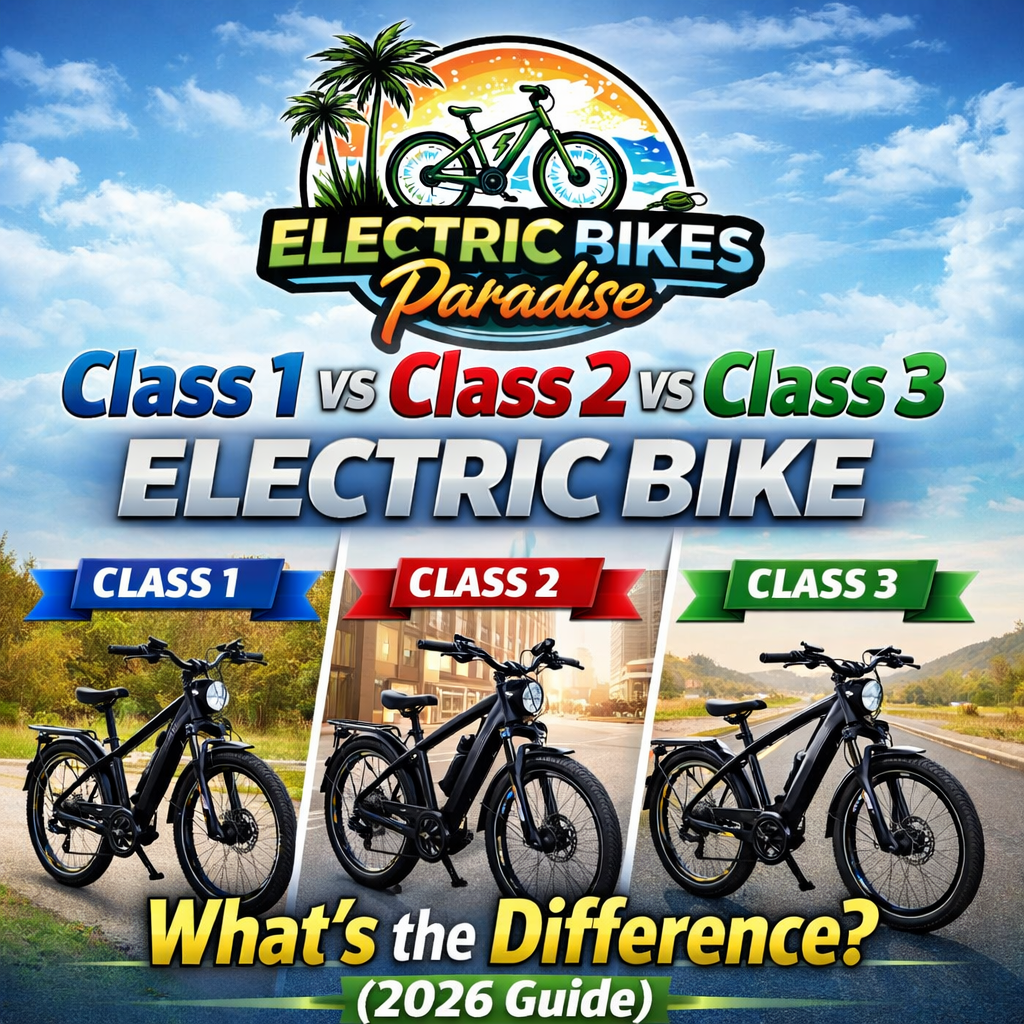
If you’ve been shopping for an electric bike, you’ve almost certainly come across the terms Class 1, Class 2, and Class 3. These classifications aren’t just marketing labels — they’re legally defined categories that determine how fast your e-bike can go, whether it has a throttle, and crucially, where you’re allowed to ride it.
Understanding the three e-bike classes before you buy is essential. Choosing the wrong class for your intended use case could mean being restricted from the trails, paths, or roads you want to ride on — or missing out on features that would make your riding experience significantly better.
In this complete guide we’ll explain exactly what each class means, how they differ in terms of speed, throttle, and legal access, which class is best for different types of riders, and how the classification system is applied across the United States in 2026.
Why Does the E-Bike Class System Exist?
The three-class e-bike system was developed to create a consistent, logical framework for regulating electric bikes across the United States. Before this system was widely adopted, e-bike regulations were a patchwork of inconsistent local rules that created confusion for riders and policymakers alike.
The classification system — originally developed by the cycling industry and adopted by the majority of U.S. states — groups e-bikes by their top assisted speed and whether they have a throttle. This allows lawmakers to set clear, reasonable rules about where each type of e-bike can be ridden without treating all e-bikes the same as motorcycles or mopeds.
As of 2026, the vast majority of U.S. states have adopted some version of the three-class system, though specific rules about where each class can ride vary by state and sometimes by municipality. Always check your local regulations before riding.
What Is a Class 1 Electric Bike?
A Class 1 electric bike is defined as a pedal-assist only e-bike with a maximum assisted speed of 20 mph and no throttle.
Key characteristics of Class 1 e-bikes:
- Motor assistance only when pedaling (pedal assist / PAS)
- Motor cuts out at 20 mph
- No throttle
- Maximum motor power: typically 750W (varies by state)
Class 1 e-bikes are the most universally accepted e-bike category. Because they only assist when you’re pedaling and are limited to 20 mph, they’re widely considered the most bicycle-like of the three classes and receive the broadest legal access.
Where can you ride a Class 1 e-bike?
Class 1 e-bikes are generally permitted anywhere a regular bicycle is allowed, including bike lanes, bike paths, multi-use trails, and roads. Many trail systems that have historically been closed to motorized vehicles have opened up to Class 1 e-bikes because of their non-throttle, lower-speed nature.
National parks, state parks, and land management agencies like the Bureau of Land Management and U.S. Forest Service have increasingly adopted policies permitting Class 1 e-bikes on non-motorized trails — access that Class 2 and Class 3 e-bikes typically do not have.
Who is Class 1 best for?
Class 1 e-bikes are ideal for trail riders who want access to non-motorized paths, fitness-focused riders who want motor assistance without a throttle, commuters on routes with dedicated bike infrastructure, and anyone in a jurisdiction with strict e-bike regulations. They’re also the most common configuration for electric mountain bikes due to their broad trail access.
What Is a Class 2 Electric Bike?
A Class 2 electric bike is defined as an e-bike with a throttle that can propel the bike up to 20 mph without pedaling, and a pedal assist system also limited to 20 mph.
Key characteristics of Class 2 e-bikes:
- Motor assistance when pedaling (pedal assist / PAS) up to 20 mph
- Throttle that can power the bike without pedaling up to 20 mph
- Motor cuts out at 20 mph under both throttle and pedal assist
- Maximum motor power: typically 750W (varies by state)
The throttle is the defining feature that separates Class 2 from Class 1. With a Class 2 e-bike, you can cruise at up to 20 mph without pedaling at all — just twist or press the throttle and go. This is particularly useful for getting started from a stop, tackling short steep sections, or resting your legs during a long ride.
Where can you ride a Class 2 e-bike?
Class 2 e-bikes are permitted on most of the same infrastructure as Class 1 bikes — bike lanes, roads, and many bike paths. However, because of the throttle, some trail systems and multi-use paths that allow Class 1 e-bikes restrict or prohibit Class 2 models. National parks and many state park trail systems that have opened to Class 1 e-bikes often exclude Class 2.
In practice, for urban and suburban commuting on roads and dedicated bike infrastructure, Class 2 access is nearly identical to Class 1.
Who is Class 2 best for?
Class 2 e-bikes are ideal for commuters who want the convenience of throttle-only riding, recreational riders who enjoy the option to cruise without pedaling, seniors or riders with limited mobility who benefit from throttle assistance, and anyone who frequently starts and stops in traffic and values the throttle for smooth takeoffs. Many of our popular electric bikes, electric fat tire bikes, and folding electric bikes are Class 2.
What Is a Class 3 Electric Bike?
A Class 3 electric bike is defined as a pedal-assist only e-bike with a maximum assisted speed of 28 mph. Class 3 e-bikes may or may not have a throttle depending on the state — some states permit Class 3 e-bikes with throttles limited to 20 mph while the pedal assist extends to 28 mph.
Key characteristics of Class 3 e-bikes:
- Motor assistance when pedaling (pedal assist / PAS) up to 28 mph
- No throttle in most configurations (some states permit a throttle limited to 20 mph)
- Motor cuts out at 28 mph
- Maximum motor power: typically 750W (varies by state)
- Many states require a speedometer
The higher top assisted speed is the defining feature of Class 3 e-bikes. The ability to cruise at 25–28 mph with motor assistance is a significant advantage for commuters covering longer distances or riding in areas where higher speeds are practical and safe.
Where can you ride a Class 3 e-bike?
Class 3 e-bikes have the most restricted access of the three classes. Because of their higher top speed, they are typically limited to roads and bike lanes and are not permitted on shared-use paths, multi-use trails, or bike paths where pedestrians and slower cyclists are present. The reasoning is straightforward — a 28 mph e-bike poses a significantly greater hazard to pedestrians on a shared path than a 20 mph bike.
Some states require riders to be at least 16 years old to operate a Class 3 e-bike, and some require a helmet by law (even in states where helmet use is otherwise optional for adults on bicycles).
Who is Class 3 best for?
Class 3 e-bikes are ideal for serious commuters covering longer distances where higher speeds are practical, riders who want to keep pace with urban traffic, fit riders who want to maintain high speeds with less effort, and experienced cyclists comfortable riding at near-road speeds on dedicated bike infrastructure. Our step-through electric bikes and premium commuter models are popular in this category.
Side-by-Side Comparison: Class 1 vs Class 2 vs Class 3
| Feature | Class 1 | Class 2 | Class 3 |
|---|---|---|---|
| Max assisted speed | 20 mph | 20 mph | 28 mph |
| Throttle | No | Yes (to 20 mph) | No (usually) |
| Pedal assist | Yes | Yes | Yes |
| Bike lanes | Yes | Yes | Yes |
| Multi-use paths | Usually yes | Sometimes | Usually no |
| Non-motorized trails | Often yes | Sometimes | Rarely |
| Age restrictions | Typically none | Typically none | 16+ in some states |
| Helmet required by law | Varies | Varies | Often yes |
| Speedometer required | No | No | Often yes |
| Best for | Trail riding, fitness, broad access | Commuting, recreational, throttle convenience | Fast commuting, longer distances |
Speed: How Much Difference Does 8 mph Make?
The 8 mph difference between a 20 mph Class 1/2 bike and a 28 mph Class 3 bike may sound modest but is significant in real-world riding.
At 20 mph you are moving at a brisk cycling pace — faster than most casual cyclists and comfortable for most urban infrastructure. At 28 mph you are moving at a speed more comparable to light motor traffic on city streets, approaching the speed of cars in many urban environments.
For commuters covering 10–20 miles each way, the difference between averaging 17 mph and averaging 23 mph across a commute translates to meaningful time savings. A 15-mile commute that takes roughly 53 minutes on a Class 1 bike could take under 40 minutes on a Class 3 bike under similar conditions.
For recreational riders on bike paths and trails, the higher speed of a Class 3 bike is less relevant and the restricted access is a genuine disadvantage. In this context, a Class 1 or Class 2 bike is often the smarter choice despite the lower top speed.
The Throttle Question: Class 1 vs Class 2
For many buyers, the most meaningful decision is not between the speed classes but between having a throttle (Class 2) and not having one (Class 1).
Arguments for choosing Class 1 (no throttle):
- Broader trail and path access in many jurisdictions
- Encourages more active pedaling and greater exercise benefit
- Simpler, often slightly lighter design
- Required for access to many national and state park trails
- More universally accepted by trail advocacy groups
Arguments for choosing Class 2 (with throttle):
- Throttle is incredibly convenient for starting from a stop in traffic
- Allows you to rest your legs on flat sections without losing momentum
- More accessible for riders with limited leg mobility
- Makes steep short climbs easier without shifting or changing effort
- Equally fast as Class 1 (both limited to 20 mph)
Many experienced e-bike riders who primarily commute on roads and bike lanes strongly prefer the throttle of a Class 2 bike for daily use. Trail riders who want access to non-motorized paths typically prefer Class 1.
E-Bike Class Laws by State: What You Need to Know
While the three-class framework is widely adopted, implementation varies by state. Here are the key points to be aware of:
States with full three-class adoption: The majority of U.S. states including California, Colorado, Florida, Texas, New York, and most others have adopted the three-class system with regulations broadly consistent with the definitions above.
Age requirements: Some states require riders to be at least 16 years old to operate a Class 3 e-bike. Check your state’s specific requirements.
Helmet laws: Helmet requirements for e-bike riders vary by state and class. Many states require helmets for Class 3 riders regardless of age. Some states require helmets for all e-bike riders under 18. A few states have no specific e-bike helmet law.
Trail access: Trail access for e-bikes is determined at the federal, state, and local level and can vary widely even within the same state. Always check the rules for specific trails before riding.
Motor power limits: Most states cap e-bike motor power at 750W for all three classes, though some states have different limits.
Speed enforcement: Some states require Class 3 e-bikes to have a functional speedometer so riders can monitor their speed.
We strongly recommend checking your specific state and local regulations before purchasing an e-bike, particularly if trail access or Class 3 speeds are important to you.
Can You Change the Class of an E-Bike?
Some e-bikes come with configurable settings that allow the rider to switch between Class 1 and Class 2 behavior (enabling or disabling the throttle) or adjust the top assisted speed limit. This flexibility is offered by some manufacturers so that one bike can be legally operated in different jurisdictions with different rules.
However, modifying an e-bike to exceed its rated class — for example, removing the speed limiter on a Class 1 or Class 2 bike to allow speeds above 20 mph — is illegal in most jurisdictions and voids the manufacturer warranty. Riding an illegally modified e-bike on public roads or trails exposes the rider to fines and liability.
Which Class Is Right for You?
Choose Class 1 if:
- Trail access is a priority and you want the broadest possible riding permissions
- You want to ride on multi-use paths and shared trails
- You’re an off-road rider on an electric mountain bike
- You want motor assistance without relying on a throttle
- You prioritize exercise and active pedaling
- You live in an area with strict e-bike trail regulations
Choose Class 2 if:
- You commute primarily on roads and bike lanes
- You want the convenience and practicality of a throttle
- You frequently start and stop in urban traffic
- You’re a senior or have limited leg mobility
- You ride electric fat tire bikes, folding e-bikes, or electric trikes for recreation
- Trail-only access restrictions are not a concern for your riding
Choose Class 3 if:
- You have a long daily commute where higher speeds save meaningful time
- You ride primarily on roads and dedicated bike lanes
- You’re comfortable riding at near-traffic speeds
- You want the most efficient, fastest assisted ride available
- Multi-use trail access is not important to your riding
- You’re an experienced cyclist comfortable at higher speeds
Frequently Asked Questions
Do I need a license to ride an e-bike? In most U.S. states, no license, registration, or insurance is required for Class 1, 2, or 3 e-bikes. A small number of states have specific requirements for Class 3 e-bikes — check your local laws.
What happens if I exceed the motor’s speed limit? The motor simply cuts out and you’re pedaling under your own power — exactly like a regular bicycle. You can pedal faster than the motor’s limit if you have the fitness to do so.
Can children ride e-bikes? Most states have no minimum age requirement for Class 1 and Class 2 e-bikes. Class 3 e-bikes often require riders to be at least 16. Always supervise young riders and ensure they wear a helmet.
Is a Class 3 e-bike considered a motor vehicle? In most states, no. As long as the bike meets the Class 3 definition (pedal assist only, up to 28 mph, 750W motor), it is legally classified as a bicycle, not a motor vehicle. Always verify with your state’s DMV or equivalent authority.
What class are most e-bikes sold in the U.S.? Class 2 e-bikes with both pedal assist and a throttle are the most common configuration sold in the U.S. consumer market, followed closely by Class 1. Class 3 represents a smaller but growing segment of the market.
Shop Electric Bikes at Electric Bikes Paradise
Now that you understand the three e-bike classes, you’re ready to find the perfect model for your riding style and local regulations. At Electric Bikes Paradise, we carry a premium selection of electric bikes across all categories — all backed by free shipping to the lower 48 states, our lowest price guarantee, and expert customer support.
Browse our categories:
- Electric Bikes
- Electric Mountain Bikes
- Electric Fat Tire Bikes
- Folding Electric Bikes
- Folding Fat Tire Electric Bikes
- Electric Trikes
- Step-Through Electric Bikes
- Electric Beach Cruiser Bikes
- Electric Hunting Bikes
- Electric Scooters
- Mobility Scooters
Have questions about which class or category is right for you? Our team of e-bike experts is available Monday–Friday, 9am–5pm MST.
Electric Bikes Paradise | Ecom Paradise LLC 5830 E 2nd St, Ste. 7000 #715, Casper, WY 82609, United States 📞 307-429-0021 ✉️ sales@electricbikesparadise.com Facebook | Pinterest | YouTube | Instagram | TikTok