Published by Electric Bikes Paradise | Updated 2026
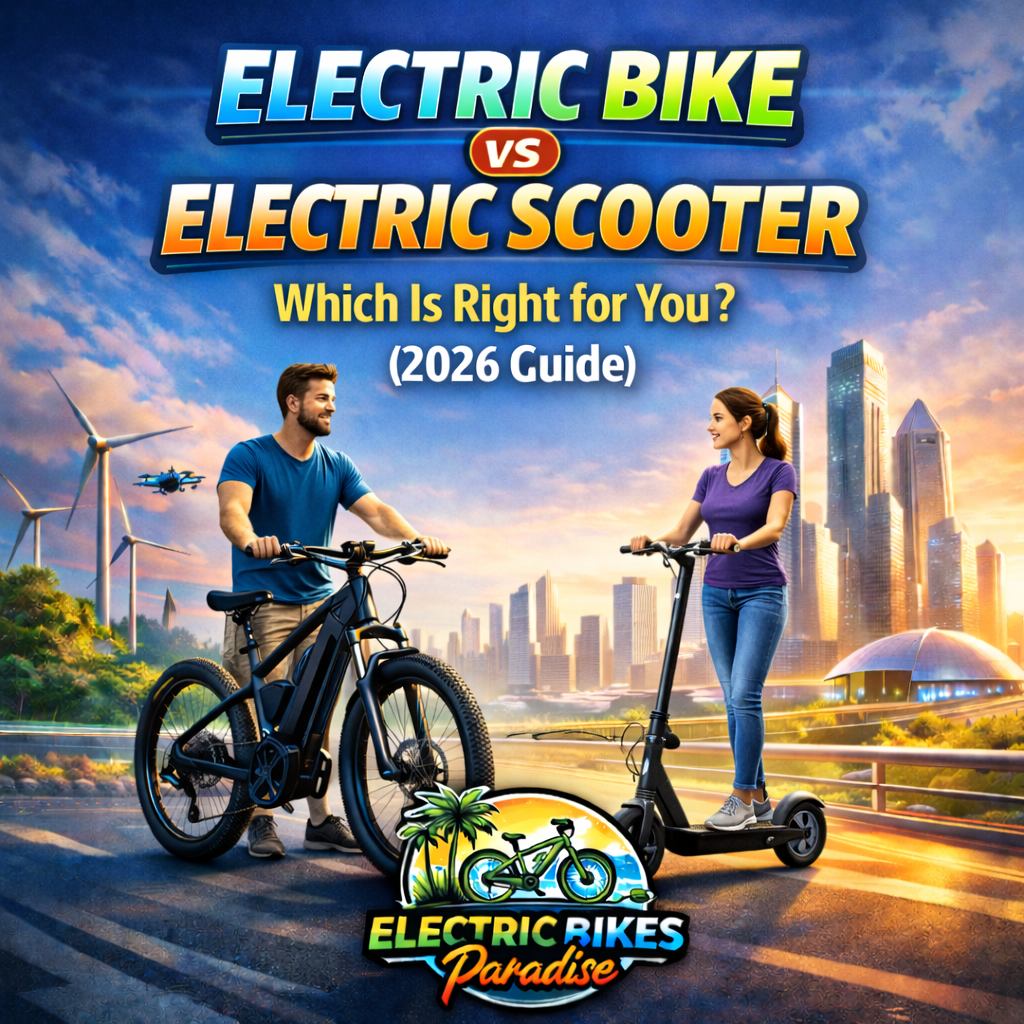
Two of the most popular forms of electric personal transportation today are electric bikes and electric scooters. Both are battery-powered, eco-friendly, and far more affordable to operate than a car. Both have exploded in popularity over the past several years as urban commuters, recreational riders, and everyday people look for smarter ways to get around.
But which one is right for you? The answer depends on how you plan to use it, where you’ll ride, how far you need to go, your budget, and what kind of riding experience you’re looking for.
In this comprehensive comparison guide, we’ll break down every major factor — speed, range, comfort, cost, portability, safety, legality, and more — so you can make a confident, informed decision between an electric bike and an electric scooter in 2026.
What Is an Electric Bike?
An electric bike is a bicycle with an integrated electric motor, battery, and controller that provides pedal assistance or throttle-powered propulsion. You ride an e-bike just like a regular bicycle — seated, with your feet on pedals — with the motor providing assistance to amplify your effort or power the bike independently.
E-bikes come in a wide variety of styles including commuter bikes, fat tire bikes, mountain bikes, folding bikes, trikes, and more. At Electric Bikes Paradise, we carry a full range of electric bikes for every type of rider and every terrain.
What Is an Electric Scooter?
An electric scooter is a stand-up or sit-down personal electric vehicle with a deck you stand on, handlebars for steering, and an electric motor powered by a rechargeable battery. Unlike e-bikes, most electric scooters don’t have pedals — you push off to get started and the motor does the rest.
Electric scooters range from lightweight, foldable commuter models to powerful off-road machines. At Electric Bikes Paradise, we carry a full range of electric scooters including road electric scooters, off-road electric scooters, fat tire electric scooters, lightweight foldable electric scooters, and fast dual motor electric scooters.
Speed: Electric Bike vs Electric Scooter
Electric Bike Speed
E-bikes in the U.S. are classified by their top assisted speed:
- Class 1 and Class 2: Motor assistance up to 20 mph
- Class 3: Motor assistance up to 28 mph
Beyond the motor’s speed limit, you can still pedal faster under your own power. Most casual e-bike riders cruise comfortably between 15–22 mph.
Electric Scooter Speed
Entry-level electric scooters typically top out at 15–20 mph. Mid-range models reach 25–30 mph. High-performance dual motor scooters can exceed 40–50 mph, though these are typically restricted from public roads and bike paths in most jurisdictions.
For everyday commuting and urban use, both vehicles are closely matched on speed. Performance scooters can be significantly faster than e-bikes for riders who prioritize top-end speed.
Winner
For everyday use, it’s roughly equal. High-performance electric scooters have higher top speeds, but most riders won’t need or legally be able to use those speeds on public roads.
Range: Electric Bike vs Electric Scooter
Electric Bike Range
Most e-bikes deliver 20–80 miles per charge depending on battery capacity, assist level, terrain, and rider weight. Because riders are pedaling and providing some of the power themselves, e-bikes are inherently more energy-efficient than scooters. A larger battery combined with light pedal assist can yield impressive real-world range.
Electric Scooter Range
Entry-level electric scooters typically offer 10–20 miles per charge. Mid-range commuter scooters deliver 20–40 miles. Premium long-range scooters can achieve 50–70 miles. Because the motor does all the work with no human power input, scooters are generally less range-efficient than e-bikes at comparable battery sizes.
Winner
Electric bikes generally offer better range per charge, especially when ridden with moderate pedal assist. For longer commutes or rides, an e-bike is the more practical choice.
Comfort: Electric Bike vs Electric Scooter
Electric Bike Comfort
E-bikes offer a seated riding position, which is far more comfortable for longer rides. The saddle, handlebars, and pedals distribute your weight across the bike and allow you to shift position during the ride. Many e-bikes also feature suspension forks or full suspension systems that absorb road vibration and bumps.
For rides longer than 15–20 minutes, the seated position of an e-bike is dramatically more comfortable than standing on a scooter deck.
Electric Scooter Comfort
Most electric scooters require you to stand for the duration of the ride. While this is fine for short trips, standing for 30+ minutes on a vibrating deck can become fatiguing on the legs, knees, and lower back. Pneumatic (air-filled) tires and deck suspension systems help absorb bumps, but scooters still generally offer a harsher ride than e-bikes on uneven surfaces.
Some electric scooters feature a seat attachment or are designed as sit-down models, which improves long-ride comfort significantly. Our electric scooters with seats are a great option for riders who want scooter convenience with added comfort.
Winner
Electric bikes win on comfort, particularly for longer rides and riders with knee or back issues. For short urban trips, the comfort difference is minimal.
Portability and Storage
Electric Bike Portability
Standard e-bikes are large and heavy — typically 45–70 lbs — which makes them challenging to carry up stairs or store in tight spaces. However, folding electric bikes fold down compactly and can be stored under a desk, in a car trunk, or taken on public transit. Folding e-bikes typically weigh 35–50 lbs, which is lighter than standard e-bikes but still heavier than most folding scooters.
Electric Scooter Portability
Lightweight foldable electric scooters are among the most portable personal electric vehicles available. Many models weigh just 20–30 lbs and fold in seconds to a compact form that fits in a locker, under a desk, or in an overhead bin on some transit systems. This exceptional portability is one of the biggest advantages scooters have over e-bikes for urban commuters who use multimodal transportation.
Winner
Electric scooters win on portability, particularly for commuters who need to carry their vehicle onto trains, buses, or up stairs. Our lightweight foldable electric scooters are specifically designed for this use case.
Cost: Electric Bike vs Electric Scooter
Electric Bike Cost
Quality e-bikes typically range from $800 for entry-level models to $5,000+ for premium performance bikes. Mid-range e-bikes that deliver reliable performance for commuting and recreational use generally fall in the $1,500–$3,000 range.
Electric Scooter Cost
Electric scooters span a similarly wide price range. Basic commuter scooters start around $300–$600. Mid-range models with better range and build quality run $600–$1,500. High-performance dual motor scooters can cost $2,000–$4,000+.
For comparable performance, electric scooters tend to be less expensive than electric bikes, primarily because they have fewer components and simpler construction.
Winner
Electric scooters generally offer a lower entry price point for comparable performance. Budget-conscious buyers will find more options at lower price points in the scooter category.
Physical Exercise
Electric Bike Exercise
E-bikes provide meaningful physical exercise through pedaling. Even on high assist levels, riders engage their legs, core, and cardiovascular system. Studies show that e-bike riders get significant health benefits from regular riding, and many riders use lower assist levels specifically to increase their workout intensity.
The option to increase or decrease assist gives e-bike riders full control over how much of a workout they get on any given ride.
Electric Scooter Exercise
Electric scooters provide minimal physical exercise. Standing requires some core engagement and balance, but there’s no significant muscular or cardiovascular exertion involved in riding a scooter. For riders who want their commute vehicle to double as a form of exercise, the scooter falls well short of the e-bike.
Winner
Electric bikes win decisively on exercise and health benefits.
Safety
Both electric bikes and electric scooters carry inherent safety risks, and both require riders to wear helmets and exercise appropriate caution. However, there are some meaningful safety differences between the two.
Electric Bike Safety
E-bikes have a lower center of gravity than scooters due to the seated position and larger wheels. Larger wheels (typically 20–29 inches) roll over obstacles more easily and provide better stability at speed. The seated position also makes it easier to absorb impacts and maintain control on rough surfaces.
E-bikes equipped with disc brakes provide reliable stopping power even at higher speeds and in wet conditions.
Electric Scooter Safety
Electric scooters have smaller wheels (typically 8–10 inches on standard models, larger on fat tire scooters) that are more susceptible to catching on cracks, potholes, and road debris — particularly at higher speeds. The standing riding position places the rider’s center of gravity higher, which can make sudden stops or turns more challenging to manage.
Small wheel scooters require more attention to road surface quality. Our fat tire electric scooters and off-road electric scooters address this with larger, more capable tires.
Winner
Electric bikes have a slight safety advantage due to larger wheels, lower center of gravity, and seated position. Always wear a helmet on both.
Terrain Capability
Electric Bike Terrain
E-bikes are highly versatile across different terrain types. Commuter and road e-bikes handle pavement and bike paths well. Fat tire e-bikes handle sand, snow, gravel, and dirt. Electric mountain bikes are purpose-built for technical off-road trails with full suspension and aggressive tires.
Electric Scooter Terrain
Most standard electric scooters are designed for smooth pavement and are not suitable for off-road or rough terrain riding. However, the category has expanded significantly and dedicated off-road electric scooters with pneumatic tires, suspension systems, and high ground clearance can handle trails and rough terrain surprisingly well.
For purely on-road use, quality scooters handle pavement excellently. For mixed terrain, e-bikes — particularly fat tire models — are the more capable choice.
Winner
Electric bikes win on terrain versatility, particularly for off-road riding. For pure pavement use, both perform well.
Legal Status and Where You Can Ride
Laws governing e-bikes and electric scooters vary significantly by state and municipality, so always check your local regulations. Here are the general guidelines in the United States as of 2026.
Electric Bike Legal Status
Most U.S. states have adopted a three-class e-bike system. Class 1 and Class 2 e-bikes (up to 20 mph) are generally allowed anywhere regular bicycles are permitted — bike lanes, bike paths, and roads. Class 3 e-bikes (up to 28 mph) may be restricted from some multi-use paths.
No license, registration, or insurance is required for e-bikes in most states.
Electric Scooter Legal Status
Electric scooter laws are more varied and in many cases more restrictive than e-bike laws. Some cities permit scooters on bike lanes and roads, while others restrict them to private property only. Many jurisdictions have minimum age requirements, helmet requirements, and speed limits for scooters.
In some states, higher-powered electric scooters may be classified as motor vehicles, requiring registration, insurance, and a driver’s license.
Winner
Electric bikes generally have clearer, more permissive legal status across the United States. E-bikes are recognized as bicycles in most states, while scooter regulations vary widely.
Maintenance
Electric Bike Maintenance
E-bikes require standard bicycle maintenance (chain lubrication, brake service, tire care) plus attention to the electrical components. Routine maintenance is mostly DIY-friendly. See our How to Maintain an Electric Bike guide for a complete breakdown.
Electric Scooter Maintenance
Electric scooters have fewer mechanical components than e-bikes — no chain, gears, or derailleur to maintain. Main maintenance tasks include tire pressure checks, brake adjustment, deck and folding mechanism inspection, and battery care. Scooters are generally simpler to maintain mechanically, though electrical issues can be equally complex to diagnose.
Winner
Electric scooters have a slight edge on mechanical simplicity due to fewer moving parts. Day-to-day maintenance is minimal for both vehicles.
Best Use Cases: Electric Bike vs Electric Scooter
Choose an Electric Bike If You:
- Commute longer distances (10+ miles each way)
- Want exercise as part of your ride
- Ride on varied terrain including hills, gravel, or off-road
- Prioritize comfort for longer rides
- Need a family-friendly or cargo-capable vehicle
- Are a senior or have mobility considerations — consider our electric trikes or step-through e-bikes
- Want to explore trails and outdoor recreation
- Need the widest legal access to bike lanes and paths
Choose an Electric Scooter If You:
- Commute short to medium distances on smooth pavement
- Need maximum portability for multimodal commuting
- Have very limited storage space
- Want a lower-cost entry point into electric personal transportation
- Primarily ride in flat, urban environments
- Want to combine transit and last-mile transportation
- Are looking for a fun, nimble urban ride
Side-by-Side Comparison
| Category | Electric Bike | Electric Scooter |
|---|---|---|
| Speed | 20–28 mph (assisted) | 15–50 mph (varies by model) |
| Range | 20–80 miles | 10–70 miles |
| Comfort | Excellent (seated) | Moderate (standing) |
| Portability | Moderate (folding models available) | Excellent |
| Cost | $800–$5,000+ | $300–$4,000+ |
| Exercise | Significant | Minimal |
| Terrain | Excellent versatility | Best on pavement |
| Safety | Slightly higher | Slightly lower |
| Legal Access | Very broad | Varies by location |
| Maintenance | Moderate | Low–Moderate |
The Verdict
Both electric bikes and electric scooters are excellent, practical, and fun forms of electric personal transportation. The right choice depends entirely on your specific needs.
If you commute longer distances, want exercise, ride on varied terrain, or prioritize comfort — an electric bike is almost certainly the better choice. If you prioritize portability, lower cost, and short urban trips — an electric scooter may be the smarter option.
Many riders end up owning both. A foldable scooter for short last-mile trips and transit connections, paired with a full-featured e-bike for longer recreational rides and regular commuting, is a powerful combination.
Shop Electric Bikes and Scooters at Electric Bikes Paradise
At Electric Bikes Paradise, we carry a premium selection of both electric bikes and electric scooters for every type of rider — all backed by free shipping to the lower 48 states, our lowest price guarantee, and expert customer support.
Browse our electric bike categories:
- Electric Bikes
- Electric Fat Tire Bikes
- Electric Mountain Bikes
- Folding Electric Bikes
- Electric Trikes
- Step-Through Electric Bikes
Browse our electric scooter categories:
- Electric Scooters
- Lightweight Foldable Electric Scooters
- Off Road Electric Scooters
- Fat Tire Electric Scooters
- Fast Dual Motor Electric Scooters
- Electric Scooters with Seats
Not sure which is right for you? Call or email our team — we’re happy to help.
Electric Bikes Paradise | Ecom Paradise LLC 5830 E 2nd St, Ste. 7000 #715, Casper, WY 82609, United States 📞 307-429-0021 ✉️ sales@electricbikesparadise.com Facebook | Pinterest | YouTube | Instagram | TikTok