Published by Electric Bikes Paradise | Updated 2026
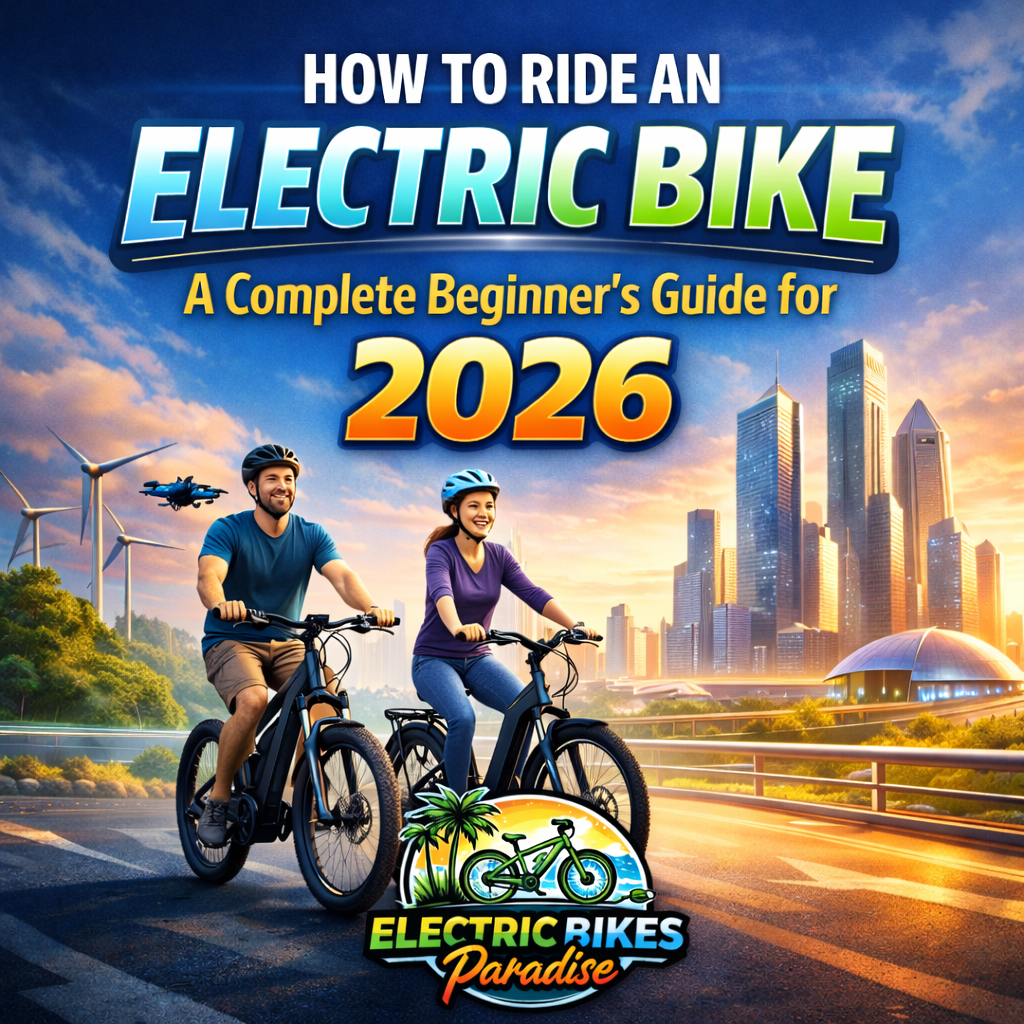
If you’ve never ridden an electric bike before, you’re in for a treat. E-bikes are intuitive, fun, and surprisingly easy to get the hang of — even if you haven’t been on a bicycle in years. That said, there are some important differences between riding a traditional bike and an e-bike that every new rider should understand before heading out on their first ride.
In this complete beginner’s guide, we’ll walk you through everything you need to know about how to ride an electric bike safely and confidently — from your first power-on to navigating traffic, hills, and different assist levels like a pro.
Before You Ride: Getting Familiar With Your E-Bike
Before you ever sit on the saddle, take a few minutes to get acquainted with your new electric bike. Understanding its controls and components will make your first ride much smoother and safer.
Locate the power button and display Most e-bikes have a handlebar-mounted display or control unit with a power button. Press and hold it to turn the bike on. The display will light up and show your battery level, current speed, and assist level.
Understand the assist levels Nearly all e-bikes have multiple pedal assist levels, usually labeled PAS 0 through PAS 5 (or ECO, TOUR, SPORT, TURBO on some brands). PAS 0 means no motor assistance — you’re riding purely on human power. PAS 5 is maximum assistance. Use the up and down buttons on your display to cycle through assist levels.
Find the throttle (if applicable) Many e-bikes — particularly those sold in the U.S. — also have a throttle that lets you power the bike without pedaling. This is usually a thumb lever or twist grip on the right handlebar. If your bike has one, test it gently before your first ride so you know how it responds.
Test the brakes Squeeze both brake levers and confirm they feel firm and engage smoothly. Most e-bikes have a motor inhibitor built into the brake levers — when you squeeze the brakes, the motor cuts out immediately for safety. Make sure this is working correctly before riding.
Check the tire pressure Proper tire pressure is essential for a safe, comfortable ride and optimal battery range. Check that your tires are inflated to the recommended PSI printed on the sidewall. Underinflated tires increase rolling resistance and can cause handling issues.
Charge the battery Make sure your battery is sufficiently charged before your first ride. A full charge gives you the best range and the most consistent power delivery. See our How to Charge an Electric Bike Battery guide for full details.
Put on your helmet Always wear a properly fitted helmet when riding an electric bike. Because e-bikes can reach higher speeds than traditional bicycles, the consequences of a fall are more serious. A helmet is your most important piece of safety equipment.
How to Start Riding an Electric Bike
Once you’re familiar with the controls, it’s time to ride. Here’s how to get started:
Step 1: Mount the bike Stand beside the bike and swing your leg over the frame to mount. If you have a step-through frame or electric trike, this is as simple as stepping through the low frame opening. For standard frames, swing your dominant leg over the rear of the bike.
Step 2: Set your starting position Position one pedal at the 2 o’clock position (slightly forward and down) with the corresponding foot on it. This gives you a strong push-off position and helps you get moving smoothly.
Step 3: Start with a low assist level For your very first ride, set the assist level to PAS 1 or PAS 2. This gives you a gentle boost without the sudden surge of power that higher assist levels can produce. You can always increase the assist once you get a feel for how the bike responds.
Step 4: Push off and start pedaling Push down on the forward pedal to get the bike moving, then bring your other foot up to the opposite pedal and begin pedaling normally. The motor will activate within a half-pedal stroke and you’ll feel the assistance kick in.
Step 5: Find your balance E-bikes are heavier than regular bicycles — typically 45–70 lbs — so they feel more stable at speed but require a bit more effort to maneuver at very low speeds. Once you’re moving, the bike will feel steady and natural.
Step 6: Adjust your assist level As you get comfortable, experiment with different assist levels. Increase to PAS 3 or higher on hills or when you want to cruise with less effort. Drop back to PAS 1 or 2 on flat sections where you want more of a workout or to conserve battery.
How to Use the Throttle
If your e-bike has a throttle, it’s important to use it correctly and safely.
Thumb throttle: Press forward gently with your thumb to apply power. The further you press, the more power the motor delivers. Release to cut the power.
Twist throttle: Rotate the grip toward you (like a motorcycle) to apply power. Release to cut power.
Start with very gentle throttle inputs until you understand how your bike responds. The acceleration from a full throttle on a 750W or 1000W e-bike can be surprisingly strong and may catch you off guard if you’re not ready for it.
Never apply full throttle from a standing start until you’re completely comfortable with the bike. Always have your hands firmly on the handlebars and your feet on the pedals before applying throttle.
Riding Uphill on an Electric Bike
One of the greatest joys of e-bike riding is how effortlessly they handle hills. Here’s how to get the most out of your e-bike on climbs:
Increase your assist level before the hill begins. Don’t wait until you’re already struggling — anticipate the climb and bump up to PAS 3, 4, or 5 before you reach the incline.
Shift to a lower gear before the hill. If your e-bike has gears, shift down before the climb begins, not during it. Shifting under heavy load can stress the drivetrain and cause chain skipping. A lower gear combined with higher assist makes even steep hills feel manageable.
Maintain a steady cadence. Try to keep pedaling at a comfortable rhythm rather than mashing heavy gears. A faster, lighter pedaling cadence is more efficient and easier on both your legs and the motor.
Use the throttle for extra help if needed. On very steep sections, a quick burst of throttle can provide additional power to get you over the top without burning out your legs.
Riding Downhill on an Electric Bike
Descending on an e-bike requires more attention than on a regular bicycle because of the additional weight and potential speed.
Use both brakes together. Apply the front and rear brakes evenly rather than grabbing just one. Using only the front brake on a heavy e-bike can cause the wheel to lock and the bike to pitch forward. Squeeze both levers progressively and smoothly.
Anticipate your braking distance. E-bikes take longer to stop than lighter bicycles. Give yourself more space than you think you need when approaching intersections, turns, or obstacles at speed.
Reduce your assist level going downhill. There’s no need for motor assistance on a descent. Drop to PAS 0 to conserve battery and let gravity do the work.
Keep your weight back. On steep descents, shift your weight slightly back on the saddle to improve rear wheel traction and prevent the front wheel from washing out.
How to Ride an Electric Bike in Traffic
Riding in urban traffic is one of the most common uses for an e-bike, and one of the situations that requires the most attention and skill.
Be predictable. Signal your turns, ride in a straight line, and avoid sudden movements. Other road users need to be able to anticipate what you’re going to do.
Ride in the bike lane where available. Many cities are rapidly expanding their bike infrastructure. Use designated bike lanes whenever possible for your safety.
Stay visible. Use front and rear lights, even during the day. Wear bright or reflective clothing. Position yourself where drivers can see you — avoid riding in blind spots.
Watch for car doors. One of the most common urban cycling hazards is a parked car door opening suddenly in your path. Ride at least 3–4 feet away from parked cars whenever possible.
Be especially careful at intersections. Most cycling accidents happen at intersections. Slow down, make eye contact with drivers, and never assume a vehicle will stop for you.
Use lower assist levels in traffic. In stop-and-go city traffic, PAS 1 or 2 gives you more control and a smoother, more predictable ride than high assist levels.
How to Ride an Electric Bike on Trails
Riding off-road opens up a whole new world of e-biking adventure. Whether you’re on a fat tire e-bike or an electric mountain bike, here are the key skills for trail riding:
Look ahead, not down. Focus your gaze 10–15 feet ahead on the trail rather than directly in front of your wheel. This gives you time to react to obstacles and choose the best line.
Relax your grip. A death grip on the handlebars transmits every bump directly to your arms and makes the bike harder to control. Keep a firm but relaxed hold with slightly bent elbows to absorb vibration.
Stand up on technical sections. When navigating rocks, roots, or rough terrain, stand up on the pedals with your knees slightly bent. Your legs act as natural suspension and allow the bike to move freely beneath you.
Control your speed before corners. Brake before a corner, not during it. Enter corners under control with your speed already set, then power out of the turn as you straighten up.
Be aware of trail etiquette. Yield to hikers and horses. Announce yourself when approaching from behind. Ride only on designated trails and respect trail closures.
Start with easier trails. If you’re new to off-road riding, build your skills on smoother, flatter trails before tackling technical terrain.
Understanding Pedal Assist vs. Throttle: When to Use Each
Most experienced e-bike riders use a combination of pedal assist and throttle depending on the situation.
Use pedal assist for: Most of your riding. Pedal assist is more efficient, provides better range, and gives you a more natural riding experience. It also provides exercise while still making the ride enjoyable.
Use throttle for: Getting started from a stop, extra power on very steep climbs, when your legs are tired, or when you need a quick burst of speed to merge safely in traffic.
Conserve battery by: Using lower assist levels on flat terrain, pedaling more actively rather than relying heavily on the motor, and using throttle sparingly.
E-Bike Safety Tips Every Rider Should Know
Always wear a helmet. This cannot be overstated. A properly fitted helmet can save your life.
Follow local traffic laws. In most U.S. states, e-bikes are subject to the same rules as regular bicycles — stop at red lights, yield to pedestrians, and ride in the correct direction.
Don’t ride distracted. No phone use while riding. If you need to check your phone, pull over safely first.
Be cautious in wet conditions. Wet pavement significantly reduces braking performance. Slow down, brake earlier, and take corners more carefully in the rain.
Check your bike before every ride. A quick pre-ride check of tires, brakes, and battery takes less than a minute and can prevent accidents.
Start slow and build confidence. If you’re a new rider or returning to cycling after a long break, start in a quiet area like a parking lot or empty path. Practice starting, stopping, turning, and using the assist levels before heading out on busier roads.
Be aware of your speed. E-bikes can reach speeds that feel surprising, especially on downhills or at high assist levels. Always ride at a speed appropriate for your surroundings.
Tips for Seniors and New Riders
Electric bikes are a fantastic option for seniors and returning cyclists because the motor assistance makes riding accessible regardless of fitness level or physical limitations. Here are some tips specifically for older or newer riders:
Consider a step-through frame or electric trike. Step-through e-bikes and electric trikes are much easier to mount and dismount than traditional frames and offer greater stability for riders with balance concerns.
Start on flat, quiet paths. Build your confidence in a low-pressure environment before venturing onto busier roads or hillier terrain.
Don’t be afraid of low assist levels. Many new riders feel intimidated by higher assist settings. PAS 1 and 2 are perfectly capable of providing a helpful, enjoyable ride without the more powerful surge of higher settings.
Take breaks as needed. Even with motor assistance, riding is physical activity. Listen to your body and rest when needed, especially on longer rides.
Bring your phone and a contact. Let someone know where you’re going and how long you expect to be out, especially for longer solo rides.
How Far Can You Ride on an Electric Bike?
Range depends on your battery capacity, assist level, terrain, rider weight, and conditions. As a general guide:
- PAS 1 (eco mode): Maximum range, typically 150–200% of the bike’s rated range
- PAS 3 (mid mode): Approximately the bike’s rated range
- PAS 5 (turbo mode): Reduced range, typically 50–70% of rated range
- Throttle only: Shortest range, typically 30–50% of rated range
For longer rides, bring a portable charger or plan your route around charging opportunities. Many riders also carry a spare battery for extended adventures.
Explore Our Full Range of Electric Bikes
Now that you know how to ride an electric bike, it’s time to find the perfect one for your lifestyle. At Electric Bikes Paradise, we carry a premium selection of electric bikes, scooters, skateboards, and mobility scooters for every type of rider — all with free shipping to the lower 48 states, our lowest price guarantee, and expert support from people who genuinely love e-bikes.
Browse our categories:
- Electric Bikes
- Electric Fat Tire Bikes
- Electric Mountain Bikes
- Folding Electric Bikes
- Folding Fat Tire Electric Bikes
- Electric Trikes
- Step-Through Electric Bikes
- Electric Beach Cruiser Bikes
- Electric Hunting Bikes
- Electric Scooters
- Mobility Scooters
Have questions? Our team of e-bike experts is available Monday–Friday, 9am–5pm MST.
Electric Bikes Paradise | Ecom Paradise LLC 5830 E 2nd St, Ste. 7000 #715, Casper, WY 82609, United States 📞 307-429-0021 ✉️ sales@electricbikesparadise.com Facebook | Pinterest | YouTube | Instagram | TikTok