
The best electric bike for RV camping on Amazon is the GOTRAX R1, because it folds, weighs a listed 45 pounds, carries a 374Wh battery that charges easily off RV power, and holds about 4.3 stars from 600+ Amazon ratings in November 2026. If you need something lighter for short campground loops, the 42-pound Jetson Bolt Pro is the easiest to lift. If you want fat tires and more battery for gravel campground roads, the Heybike Ranger 2.0 (600Wh) is my pick.
Here’s the deal with RV e-bikes. The bike has two jobs: riding around once you park, and traveling with you between stops. Most buyers obsess over the first and get burned by the second. So this guide covers both, with folded size, weight, storage math, hitch rack limits, charging off RV power and range planning from camp.
Disclosure: Electric Bikes Paradise earns a commission when you buy through links on this page, at no extra cost to you. As an Amazon Associate I earn from qualifying purchases.
Key takeaways
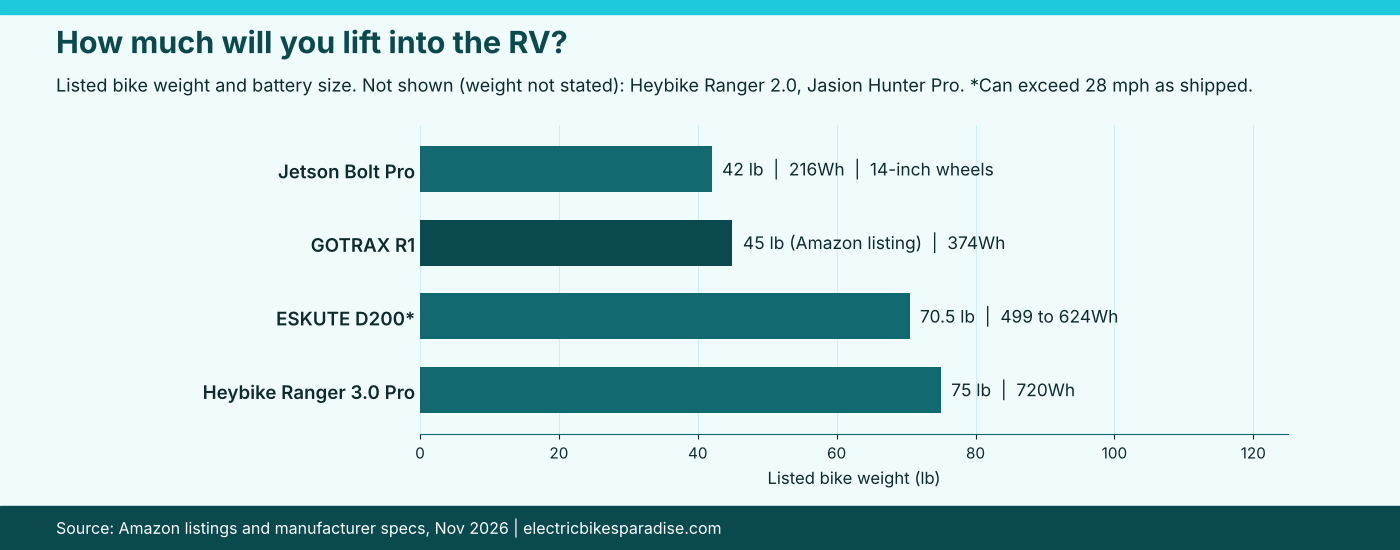
- For storage bays, look for a folding e-bike around 50 pounds or less. The GOTRAX R1 (45 lb) and Jetson Bolt Pro (42 lb) are the lightest picks here.
- Measure the bay door, not just the bay. The R1 folds to 37.4 x 17.7 x 27.5 inches per its Amazon listing.
- Fat-tire folders like the Heybike Rangers carry 600 to 720Wh but weigh 70-plus pounds. Plan on a hitch rack or two people to lift.
- A 374Wh battery uses under half a kilowatt-hour to fill, which shore power, a generator or a 1,000Wh power station handles easily.
- Plan on about 13 to 21 miles from camp on 374Wh, and 24 to 41 miles on 720Wh.
- Many hitch racks are not approved for travel trailers. Read the rack’s vehicle list before you buy.
Quick picks: best e-bikes for RV camping
| Product | Best for | Motor (rated / peak) | Battery | Top speed / class | Weight | Amazon rating (Nov 2026) |
|---|---|---|---|---|---|---|
| GOTRAX R1 (20-inch) | Best overall | 350W / 500W | 374Wh (48V 7.8Ah) | 20 mph (Class 2 style) | 45 lb | 4.3 (600+) |
| Jetson Bolt Pro | Lightest, budget | 350W | 216Wh (36V 6Ah) | 15.5 mph | 42 lb | 4.0 (280+) |
| Heybike Ranger 2.0 | Campground dirt and gravel | 750W / 1,400W peak | 600Wh | Up to 28 mph (Amazon listing) | Not stated | 4.4 (700+) |
| Heybike Ranger 3.0 Pro | Most range in a folder | 750W / 1,200 to 1,400W | 720Wh | Ships Class 2, 20 mph | 75 lb | 4.6 (13, new listing) |
| Jasion Hunter Pro | Boondocking, private land | 1,800W peak (Amazon listing) | 720Wh | 30+ mph (not street legal: not a legal e-bike in most states) | Not stated | 4.4 (210+) |
| ESKUTE D200 | Highest payload | 1,200W peak, 65Nm | 499 to 624Wh (sources differ) | Listed Class 3, “28 mph+” | 70.5 lb | 4.3 (180+) |
If the bike rides inside a storage bay and you lift it yourself, stick with the R1 or the Bolt Pro. If you have an RV-rated hitch rack and want to ride gravel roads and longer distances, the Heybike Rangers make more sense.
GOTRAX R1: best overall electric bike for RV camping

The GOTRAX R1 hits the sweet spot for most RVers: light enough to lift into a bay, big enough to ride comfortably, and simple enough to live with on the road. It is a 20-inch aluminum folding bike with a 48V 7.8Ah (about 374Wh) battery, a 350W rated motor (500W peak per GOTRAX), a 20 mph top speed and 20 x 2.6-inch tires that handle packed gravel campground roads better than skinny commuter tires.
The Amazon listing lists it at 45 pounds and gives a folded size of 37.4 x 17.7 x 27.5 inches, and the total weight limit is 264 pounds.
Two things to go in with eyes open. First, it uses mechanical disc brakes, which need more hand force and more frequent adjustment than hydraulics, especially on long campground descents. Second, the safety wording is inconsistent: a GOTRAX blog post says UL 2849, while its product page cites UL 2272, which is the standard for scooters and hoverboards. Our UL 2849 guide explains why that difference matters if you charge inside your RV.
It is also the most-proven bike here for the price, at about 4.3 stars from 600+ Amazon ratings in November 2026, and it usually sells for well under $1,000 on Amazon, which matters when you are buying two.
Best for: couples buying two bikes, tight storage bays and paved or packed-gravel riding around camp. Skip it if: your campgrounds are hilly, where 350W rated is on the weak side. Check the GOTRAX R1 on Amazon.
Jetson Bolt Pro: lightest and cheapest RV e-bike
If every pound matters, the Jetson Bolt Pro is the one to look at. Jetson lists it at 42 pounds with a 350W motor, a 36V 6Ah (about 216Wh) battery, 14-inch wheels and a 15.5 mph top speed. It folds into a compact package that fits in places a 20-inch bike will not, like a small pass-through bay or the corner of a van.
The trade-offs are real. 14-inch wheels feel twitchy on rough ground and do not like potholes or loose gravel. The 216Wh battery is small, so think quick trips to the camp store or a short loop around the park, not a 20-mile ride. The 15.5 mph top speed is below the 20 mph Class 1 and 2 limit, which keeps you well within campground speed expectations. Jetson calls it UL-listed but does not name the standard. Weight limit is 265 pounds.
It usually sells for under $500 on Amazon and holds about 4.0 stars from 280+ Amazon ratings in November 2026.
Best for: short campground hops, small rigs and riders who want the lightest lift. Skip it if: you plan rides over about 10 miles or on dirt roads. Check the Jetson Bolt Pro on Amazon.
Heybike Ranger 2.0: best for campground dirt and gravel

A lot of campgrounds and state parks have gravel loops, sandy spurs and washboard roads. That is where the Ranger 2.0’s 20 x 4-inch fat tires earn their keep. You also get a 750W rated motor (the Amazon listing lists 1,400W peak and up to 28 mph), a removable 600Wh battery, a 7-speed drivetrain, front suspension and a folding step-through frame with a 330 lb payload. Heybike’s listing states UL 2849.
The catch for RV life is weight and bulk. Fat tires and a 750W motor add pounds, and the listing data I have does not state the total weight, so check it on the page and plan for a heavy lift. Most riders will put this bike on a hitch rack rather than in a bay. Make sure you are on the Ranger 2.0 listing, not the Ranger S 2.0.
It has the biggest review base in this guide at about 4.4 stars from 720+ Amazon ratings in November 2026.
Best for: RVers who ride dirt and gravel and carry bikes on a rack. Skip it if: you lift the bike into a bay by yourself. Check the Heybike Ranger 2.0 on Amazon.
Heybike Ranger 3.0 Pro: most range in a folding RV bike
If you like long out-and-back rides from camp, the Ranger 3.0 Pro has the biggest battery of the folders here at 720Wh. Heybike lists a 750W rated motor with a torque sensor rated at 80Nm, full suspension with an air rear shock, 20 x 4-inch Kenda puncture-protection tires and a 440 lb payload with a 100 lb rear rack. Heybike states UL 2849.
It ships as a Class 2 bike limited to 20 mph, which is what you want for campground roads and park paths. At 75 pounds, though, it is the heaviest bike in this guide with a published weight, and it is close to the 80-pound per-bike limit on popular e-bike hitch racks. This is a newer listing with few ratings yet, about 4.6 stars from 13 Amazon ratings in November 2026. For more on how far big batteries really go, see my best long range electric bikes guide.
Best for: long rides from camp on mixed surfaces with a rack-equipped rig. Skip it if: you need to lift it often. Check the Heybike Ranger 3.0 Pro on Amazon.
Jasion Hunter Pro: boondocking on private land
If your RV trips lean toward dispersed camping, BLM land and forest roads, the bike behind this listing, titled Jasion Hunter Pro, is built for it. It folds to fit in a truck bed or SUV, and the listing gives it full suspension, 20 x 4-inch fat tires, dual hydraulic brakes, app control, a 720Wh removable battery and an 1,800W peak motor. The title does not state the bike’s weight, so check the product details before you plan your rack.
The legality label matters here. Not street legal: the listing claims 30+ mph, so it is not a legal e-bike in most states and is treated as a moped or motor vehicle. Keep it on private land. My electric bike classes guide explains where each class can ride. The listing title does not state UL certification.
It holds about 4.4 stars from 210+ Amazon ratings in November 2026.
Best for: boondockers and back-road riders with a hitch rack. Skip it if: you mostly ride paved campground loops. Check the Jasion Hunter Pro on Amazon.
ESKUTE D200: highest payload folder
The ESKUTE D200 is a folding step-through with a 400 lb payload and a 120 lb rear rack, which is unusually high for a folder. It runs on 20 x 3-inch tires with front suspension and a 7-speed drivetrain, and the motor is listed at 1,200W peak with 65Nm of torque. It weighs 70.5 pounds.
The battery is listed as 48V 10.4Ah (about 499Wh) by ESKUTE and 48V 13Ah (624Wh) in the Amazon title, so check which pack you are getting. It is listed as Class 3 with a “28 mph+” top speed. Anything that keeps assisting past 28 mph is not a legal e-bike in most states and is treated as a moped or motor vehicle, so keep it limited to 28 mph or below, and lower for campground roads. I did not find UL certification on the manufacturer page.
It holds about 4.3 stars from 180+ Amazon ratings in November 2026.
Best for: heavier riders and anyone hauling groceries back to camp. Skip it if: you will charge inside the RV and want stated UL certification. Check the ESKUTE D200 on Amazon.
How we chose
This guide is based on research, not my own RV trips with these bikes: I compared manufacturer spec pages, Amazon listing details and Amazon ratings for folding bikes confirmed in stock on Amazon in November 2026. When I ran Electric Bikes Paradise as an e-bike store, RVers asked about weight, folded size and charging off their rigs far more than top speed, so I ranked by those first, then battery size, brakes, payload and review volume. I preferred 4.0+ stars and 50+ ratings and flagged the young Ranger 3.0 Pro listing. Bikes with no Amazon listing are out. If you’d rather buy direct, Lectric sells a popular lightweight folder on its own site.
What to look for in an RV e-bike
- Weight around 50 lb or less if you lift it into a bay, ideally with a removable battery so the frame lifts lighter.
- A folded size that fits your actual bay door, not just the bay.
- 20-inch wheels for a compact fold, with tires at least 2.4 inches wide for gravel campground roads.
- Hydraulic brakes if your campgrounds are hilly. Mechanical discs work but need more adjustment.
- A battery of at least 374Wh, or 600Wh-plus if you plan rides over 15 miles.
- Class 1 or 2 settings for campground roads and park paths.
- UL 2849 certification, especially if you will charge inside the RV.
- A wheelbase and weight your hitch rack accepts if the bike rides outside.
If you are still weighing folding against full-size for life on the road, our folding vs full-size comparison covers that decision in depth.
Will it fit in your RV storage bay?
Measure three things: the door opening (width and height), the bay’s usable interior (length, depth and height), and the path from the door to where the bike will sit. A big bay behind a narrow door is the most common trap.
Worked example with a hypothetical bay: the interior is 40 inches long, 20 inches deep and 30 inches tall. The R1’s listed fold of 37.4 x 17.7 x 27.5 inches fits inside on paper. Now say the door opening is 17 inches wide. The R1’s 17.7-inch folded width does not go through in that orientation, so you would have to tilt it or find another spot. That one measurement can make the decision for you.
Budget space for padding and tie-downs, plus the chairs, hoses and leveling blocks already living in that bay. Cut a cardboard rectangle to the folded dimensions and test it before you buy. It takes ten minutes and saves a return.
Lifting angle matters too. A 50-pound bike lifted from the ground into a waist-high bay is manageable for many adults. A 75-pound bike pushed into a bay at knee height while you crouch is a two-person job. Pull the battery first to save several pounds. Our guide to transporting an electric bike covers loading technique and tie-downs. The electric bike weight guide shows typical weights by bike type.
Carrying e-bikes on an RV hitch rack
If the bikes ride outside, the rack matters as much as the bike. Here’s the thing most people miss: many bike racks are not rated for the back of a travel trailer, because trailers bounce far more than cars.
Hollywood Racks’ RV Rider is a good example of the fine print. When EBP checked its published specs in October 2026, it carried two e-bikes up to 80 pounds each, required a 2-inch Class 3 hitch with no 1-1/4-inch adapter and no extension longer than 8 inches, and was approved for motorhomes, fifth wheels (with minimum size requirements) and flat-towed vehicles. It also said plainly that it was not to be used on any trailer. It holds about 4.6 stars from 310+ Amazon ratings in November 2026. Check the Hollywood Racks RV Rider on Amazon.
Load math: two GOTRAX R1s at 45 pounds each is 90 pounds of bikes, plus the rack itself, which sources list at 56 to 63.5 pounds. That puts roughly 146 to 154 pounds on the hitch. Two Ranger 3.0 Pros at 75 pounds each would be 150 pounds of bikes alone. Compare the total with your hitch’s tongue weight rating, and remember that a rack hanging off the back of a long motorhome multiplies bounce. Pull batteries for transport and pack them inside, protected from heat.
Whatever rack you use, lock the bikes to it. Busy campgrounds see bike theft, and our best electric bike locks guide covers locks that stand up to cutters.
Charging an e-bike in an RV or at camp
Good news: e-bike batteries are small compared with what an RV runs every day. A 374Wh battery holds about 0.37kWh, so even with charger losses a full charge is under half a kilowatt-hour from the wall. Even a 720Wh pack is under 1kWh with losses.
- Shore power: just plug in the supplied charger.
- Generator: works fine, since an e-bike charger is a small load.
- Inverter on house batteries: fine if your inverter and batteries are sized for it. A charger drawing roughly 100 to 150 watts for a few hours is a modest load for most RV systems.
- Portable power station: a 1,000Wh unit can typically refill a 374Wh battery about twice after inverter and charger losses (my estimate).
- Solar: a few hundred watts of panels on a sunny day can cover a bike charge, but cloudy days will not.
Use only the charger that came with the bike. The CPSC warning about universal micromobility chargers explains why. Charge while you are awake and nearby, not overnight while everyone sleeps in a 30-foot space with one exit. Our how to charge an electric bike guide covers the details.
Hot storage bays are hard on lithium-ion batteries, so bring batteries inside during travel days in summer. The UL overview of UL 2849 testing explains what certified e-bike systems are tested for. Our battery safety guide covers storage temperatures.
How far can you ride from camp?
Ignore the headline range claims, which assume the lowest assist level on flat ground. For planning, I use 15 to 25Wh per mile and only count about 85 percent of the battery, so you are not limping back to camp on an empty pack.
| Battery | Usable (85%) | Range at 25Wh/mi | Range at 15Wh/mi |
|---|---|---|---|
| 216Wh (Jetson Bolt Pro) | about 184Wh | about 7 mi | about 12 mi |
| 374Wh (GOTRAX R1) | about 318Wh | about 13 mi | about 21 mi |
| 600Wh (Heybike Ranger 2.0) | about 510Wh | about 20 mi | about 34 mi |
| 720Wh (Heybike Ranger 3.0 Pro, Jasion Hunter Pro) | about 612Wh | about 24 mi | about 41 mi |
These are my planning estimates, not test results. Worked example: a 5-mile ride into town and back is 10 miles, comfortably inside the R1’s battery even at the hilly, throttle-heavy end. A 25-mile loop on a rail trail is a stretch on 374Wh, and that is when a 600 to 720Wh bike earns its extra weight. Fat tires on pavement push you toward the 25Wh-per-mile column. If two of you ride, plan your turnaround around whichever battery is lower. You can run your own numbers in the EBP e-bike range calculator.
Where you can ride: campgrounds, trails and parks
Most RV riding is campground loops, paved paths and trips into town for groceries or coffee. Check each campground’s rules when you check in, because some private parks restrict e-bikes on certain paths.
National parks are a special case. Park superintendents can allow e-bikes only where traditional bikes are allowed, and each park can limit them further. Check the NPS e-bike page and the specific park’s site before you unload. Our e-bikes in national parks guide has park-by-park notes.
Boondocking on public land has its own rules. The BLM e-bike page explains how Bureau of Land Management areas handle e-bikes, and many routes there are open only where motorized travel is allowed. State rules on e-bike classes vary too, and PeopleForBikes keeps a state-by-state summary.
RV e-bike FAQ
What is the best electric bike for RV camping?
For most RVers, a folding e-bike around 50 pounds. My Amazon pick is the GOTRAX R1: a listed 45 pounds, a 374Wh battery, 20 mph top speed and about 4.3 stars from 600+ ratings in November 2026.
Is a folding e-bike better than a full-size one for an RV?
If the bike rides inside a storage bay, yes. If you have an RV-rated hitch rack and want to ride real trails, a full-size or fat-tire bike can be the better choice.
Can I put an e-bike rack on my travel trailer?
Only if the rack maker approves it for trailers. Many do not. Hollywood Racks’ RV Rider, for example, is approved for motorhomes, fifth wheels and flat-towed vehicles but says it is not to be used on any trailer.
Can I charge an e-bike off my RV batteries?
Usually, yes, through an inverter sized for the charger. A full charge on a 374Wh battery is under half a kilowatt-hour from the wall. Stay with the bike while it charges.
How far can I ride an e-bike from my campsite?
Plan on roughly 13 to 21 miles on a 374Wh battery and 24 to 41 miles on a 720Wh battery, depending on hills, assist level, tires and rider weight. These are planning estimates, not test results.
Should I remove the battery for travel?
Yes, for rack transport. It lightens the bike, protects the battery from road spray and heat, and lets you store it in a climate-controlled spot inside the RV.
My recommendation
For most RVers, the GOTRAX R1 is the bike I would put in the bay. It folds, it is light enough for one adult to lift, it charges easily off RV power and it has hundreds of Amazon ratings behind it. Pick the Jetson Bolt Pro if you only need short campground hops, the Heybike Ranger 2.0 if you ride gravel and carry bikes on a rack, and the Ranger 3.0 Pro if range matters most.
Measure your bay door, check your rack’s vehicle list, and plan rides around about 20Wh per mile. Check the GOTRAX R1 on Amazon.

Trevor Fenner is the founder of Ecommerce Paradise and publisher of Electric Bikes Paradise. He brings practical ecommerce and bicycle-business experience to clear buying guides, comparison research, and ownership checklists. Product coverage distinguishes research from hands-on testing.
Connect with Trevor and Ecommerce Paradise using the social links below, or visit the Ecommerce Paradise LinkedIn page and Skool community.